Schöne Jonas Paul, Parkinson Brian, Goldenberg Amit
Department of Experimental Psychology, University of Oxford, Oxford, England.
Harvard Business School, Harvard University, Oxford, England.
Affect Sci. 2021 Oct 12;2(4):379-390. doi: 10.1007/s42761-021-00057-7. eCollection 2021 Dec.
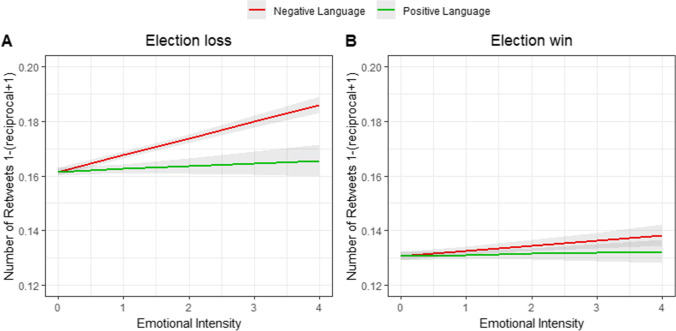
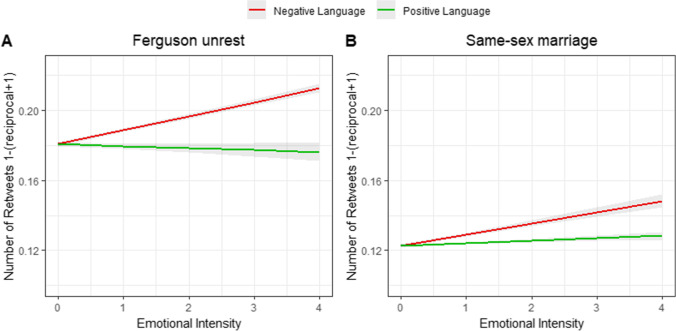
What type of emotional language spreads further in political discourses on social media? Previous research has focused on situations that primarily elicited negative emotions, showing that negative language tended to spread further. The current project extends existing knowledge by examining the spread of emotional language in response to both predominantly positive and negative political situations. In Study 1, we examined the spread of emotional language in tweets related to the winning and losing parties in the 2016 US elections, finding that increased negativity (but not positivity) predicted content sharing in both situations. In Study 2, we compared the spread of emotional language in two separate situations: the celebration of the US Supreme Court approval of same-sex marriage (positive) and the Ferguson unrest (negative), finding again that negativity spread further. These results shed light on the nature of political discourse and engagement.
The online version contains supplementary material available at 10.1007/s42761-021-00057-7.
哪种情感语言在社交媒体上的政治话语中传播得更远?先前的研究主要集中在主要引发负面情绪的情况上,表明负面语言往往传播得更远。当前项目通过研究情感语言在主要为积极和消极政治情境中的传播来扩展现有知识。在研究1中,我们研究了与2016年美国大选输赢政党相关的推文里情感语言的传播情况,发现消极情绪增加(而非积极情绪)在两种情况下都能预测内容分享。在研究2中,我们比较了情感语言在两种不同情境下的传播:美国最高法院批准同性婚姻的庆祝活动(积极)和弗格森骚乱(消极),再次发现消极情绪传播得更远。这些结果揭示了政治话语和参与的本质。
在线版本包含可在10.1007/s42761-021-00057-7获取的补充材料。