Poultry Department, Faculty of Agriculture, Zagazig University, Zagazig, 44511, Egypt.
Department of Agricultural Microbiology, Faculty of Agriculture, Zagazig University, Zagazig, 44511, Egypt.
Int J Biometeorol. 2022 Nov;66(11):2183-2194. doi: 10.1007/s00484-022-02347-6. Epub 2022 Aug 31.
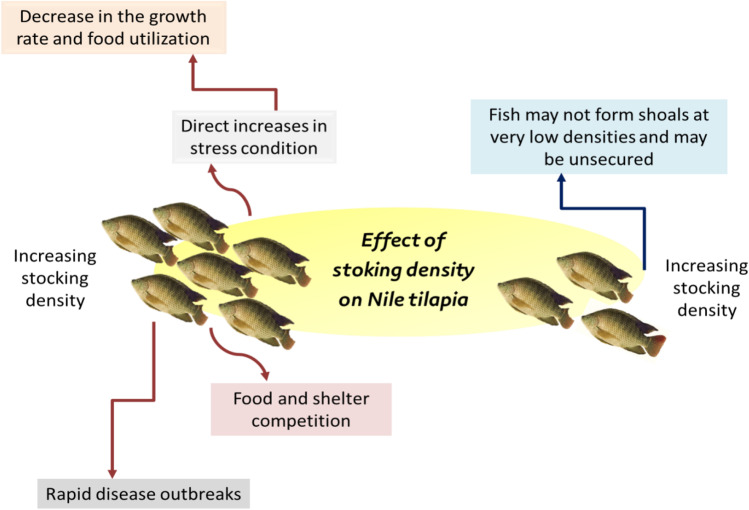
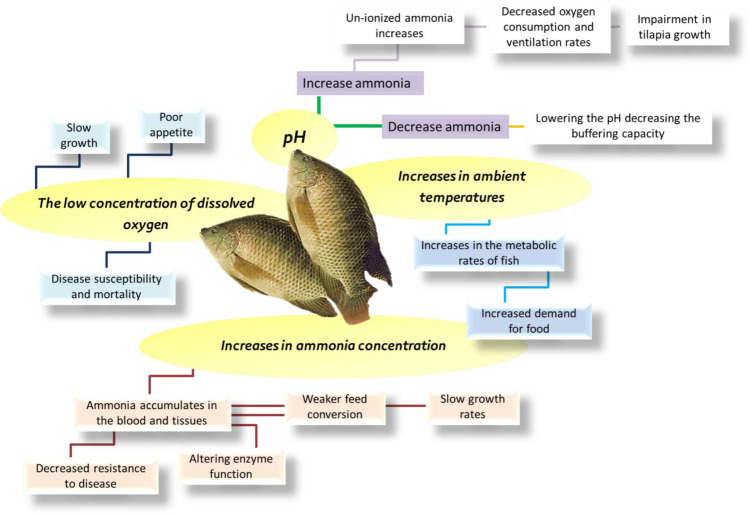
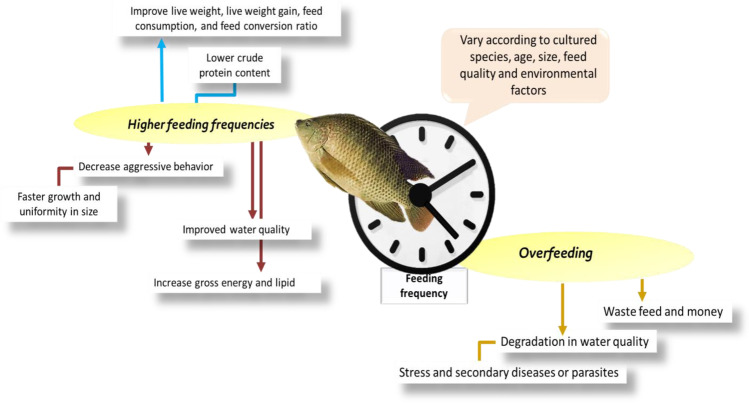
Aquaculture is the practice of developing aquatic animals and plants under artificial environmental conditions, either in a controlled or semi-controlled environment. Due to high animal protein demand, it is one of the world's growing food production industries. It plays a vital role in contributing to food security and lowering the unemployment rate of the world's growing population. This review article aims to scope sight on the environmental factors that affect the growth and economic production process of Nile tilapia. Many of these factors are listed and analyzed in this review, such as stocking densities; various feed frequencies and feeding rates; water quality; water temperature; dissolved oxygen concentration; water pH degree; ammonia (NH), nitrite (NO), and nitrate (NO) concentration; feeding regimes; feed cost; and tank culturing system of Nile tilapia. These factors can significantly alter body weight, composition, survival, behavior, feed intake, feed conversion ratio, feeding efficiency, and the health and reproduction of Oreochromis niloticus. Furthermore, feeding, growth, disease risks, and survival rates are all affected by water quality parameters. In general, higher growth performance of O. niloticus in aquaculture can be obtained by keeping the optimum quantity of feed with proper feeding rate and frequency, maintaining a good proportion of stocking density, and regularly evaluating water quality. This review article highlights-in details-the impact of various environmental factors on growth performance criteria of Nile tilapia (Oreochromis niloticus).
水产养殖是在人工环境条件下开发水生动物和植物的实践,无论是在受控还是半受控的环境中。由于对动物蛋白的高需求,它是世界上增长最快的食品生产行业之一。它在为食品安全做出贡献和降低世界不断增长的人口的失业率方面发挥着至关重要的作用。本文旨在探讨影响尼罗罗非鱼生长和经济生产过程的环境因素。本文列出并分析了许多这样的因素,例如放养密度;各种饲料频率和喂养率;水质;水温和溶解氧浓度;水的 pH 值;氨(NH)、亚硝酸盐(NO)和硝酸盐(NO)浓度;喂养制度;饲料成本;以及尼罗罗非鱼的水箱养殖系统。这些因素会显著改变尼罗罗非鱼的体重、组成、存活率、行为、摄食量、饲料转化率、喂养效率以及健康和繁殖能力。此外,水质参数还会影响到喂养、生长、疾病风险和存活率。总的来说,通过保持适量的饲料、适当的喂养率和频率、保持良好的放养密度比例以及定期评估水质,可以获得尼罗罗非鱼在水产养殖中的最佳生长性能。本文详细介绍了各种环境因素对尼罗罗非鱼(Oreochromis niloticus)生长性能标准的影响。