Padilla Sergio, Andreo María, Marco Pascual, Marco-Rico Ana, Ledesma Christian, Fernández-González Marta, García-Abellán Javier, Mascarell Paula, Botella Ángela, Gutiérrez Félix, Masiá Mar
Infectious Diseases Unit and Department of Clinical Medicine, Hospital General Universitario and Universidad Miguel Hernández de Elche, Alicante, Spain.
CIBER de Enfermedades Infecciosas (CIBERINFEC; Biomedical Research Networking Center for Infectious Diseases), Instituto de Salud Carlos III, Madrid, Spain.
PLoS One. 2025 Mar 19;20(3):e0319666. doi: 10.1371/journal.pone.0319666. eCollection 2025.
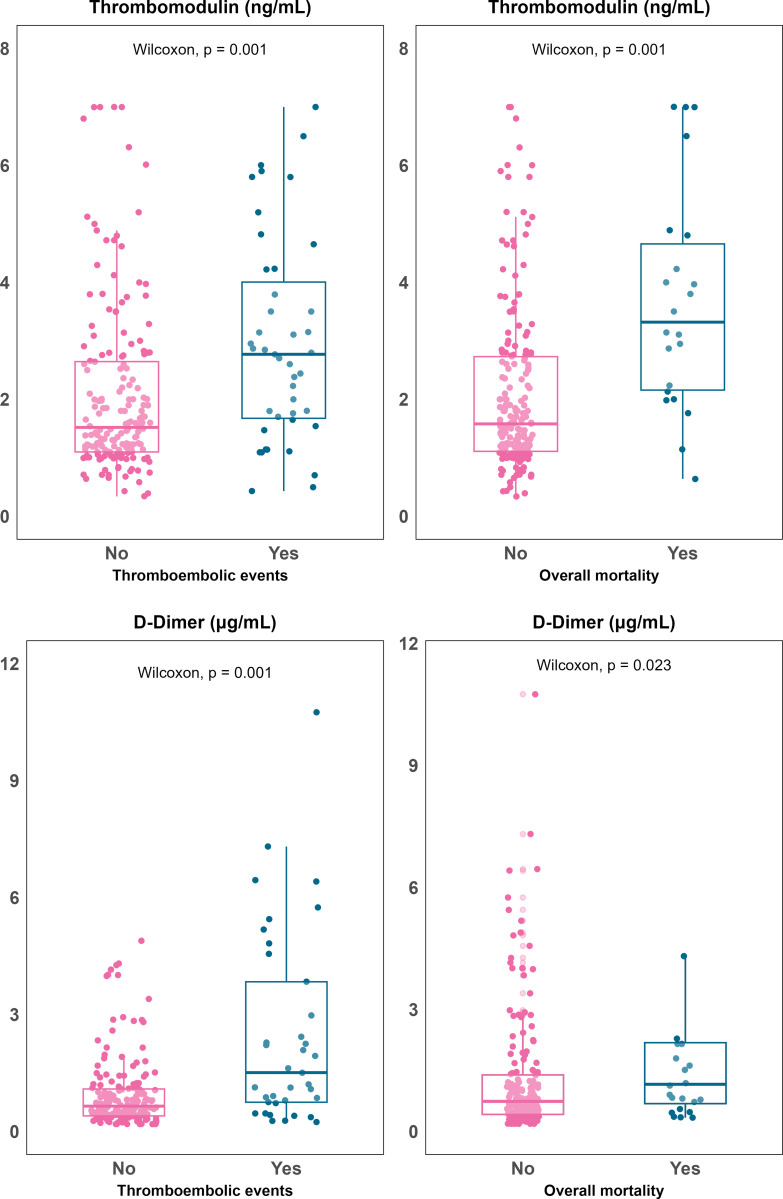
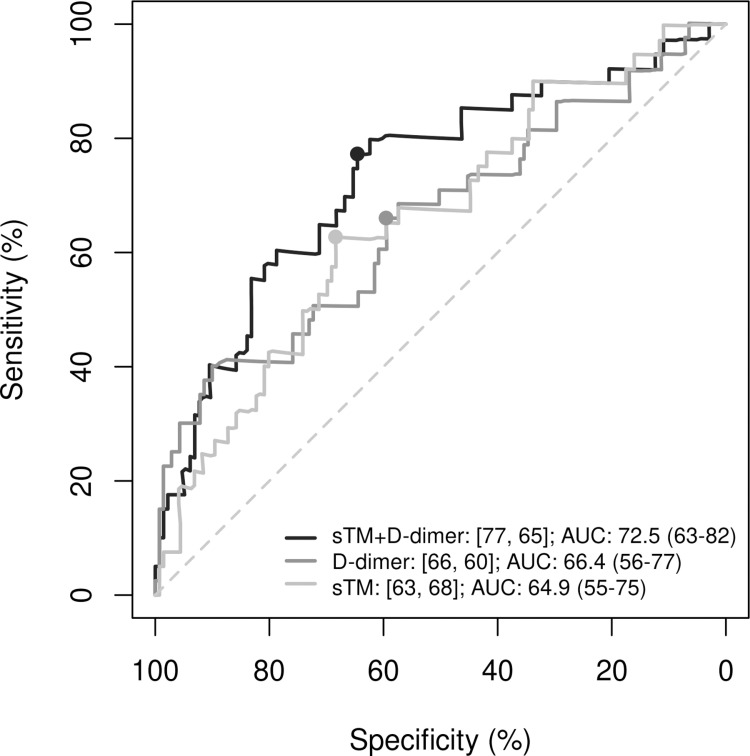
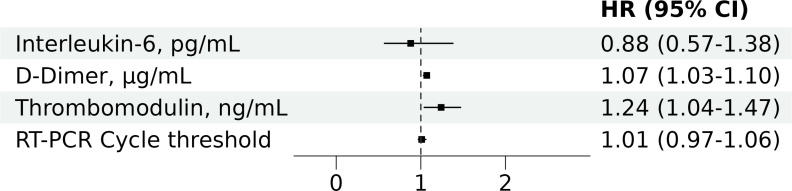
We aimed to determine the predictive accuracy of elevated soluble thrombomodulin (sTM) and angiopoietin-2 (Ang2) for thrombotic events (TE) in hospitalized COVID-19 patients. We conducted a nested case-control study within a cohort of people admitted to hospital with COVID-19 from March 2020 to August 2022. The cases (people with TE within 28 days after hospital admission) were matched by propensity score to comparable patients without TE. We determined plasma levels of sTM and Ang2 in all available frozen samples, prioritizing the earliest post-admission samples, using an automated immunoassay technique. Among 2,524 hospitalized COVID-19 patients (43% females; median age 67 years), 73 had TE (incidence 1.15 events per 1000 patient-days of follow-up). Frozen plasma samples were available for 43 cases and 176 controls. Elevated plasma concentration of sTM was significantly associated with TE (2.8 [1.8, 4] vs. 1.52 [1.1, 2.65] ng/mL; p = 0.001) and mortality (median [Q1, Q3], 3.32 [2.16, 4.65] vs. 1.58 [1.11, 2.73] ng/mL; p = 0.001), while D-dimer showed a specific association with TE (2.3 [0.8, 7.4] vs. 0.75 [0.4, 1.6] mcg/mL; p = 0.001). In contrast, Ang2 was not associated with any of these events. The association with thrombotic events remained in adjusted models (HR [95%CI] per unit increase, 1.24 [1.04-1.47] for sTM; 1.07 [1.03-1.10] for D-dimer). The adjusted regression model that included both biomarkers, sTM and D-dimer, improved (AUC 73%, sensitivity 77% and specificity 65% for TE diagnosis; p = 0.007) the predictive capacity of the same model without sTM. In conclusion, determination of soluble thrombomodulin along with D-dimer enhances thrombotic risk assessment in hospitalized COVID-19 patients.
我们旨在确定可溶性血栓调节蛋白(sTM)和血管生成素-2(Ang2)升高对住院COVID-19患者血栓形成事件(TE)的预测准确性。我们在2020年3月至2022年8月因COVID-19入院的人群队列中进行了一项巢式病例对照研究。病例(入院后28天内发生TE的患者)通过倾向评分与无TE的可比患者进行匹配。我们使用自动免疫测定技术,在所有可用的冷冻样本中测定sTM和Ang2的血浆水平,优先选取入院后最早的样本。在2524例住院的COVID-19患者中(43%为女性;中位年龄67岁),73例发生了TE(发病率为每1000患者随访日1.15次事件)。有43例病例和176例对照的冷冻血浆样本可供检测。sTM血浆浓度升高与TE显著相关(2.8 [1.8, 4] 对1.52 [1.1, 2.65] ng/mL;p = 0.001)和死亡率相关(中位数 [Q1, Q3],3.32 [2.16, 4.65] 对1.58 [1.11, 2.73] ng/mL;p = 0.001),而D-二聚体与TE有特异性关联(2.3 [0.8, 7.4] 对0.75 [0.4, 1.6] mcg/mL;p = 0.001)。相比之下,Ang2与这些事件均无关联。在调整模型中,与血栓形成事件的关联依然存在(每单位增加的HR [95%CI],sTM为1.24 [1.04 - 1.47];D-二聚体为1.07 [1.03 - 1.10])。包含sTM和D-二聚体这两种生物标志物的调整回归模型改善了(TE诊断的AUC为73%,敏感性为77%,特异性为65%;p = 0.007)不含sTM的同一模型的预测能力。总之,测定可溶性血栓调节蛋白和D-二聚体可增强住院COVID-19患者的血栓形成风险评估。