Diamant Nathaniel, Di Achille Paolo, Weng Lu-Chen, Lau Emily S, Khurshid Shaan, Friedman Samuel, Reeder Christopher, Singh Pulkit, Wang Xin, Sarma Gopal, Ghadessi Mercedeh, Mielke Johanna, Elci Eren, Kryukov Ivan, Eilken Hanna M, Derix Andrea, Ellinor Patrick T, Anderson Christopher D, Philippakis Anthony A, Batra Puneet, Lubitz Steven A, Ho Jennifer E
Data Sciences Platform, Broad Institute of Harvard and the Massachusetts Institute of Technology, Cambridge, Massachusetts.
Cardiovascular Research Center, Massachusetts General Hospital, Boston, Massachusetts.
Cardiovasc Digit Health J. 2022 Jun 24;3(4):161-170. doi: 10.1016/j.cvdhj.2022.06.001. eCollection 2022 Aug.
Postexercise heart rate recovery (HRR) is an important indicator of cardiac autonomic function and abnormal HRR is associated with adverse outcomes. We hypothesized that deep learning on resting electrocardiogram (ECG) tracings may identify individuals with impaired HRR.
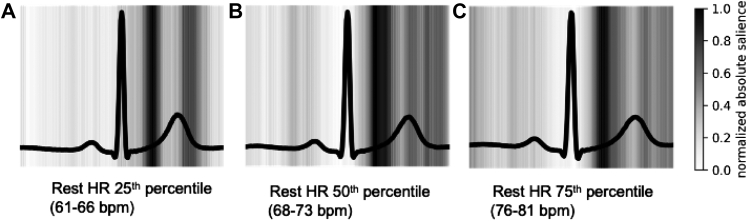
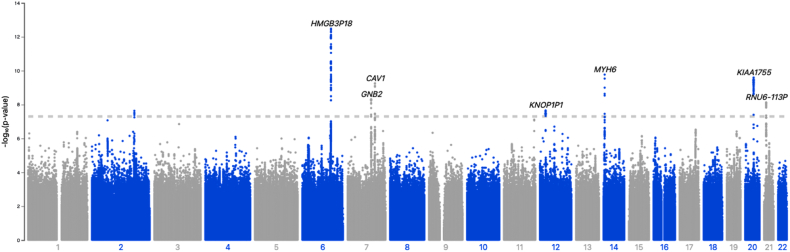
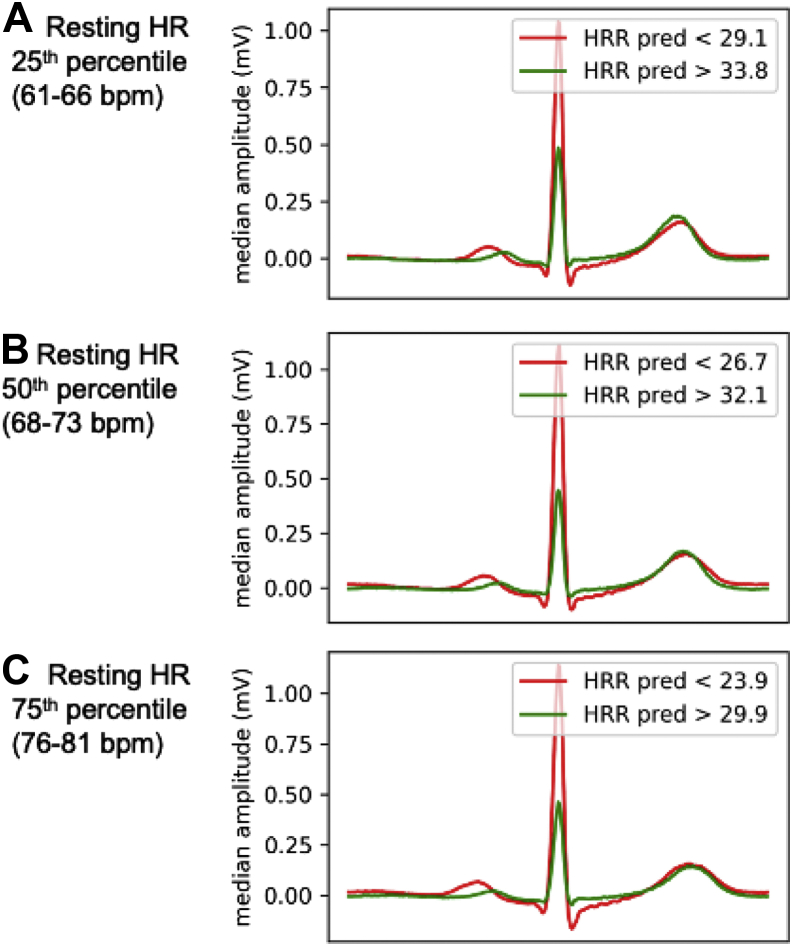
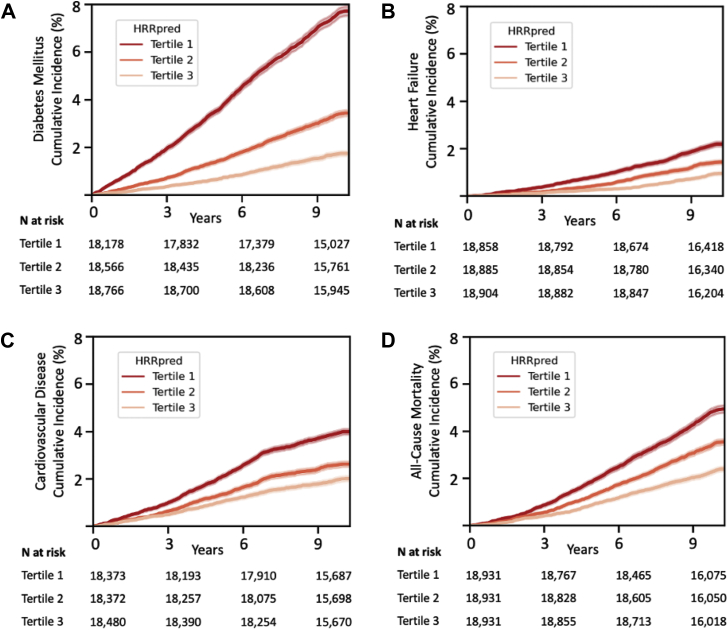
We trained a deep learning model (convolutional neural network) to infer HRR based on resting ECG waveforms (HRR) among UK Biobank participants who had undergone exercise testing. We examined the association of HRR with incident cardiovascular disease using Cox models, and investigated the genetic architecture of HRR in genome-wide association analysis.
Among 56,793 individuals (mean age 57 years, 51% women), the HRR model was moderately correlated with actual HRR (r = 0.48, 95% confidence interval [CI] 0.47-0.48). Over a median follow-up of 10 years, we observed 2060 incident diabetes mellitus (DM) events, 862 heart failure events, and 2065 deaths. Higher HRR was associated with lower risk of DM (hazard ratio [HR] 0.79 per 1 standard deviation change, 95% CI 0.76-0.83), heart failure (HR 0.89, 95% CI 0.83-0.95), and death (HR 0.83, 95% CI 0.79-0.86). After accounting for resting heart rate, the association of HRR with incident DM and all-cause mortality were similar. Genetic determinants of HRR included known heart rate, cardiac conduction system, cardiomyopathy, and metabolic trait loci.
Deep learning-derived estimates of HRR using resting ECG independently associated with future clinical outcomes, including new-onset DM and all-cause mortality. Inferring postexercise heart rate response from a resting ECG may have potential clinical implications and impact on preventive strategies warrants future study.
运动后心率恢复(HRR)是心脏自主神经功能的重要指标,HRR异常与不良预后相关。我们假设基于静息心电图(ECG)描记进行深度学习可以识别HRR受损的个体。
我们训练了一个深度学习模型(卷积神经网络),以根据英国生物银行中接受过运动测试的参与者的静息ECG波形推断HRR。我们使用Cox模型研究了HRR与心血管疾病发病的关联,并在全基因组关联分析中研究了HRR的遗传结构。
在56793名个体(平均年龄57岁,51%为女性)中,HRR模型与实际HRR呈中度相关(r = 0.48,95%置信区间[CI] 0.47 - 0.48)。在中位随访10年期间,我们观察到2060例新发糖尿病(DM)事件、862例心力衰竭事件和2065例死亡。较高的HRR与较低的DM风险(每1个标准差变化的风险比[HR] 0.79,95% CI 0.76 - 0.83)、心力衰竭(HR 0.89,95% CI 0.83 - 0.95)和死亡(HR 0.83,95% CI 0.79 - 0.86)相关。在考虑静息心率后,HRR与新发DM和全因死亡率的关联相似。HRR的遗传决定因素包括已知的心率、心脏传导系统、心肌病和代谢性状位点。
使用静息ECG通过深度学习得出的HRR估计值与未来临床结局独立相关,包括新发DM和全因死亡率。从静息ECG推断运动后心率反应可能具有潜在的临床意义,其对预防策略的影响值得未来研究。