Department of Urology, Xiangya Hospital, Central South University, Changsha, China.
National Clinical Research Center for Geriatric Disorders, Xiangya Hospital, Central South University, Changsha, China.
Front Endocrinol (Lausanne). 2022 Aug 16;13:974773. doi: 10.3389/fendo.2022.974773. eCollection 2022.
This study aimed to explore the relationship between serum testosterone levels and systemic immune-inflammation index (SII).
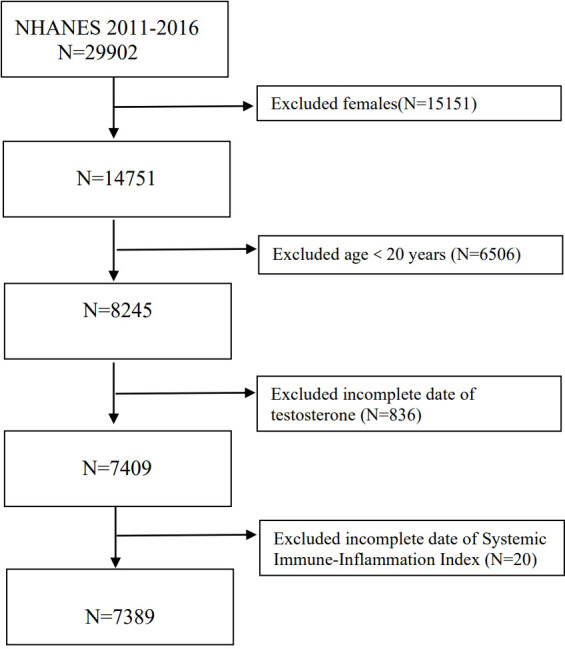
Complete SII and serum testosterone data of men over 20 years of age were retrieved from the 2011-2016 National Health and Nutrition Examination Survey to conduct a prevalence survey. To calculate SII, the platelet count was multiplied by the neutrophil-to-lymphocyte count ratio. Isotope dilution liquid chromatography and tandem mass spectrometry were employed to measure serum testosterone concentration. Testosterone deficiency (TD) was defined as a serum testosterone level ≤ 300ng/dl. Weighted proportions and multivariable regression analyses were used to analyze the association between SII and TD.
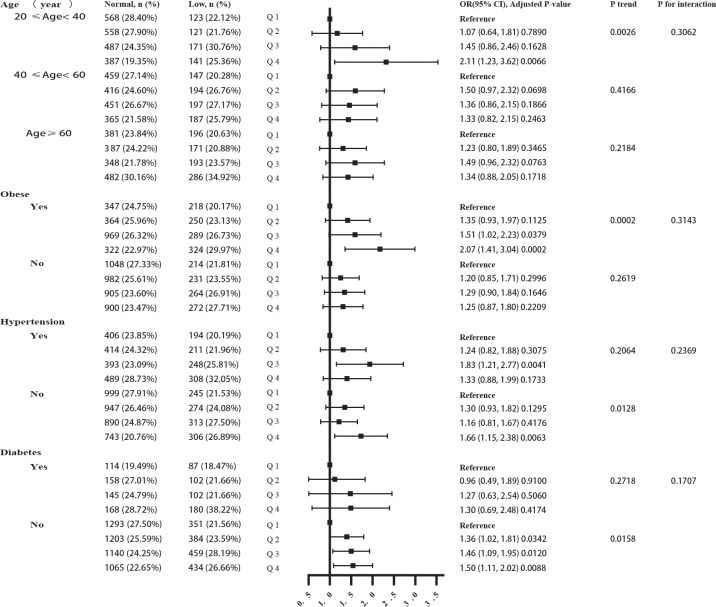
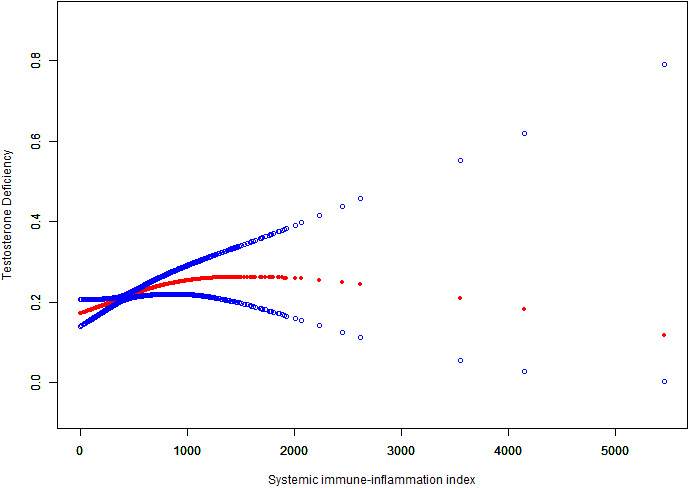
Overall, the data of 7389 participants were analyzed, The SII ranged from 1.53 - 6297.60. Of the participants, 28.42% had a low serum testosterone level (≤ 300 ng/dl). In the fully adjusted multivariable logistic model, the second quartile (OR: 1.27, p = 0.0737), the third quartile (OR: 1.43, p = 0.0090), and the fourth quartile (OR:1.48, p = 0.0042) of SII significantly increased the TD incidence rate, with the lowest quartile of the SII as a reference. For subgroup analysis, statistically significant associations were observed in participants aged 20-40, obese, non-hypertensive, and non-diabetic. The interaction test revealed no significant effect on this connection.
There was a positive relationship between a high SII and an increased prevalence of TD in a nationwide sample of adult men in the United States. Further prospective studies on a larger scale are warranted to confirm the causality between SII and TD.
本研究旨在探讨血清睾酮水平与全身免疫炎症指数(SII)之间的关系。
从 2011 年至 2016 年全国健康与营养调查中检索了 20 岁以上男性的完整 SII 和血清睾酮数据,进行患病率调查。通过将血小板计数乘以中性粒细胞与淋巴细胞比值来计算 SII。采用同位素稀释液相色谱串联质谱法测量血清睾酮浓度。将血清睾酮水平≤300ng/dl 定义为睾酮缺乏症(TD)。采用加权比例和多变量回归分析来分析 SII 与 TD 之间的关系。
共分析了 7389 名参与者的数据,SII 范围为 1.53-6297.60。参与者中,28.42%的人血清睾酮水平较低(≤300ng/dl)。在完全调整的多变量逻辑模型中,SII 的第二四分位数(OR:1.27,p=0.0737)、第三四分位数(OR:1.43,p=0.0090)和第四四分位数(OR:1.48,p=0.0042)显著增加了 TD 的发生率,以 SII 的最低四分位数为参考。亚组分析显示,在年龄为 20-40 岁、肥胖、非高血压和非糖尿病的参与者中,这种关联具有统计学意义。交互检验显示这种关联没有显著影响。
在美国成年男性的全国性样本中,高 SII 与 TD 患病率升高呈正相关。需要进一步开展大规模的前瞻性研究来证实 SII 和 TD 之间的因果关系。