Qi Xiangjun, Li Yanlong, Fang Caishan, Jia Yingying, Chen Meicong, Chen Xueqing, Jia Jie
The First Clinical School of Guangzhou University of Chinese Medicine, Guangzhou, China.
Hospital of Chengdu University of Traditional Chinese Medicine, Chengdu University of Traditional Chinese Medicine, Chengdu, China.
Front Nutr. 2023 Aug 31;10:1216445. doi: 10.3389/fnut.2023.1242115. eCollection 2023.
In recent years, there has been considerable growth in abnormal inflammatory reactions and immune system dysfunction, which are implicated in chronic inflammatory illnesses and a variety of other conditions. Dietary fibers have emerged as potential regulators of the human immune and inflammatory response. Therefore, this study aims to investigate the associations between dietary fibers intake and systemic immune and inflammatory biomarkers.
This cross-sectional study used data from the National Health and Nutrition Examination Survey (2015-2020). Dietary fibers intake was defined as the mean of two 24-h dietary recall interviews. The systemic immune-inflammation index (SII), systemic inflammation response index (SIRI), neutrophil-to-lymphocyte ratio (NLR), platelet-lymphocyte ratio (PLR), red blood cell distribution width-to-albumin ratio (RA), ferritin, high-sensitivity C-reactive protein (hs-CRP), and white blood cell (WBC) count were measured to evaluate systemic immune and inflammatory states of the body. The statistical software packages R and EmpowerStats were used to examine the associations between dietary fibers intake and systemic immune and inflammatory biomarkers.
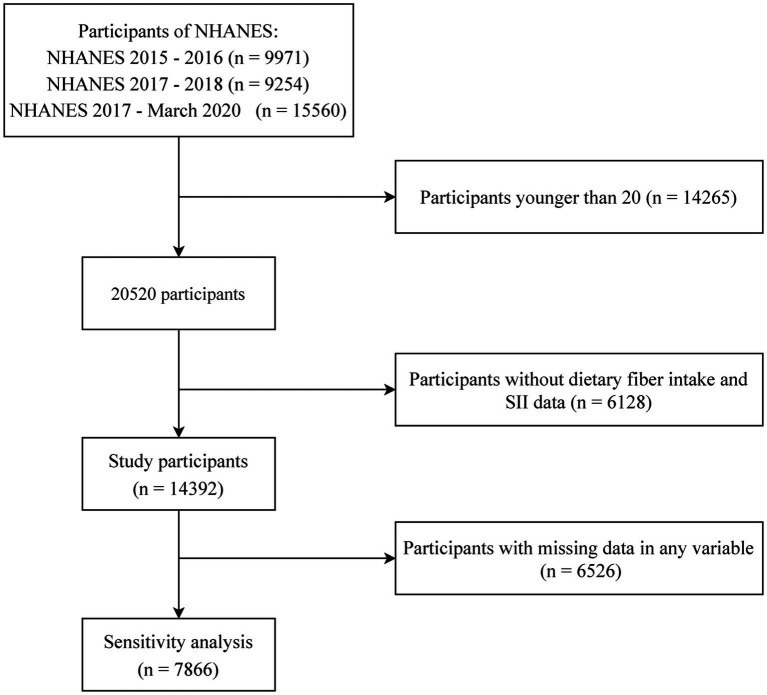
Overall, 14,392 participants were included in this study. After adjusting for age, gender, race, family monthly poverty level index, alcohol consumption, smoking status, vigorous recreational activity, body mass index, hyperlipidemia, hypertension, diabetes, and dietary inflammatory index, dietary fibers intake was inversely associated with SII (β = -2.19885, 95% CI: -3.21476 to -1.18294, = 0.000248), SIRI (β = -0.00642, 95% CI: -0.01021 to -0.00263, = 0.001738), NLR (β = -0.00803, 95% CI: -0.01179 to -0.00427, = 0.000284), RA (β = -0.00266, 95% CI: -0.00401 to -0.00131, = 0.000644), ferritin (β = -0.73086, 95% CI: -1.31385 to -0.14787, = 0.020716), hs-CRP (β = -0.04629, 95% CI: -0.0743 to -0.01829, = 0.002119), WBC (β = -0.01624, 95% CI: -0.02685 to -0.00563, = 0.004066), neutrophils (β = -0.01346, 95% CI: -0.01929 to -0.00764, = 0.000064). An inverse association between dietary fibers and PLR was observed in the middle (β = -3.11979, 95% CI: -5.74119 to -0.4984, = 0.028014) and the highest tertile (β = -4.48801, 95% CI: -7.92369 to -1.05234, = 0.016881) and the trend test (β = -2.2626, 95% CI: -3.9648 to -0.5604, = 0.0150). The observed associations between dietary fibers intake and SII, SIRI, NLR, RA, ferritin, hs-CRP, WBC, and neutrophils remained robust and consistent in the sensitivity analysis. No significant interaction by race was found.
Dietary fibers intake is associated with the improvement of the parameters of the immune response and inflammatory biomarkers, supporting recommendations to increase dietary fibers intake for enhanced immune health.
近年来,异常炎症反应和免疫系统功能障碍显著增加,这与慢性炎症性疾病及多种其他病症有关。膳食纤维已成为人类免疫和炎症反应的潜在调节因子。因此,本研究旨在探讨膳食纤维摄入量与全身免疫及炎症生物标志物之间的关联。
这项横断面研究使用了美国国家健康与营养检查调查(2015 - 2020年)的数据。膳食纤维摄入量定义为两次24小时饮食回顾访谈的平均值。测量全身免疫炎症指数(SII)、全身炎症反应指数(SIRI)、中性粒细胞与淋巴细胞比值(NLR)、血小板与淋巴细胞比值(PLR)、红细胞分布宽度与白蛋白比值(RA)、铁蛋白、高敏C反应蛋白(hs-CRP)和白细胞(WBC)计数,以评估身体的全身免疫和炎症状态。使用统计软件包R和EmpowerStats来检验膳食纤维摄入量与全身免疫和炎症生物标志物之间的关联。
本研究共纳入14392名参与者。在调整年龄、性别、种族、家庭月贫困水平指数、饮酒、吸烟状况、剧烈休闲活动、体重指数、高脂血症、高血压、糖尿病和饮食炎症指数后,膳食纤维摄入量与SII(β = -2.19885,95%可信区间:-3.21476至-1.18294,P = 0.000248)、SIRI(β = -0.00642,95%可信区间:-0.01021至-0.00263,P = 0.001738)、NLR(β = -0.00803,95%可信区间:-0.01179至-0.00427,P = 0.000284)、RA(β = -0.00266,95%可信区间:-0.00401至-0.00131,P = 0.000644)、铁蛋白(β = -0.73086,95%可信区间:-1.31385至-0.14787,P = 0.020716)、hs-CRP(β = -0.04629,95%可信区间:-0.0743至-0.01829,P = 0.002119)、WBC(β = -0.01624,95%可信区间:-0.02685至-0.00563,P = 0.
