Moussa George, Tadros Maria, Ch'ng Soon Wai, Sharma Ash, Lett Kim Son, Mitra Arijit, Tyagi Ajai K, Andreatta Walter
Birmingham and Midland Eye Centre and Academic Unit of Ophthalmology, University of Birmingham, Birmingham, UK.
Birmingham and Midland Eye Centre, Sandwell and West, Birmingham Hospitals NHS Trust, Dudley Road, Birmingham, B18 7QH, UK.
Int J Retina Vitreous. 2022 Sep 3;8(1):61. doi: 10.1186/s40942-022-00413-0.
To measure the visual outcomes, proliferative vitreoretinopathy (PVR) and retinectomy rates following primary rhegmatogenous retinal detachment (RRD) repair, comparing silicone oil (SO) and heavy SO (Densiron).
Retrospective, continuous comparative study from January 2017 to May 2021 of all primary RRD. Multivariable linear (logMAR gain) and binary-logistic (PVR-C and retinectomy rate) regression models to compare tamponade were performed. Covariates included age, gender, ocular co-morbidities, high myopia, macula-status, giant-retinal-tear (GRT), pre-op vision, PVR-C, oil type, perfluorocarbon-use, combined scleral buckle/vitrectomy, combined phaco-vitrectomy, 360-degrees-endolaser and oil duration. Cases with trauma or less than six-month follow-up were excluded.
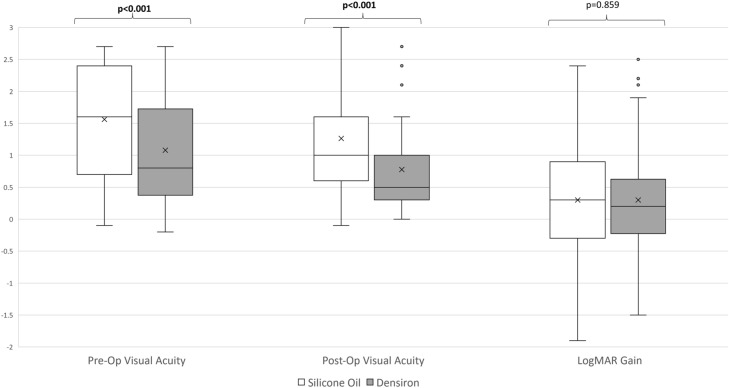
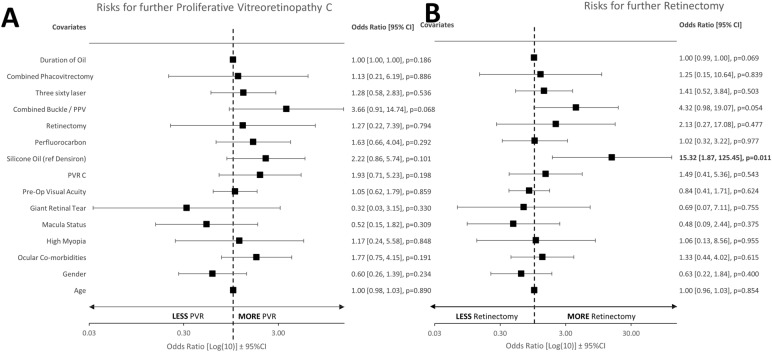
A total of 259 primary RD were analysed. There were 179 SO patients and 80 Densiron patients that had six-month primary re-detachment in 18 (10.1%) and 8 (10.0%) respectively (p = 1.000). No difference in logMAR gain was detected between tamponade choice on multivariable linear regression. Subsequent glaucoma surgery was 5 (2.8%) and 4 (5.0%) for SO and Densiron patients respectively (p = 0.464). On multivariate binary-logistic regression we found no difference in development of PVR-C between oil tamponades. However, SO had significantly higher subsequent retinectomy rate compared to Densiron (odds ratio 15.3, 95% CI 1.9-125.5, p = 0.011). Duration of oil tamponade was not linked to differences in logMAR gain, PVR-C formation or increased retinectomy rate.
We report no difference in primary anatomical success, number of further RRD surgeries, subsequent glaucoma surgery, visual outcomes, PVR-C between both tamponades on multivariable models. Densiron oil was found to be more retinectomy sparing relative to SO.
测量原发性孔源性视网膜脱离(RRD)修复术后的视力结果、增殖性玻璃体视网膜病变(PVR)和视网膜切除术发生率,比较硅油(SO)和重硅油(Densiron)。
对2017年1月至2021年5月期间所有原发性RRD进行回顾性、连续性比较研究。采用多变量线性(logMAR增益)和二元逻辑回归模型(PVR-C和视网膜切除术发生率)来比较填塞物。协变量包括年龄、性别、眼部合并症、高度近视、黄斑状态、巨大视网膜裂孔(GRT)、术前视力、PVR-C、油的类型、全氟碳化物的使用、巩膜扣带/玻璃体切除术联合、白内障超声乳化/玻璃体切除术联合、360度视网膜光凝和油的使用时间。排除有外伤或随访时间少于6个月的病例。
共分析了259例原发性视网膜脱离病例。其中179例使用SO的患者和80例使用Densiron的患者,6个月时原发性视网膜再脱离的发生率分别为18例(10.1%)和8例(10.0%)(p = 1.000)。多变量线性回归分析显示,填塞物选择对logMAR增益无差异。SO组和Densiron组患者随后进行青光眼手术的比例分别为5例(2.8%)和4例(5.0%)(p = 0.464)。多变量二元逻辑回归分析发现,两种油填塞物在PVR-C的发生方面无差异。然而,与Densiron相比,SO组随后的视网膜切除术发生率显著更高(优势比15.3,95%可信区间1.9 - 125.5,p = 0.011)。油填塞物的使用时间与logMAR增益、PVR-C形成或视网膜切除术发生率的增加无关。
我们报告在多变量模型中,两种填塞物在原发性解剖学成功率、进一步RRD手术次数、随后的青光眼手术、视力结果、PVR-C方面无差异。发现Densiron油相对于SO更能减少视网膜切除术的发生。