Institute of Pathology, Sheba Medical Center, Ramat Gan, Israel.
Imagene AI, Tel Aviv, Israel.
Mod Pathol. 2022 Dec;35(12):1882-1887. doi: 10.1038/s41379-022-01141-4. Epub 2022 Sep 3.
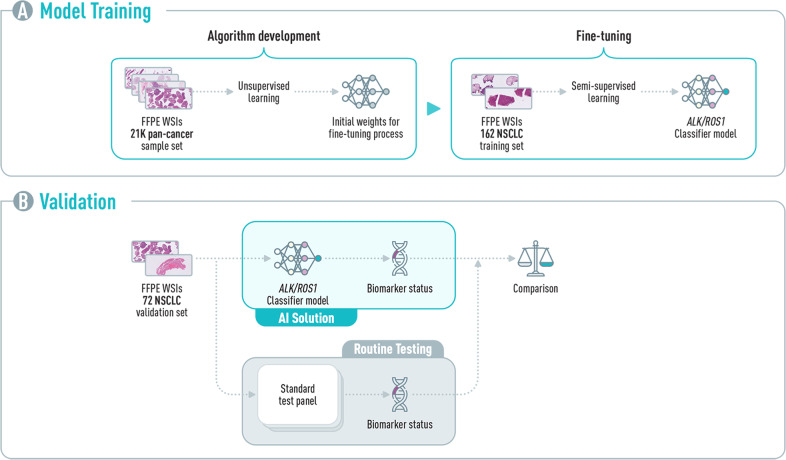
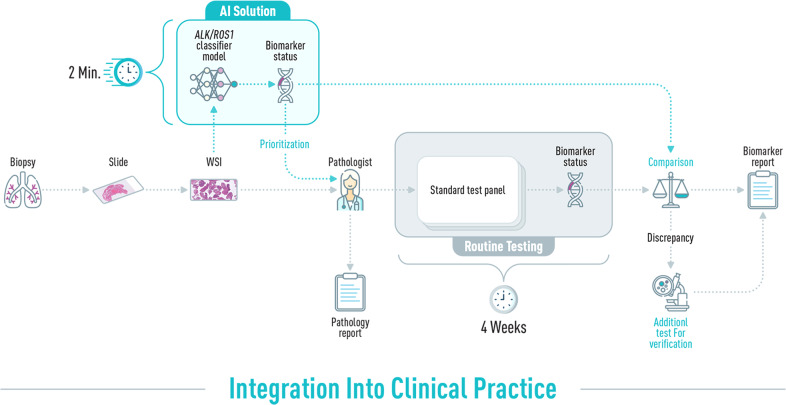
Anaplastic lymphoma kinase (ALK) and ROS oncogene 1 (ROS1) gene fusions are well-established key players in non-small cell lung cancer (NSCLC). Although their frequency is relatively low, their detection is important for patient care and guides therapeutic decisions. The accepted methods used for their detection are immunohistochemistry (IHC) and fluorescence in situ hybridization (FISH) assay, as well as DNA and RNA-based sequencing methodologies. These assays are expensive, time-consuming, and require technical expertise and specialized equipment as well as biological specimens that are not always available. Here we present an alternative detection method using a computer vision deep learning approach. An advanced convolutional neural network (CNN) was used to generate classifier models to detect ALK and ROS1-fusions directly from scanned hematoxylin and eosin (H&E) whole slide images prepared from NSCLC tumors of patients. A two-step training approach was applied, with an initial unsupervised training step performed on a pan-cancer sample cohort followed by a semi-supervised fine-tuning step, which supported the development of a classifier with performances equal to those accepted for diagnostic tests. Validation of the ALK/ROS1 classifier on a cohort of 72 lung cancer cases who underwent ALK and ROS1-fusion testing at the pathology department at Sheba Medical Center displayed sensitivities of 100% for both genes (six ALK-positive and two ROS1-positive cases) and specificities of 100% and 98.6% respectively for ALK and ROS1, with only one false-positive result for ROS1-alteration. These results demonstrate the potential advantages that machine learning solutions may have in the molecular pathology domain, by allowing fast, standardized, accurate, and robust biomarker detection overcoming many limitations encountered when using current techniques. The integration of such novel solutions into the routine pathology workflow can support and improve the current clinical pipeline.
间变性淋巴瘤激酶(ALK)和 ROS 原癌基因 1(ROS1)基因融合是明确的非小细胞肺癌(NSCLC)关键驱动因素。虽然它们的频率相对较低,但它们的检测对于患者的治疗非常重要,并指导治疗决策。目前公认的检测方法包括免疫组织化学(IHC)和荧光原位杂交(FISH)检测,以及基于 DNA 和 RNA 的测序方法。这些检测方法昂贵、耗时,需要技术专长和专门设备,并且还需要并非总是可用的生物样本。在这里,我们提出了一种使用计算机视觉深度学习方法的替代检测方法。先进的卷积神经网络(CNN)用于生成分类器模型,直接从患者 NSCLC 肿瘤的苏木精和伊红(H&E)全切片图像扫描中检测 ALK 和 ROS1 融合。应用了两步训练方法,首先在泛癌样本队列上进行无监督训练步骤,然后进行半监督微调步骤,这支持开发出与诊断测试相当的分类器。在 Sheba 医疗中心病理科进行 ALK 和 ROS1 融合检测的 72 例肺癌病例队列中对 ALK/ROS1 分类器进行验证,结果显示两种基因的灵敏度均为 100%(六例 ALK 阳性和两例 ROS1 阳性病例),ALK 和 ROS1 的特异性分别为 100%和 98.6%,仅一例 ROS1 改变为假阳性。这些结果表明,机器学习解决方案在分子病理学领域可能具有潜在优势,可以实现快速、标准化、准确和稳健的生物标志物检测,克服当前技术中遇到的许多限制。将此类新解决方案集成到常规病理工作流程中,可以支持和改善当前的临床流程。