Dept. of Electrical and Computer Engineering, University of Iceland, Reykjavik, Iceland.
Dept. of Medicine, University of Iceland, Reykjavik, Iceland.
PLoS One. 2022 Sep 6;17(9):e0274212. doi: 10.1371/journal.pone.0274212. eCollection 2022.
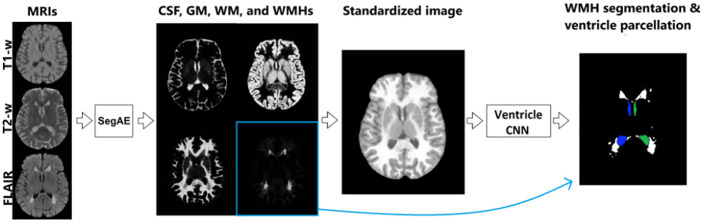
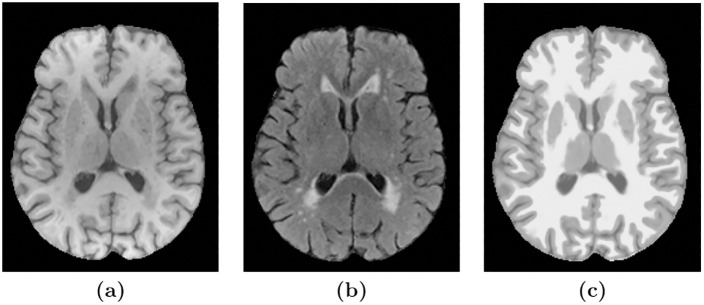
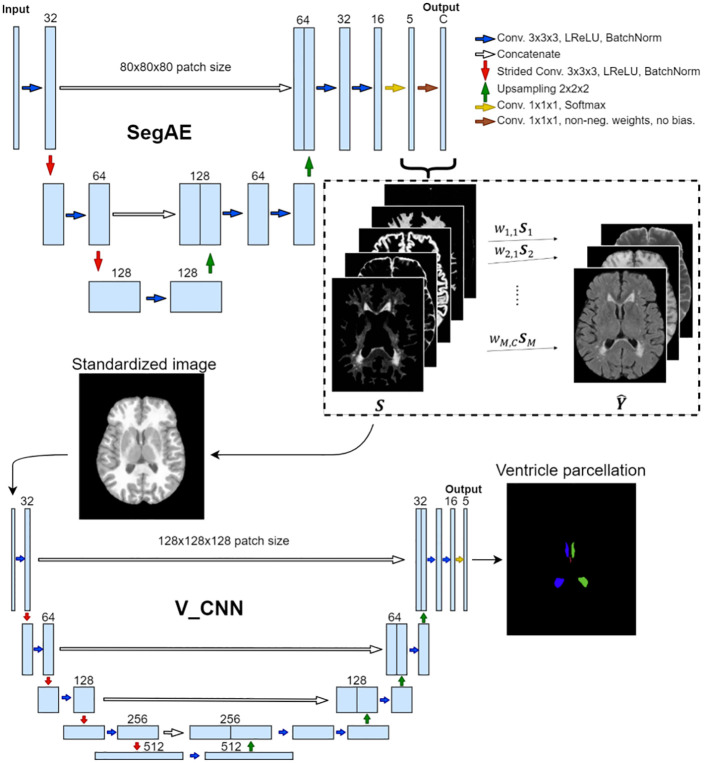
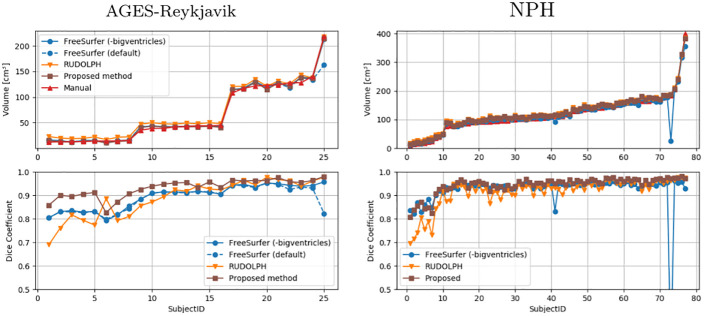
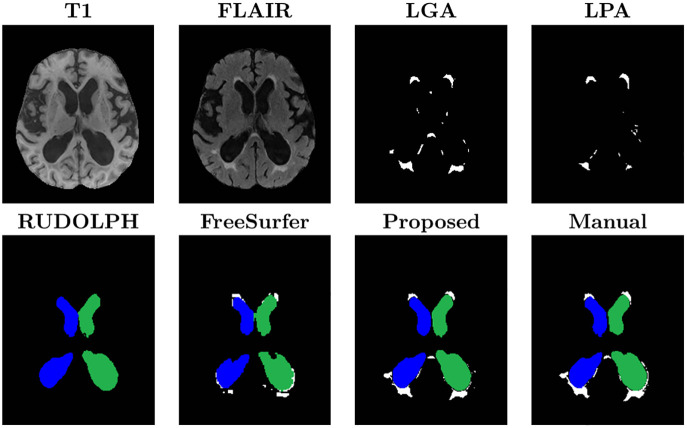
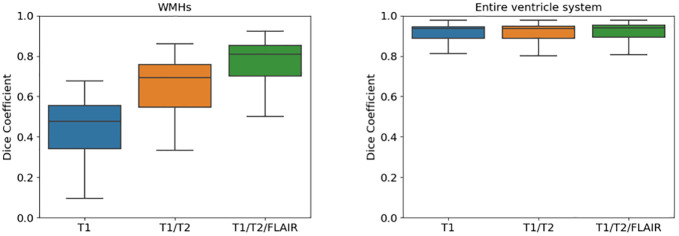
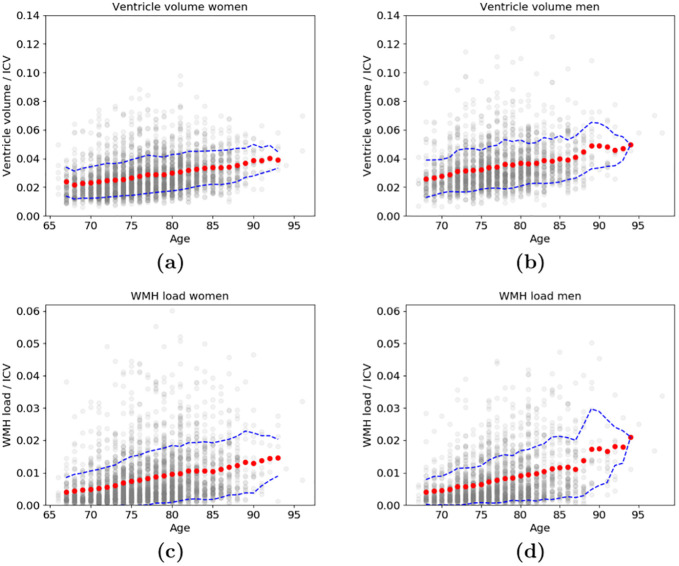
Age-related changes in brain structure include atrophy of the brain parenchyma and white matter changes of presumed vascular origin. Enlargement of the ventricles may occur due to atrophy or impaired cerebrospinal fluid (CSF) circulation. The co-occurrence of these changes in neurodegenerative diseases and in aging brains often requires investigators to take both into account when studying the brain, however, automated segmentation of enlarged ventricles and white matter hyperintensities (WMHs) can be a challenging task. Here, we present a hybrid multi-atlas segmentation and convolutional autoencoder approach for joint ventricle parcellation and WMH segmentation from magnetic resonance images (MRIs). Our fully automated approach uses a convolutional autoencoder to generate a standardized image of grey matter, white matter, CSF, and WMHs, which, in conjunction with labels generated by a multi-atlas segmentation approach, is then fed into a convolutional neural network to parcellate the ventricular system. Hence, our approach does not depend on manually delineated training data for new data sets. The segmentation pipeline was validated on both healthy elderly subjects and subjects with normal pressure hydrocephalus using ground truth manual labels and compared with state-of-the-art segmentation methods. We then applied the method to a cohort of 2401 elderly brains to investigate associations of ventricle volume and WMH load with various demographics and clinical biomarkers, using a multiple regression model. Our results indicate that the ventricle volume and WMH load are both highly variable in a cohort of elderly subjects and there is an independent association between the two, which highlights the importance of taking both the possibility of enlarged ventricles and WMHs into account when studying the aging brain.
脑结构的年龄相关性变化包括脑实质和可能由血管原因引起的白质变化的萎缩。由于萎缩或脑脊液 (CSF) 循环受损,脑室可能会扩大。在神经退行性疾病和衰老大脑中这些变化的共同发生通常要求研究人员在研究大脑时同时考虑到这两个方面,但是,自动分割扩大的脑室和白质高信号 (WMHs) 可能是一项具有挑战性的任务。在这里,我们提出了一种混合多图谱分割和卷积自动编码器方法,用于从磁共振图像 (MRI) 联合分割脑室和 WMH。我们的全自动方法使用卷积自动编码器生成灰质、白质、CSF 和 WMH 的标准化图像,然后与多图谱分割方法生成的标签结合,输入到卷积神经网络中分割脑室系统。因此,我们的方法不依赖于新数据集的手动描绘的训练数据。该分割管道使用地面真实手动标签在健康老年受试者和正常压力脑积水受试者上进行了验证,并与最先进的分割方法进行了比较。然后,我们使用多元回归模型将该方法应用于 2401 例老年脑队列,以研究脑室体积和 WMH 负荷与各种人口统计学和临床生物标志物之间的关联。我们的结果表明,在老年受试者队列中,脑室体积和 WMH 负荷都具有高度的可变性,并且两者之间存在独立的关联,这突出了在研究衰老大脑时考虑扩大的脑室和 WMH 的可能性的重要性。