Image Sciences Institute, University Medical Center Utrecht and Utrecht University, The Netherlands; Medical Image Analysis, Department of Biomedical Engineering, Eindhoven University of Technology, The Netherlands.
Department of Radiology, University Medical Center Utrecht, The Netherlands.
Neuroimage Clin. 2017 Oct 12;17:251-262. doi: 10.1016/j.nicl.2017.10.007. eCollection 2018.
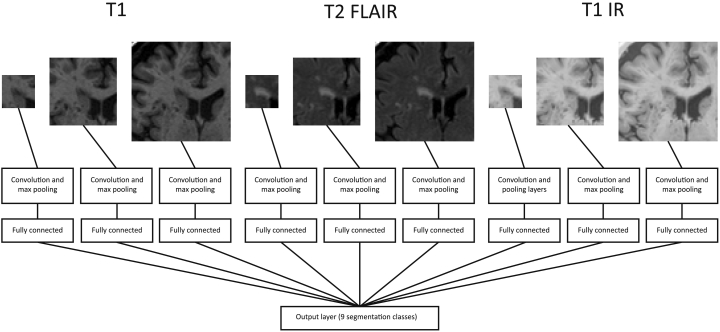
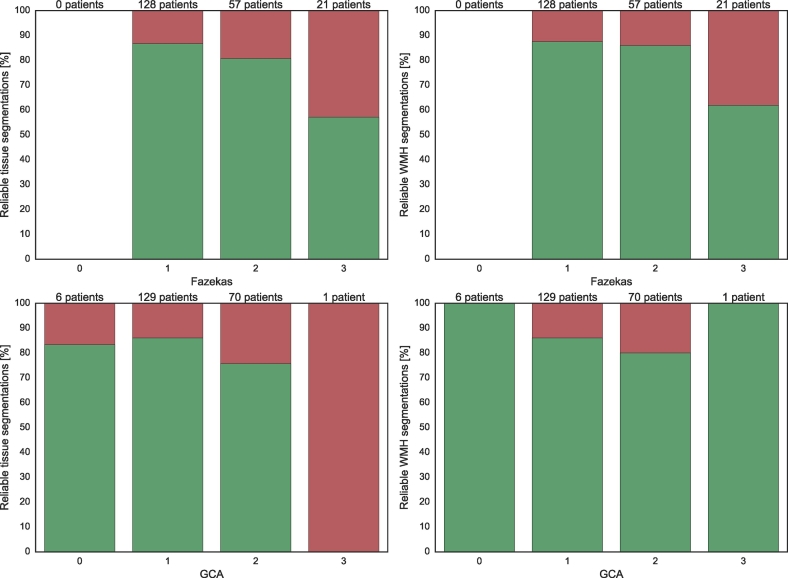
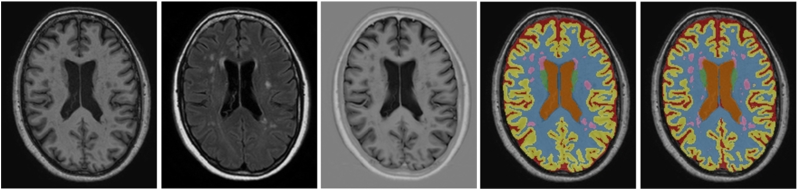
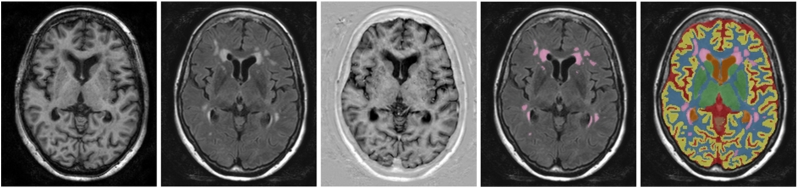
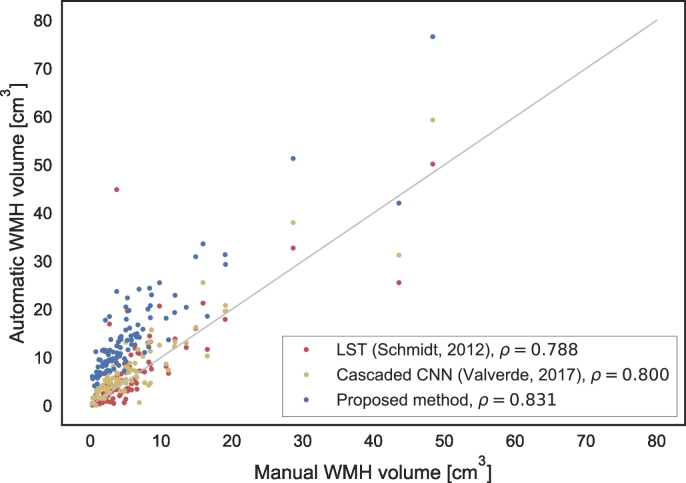
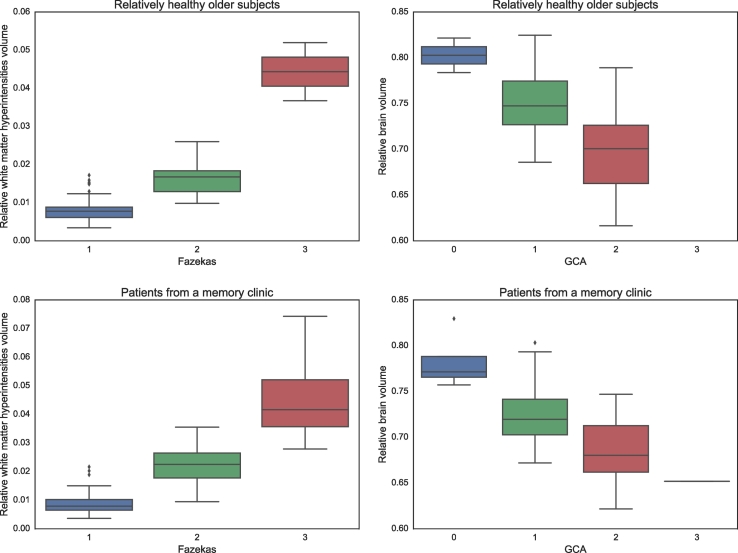
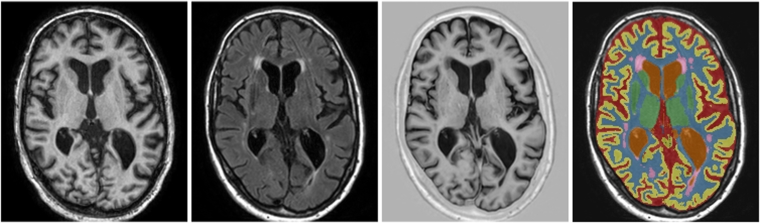
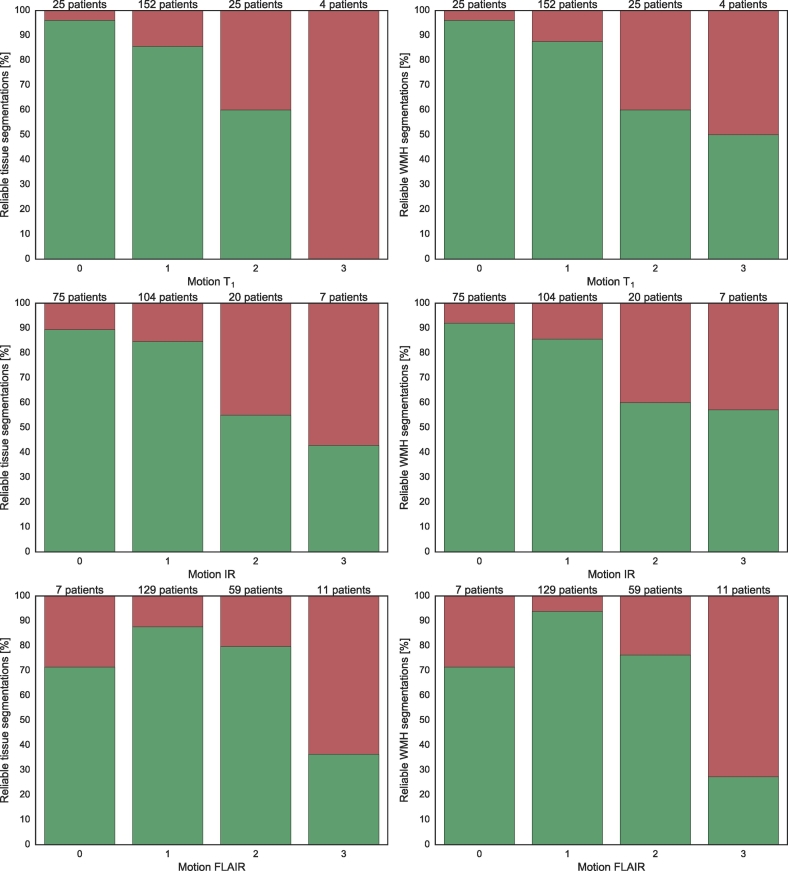
Automatic segmentation of brain tissues and white matter hyperintensities of presumed vascular origin (WMH) in MRI of older patients is widely described in the literature. Although brain abnormalities and motion artefacts are common in this age group, most segmentation methods are not evaluated in a setting that includes these items. In the present study, our tissue segmentation method for brain MRI was extended and evaluated for additional WMH segmentation. Furthermore, our method was evaluated in two large cohorts with a realistic variation in brain abnormalities and motion artefacts. The method uses a multi-scale convolutional neural network with a T-weighted image, a T-weighted fluid attenuated inversion recovery (FLAIR) image and a T-weighted inversion recovery (IR) image as input. The method automatically segments white matter (WM), cortical grey matter (cGM), basal ganglia and thalami (BGT), cerebellum (CB), brain stem (BS), lateral ventricular cerebrospinal fluid (lvCSF), peripheral cerebrospinal fluid (pCSF), and WMH. Our method was evaluated quantitatively with images publicly available from the MRBrainS13 challenge ( = 20), quantitatively and qualitatively in relatively healthy older subjects ( = 96), and qualitatively in patients from a memory clinic ( = 110). The method can accurately segment WMH (Overall Dice coefficient in the MRBrainS13 data of 0.67) without compromising performance for tissue segmentations (Overall Dice coefficients in the MRBrainS13 data of 0.87 for WM, 0.85 for cGM, 0.82 for BGT, 0.93 for CB, 0.92 for BS, 0.93 for lvCSF, 0.76 for pCSF). Furthermore, the automatic WMH volumes showed a high correlation with manual WMH volumes (Spearman's = 0.83 for relatively healthy older subjects). In both cohorts, our method produced reliable segmentations (as determined by a human observer) in most images (relatively healthy/memory clinic: tissues 88%/77% reliable, WMH 85%/84% reliable) despite various degrees of brain abnormalities and motion artefacts. In conclusion, this study shows that a convolutional neural network-based segmentation method can accurately segment brain tissues and WMH in MR images of older patients with varying degrees of brain abnormalities and motion artefacts.
在老年患者的 MRI 中,自动分割脑组织结构和由假定血管来源引起的脑白质高信号(WMH)在文献中被广泛描述。尽管在这个年龄段,脑异常和运动伪影很常见,但大多数分割方法并没有在包含这些项目的环境中进行评估。在本研究中,我们扩展了用于脑 MRI 的组织分割方法,并对额外的 WMH 分割进行了评估。此外,我们的方法在具有不同程度脑异常和运动伪影的两个大型队列中进行了评估。该方法使用多尺度卷积神经网络,以 T 加权图像、T 加权液体衰减反转恢复(FLAIR)图像和 T 加权反转恢复(IR)图像作为输入。该方法自动分割脑白质(WM)、皮质灰质(cGM)、基底节和丘脑(BGT)、小脑(CB)、脑桥(BS)、侧脑室脑脊液(lvCSF)、周围脑脊液(pCSF)和 WMH。我们的方法使用公开的 MRBrainS13 挑战赛图像进行了定量评估(=20),使用相对健康的老年受试者进行了定量和定性评估(=96),并使用记忆诊所的患者进行了定性评估(=110)。该方法可以准确分割 WMH(在 MRBrainS13 数据中的总体 Dice 系数为 0.67),而不会影响组织分割的性能(在 MRBrainS13 数据中的总体 Dice 系数为 WM 0.87、cGM 0.85、BGT 0.82、CB 0.93、BS 0.92、lvCSF 0.93、pCSF 0.76)。此外,自动 WMH 体积与手动 WMH 体积具有高度相关性(相对健康的老年受试者的 Spearman's 系数为 0.83)。在两个队列中,尽管存在不同程度的脑异常和运动伪影,但我们的方法在大多数图像中都产生了可靠的分割(由人类观察者确定)(相对健康/记忆诊所:组织 88%/77%可靠,WMH 85%/84%可靠)。总之,本研究表明,基于卷积神经网络的分割方法可以准确分割具有不同程度脑异常和运动伪影的老年患者的脑组织结构和 WMH。