Department of Computational Biology, University of Lausanne, Lausanne, Switzerland.
Clinical, Educational and Health Psychology, University College London, London, UK.
Transl Psychiatry. 2022 Sep 6;12(1):369. doi: 10.1038/s41398-022-02112-8.
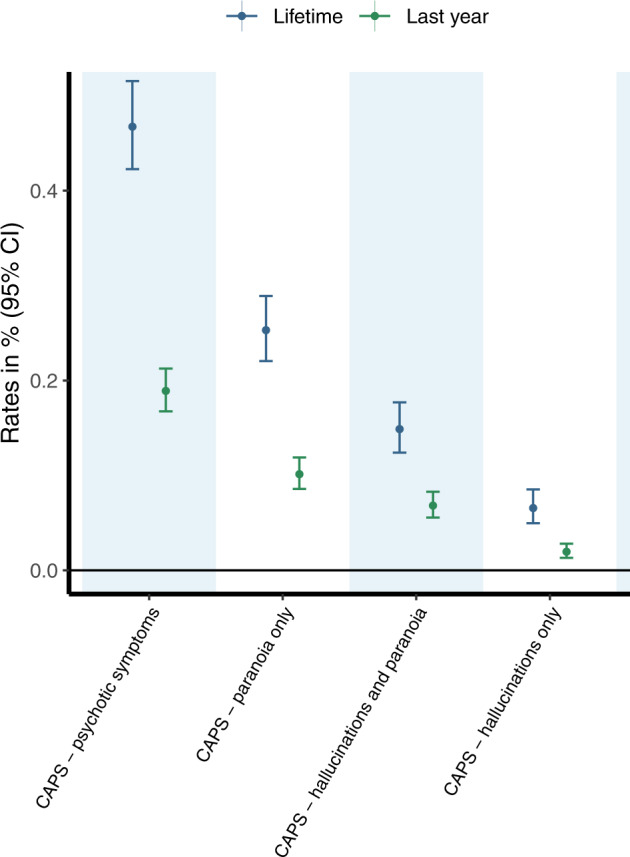
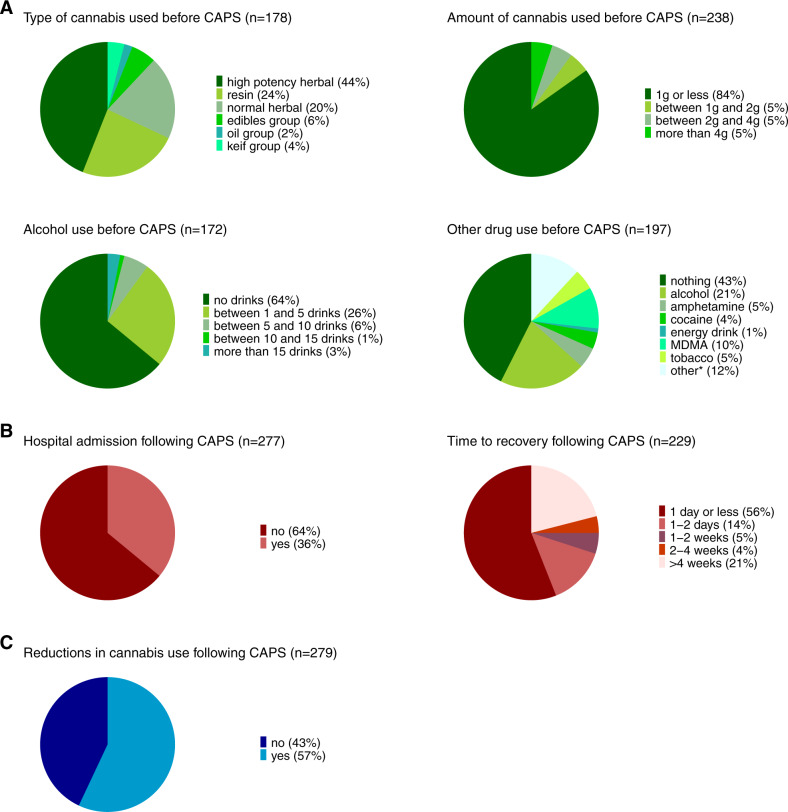
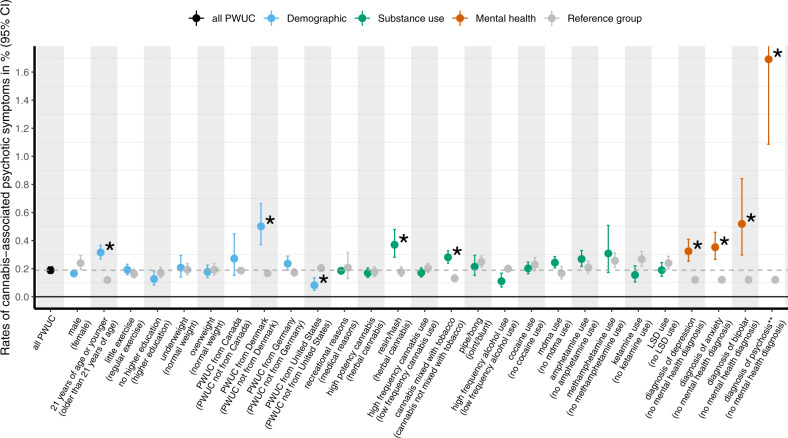
Cannabis, a widely used psychoactive substance, can trigger acute cannabis-associated psychotic symptoms (CAPS) in people who use cannabis (PWUC). To assess rates and correlates of CAPS requiring emergency medical treatment, we analyzed data from an international sample of PWUC (n = 233,475). We found that 0.47% (95%CI 0.42; 0.52) PWUC reported lifetime occurrence of CAPS, defined as the occurrence of hallucinations and/or paranoia requiring emergency medical treatment following the use of cannabis. A range of factors correlated with risk of CAPS in the last year: higher rates were observed in young individuals [risk ratio (RR) 2.66, compared to older PWUC] and those residing in Denmark (RR 3.01, compared to PWUC from other countries). Furthermore, risk was elevated in those using predominantly high-potency resin (RR 2.11, compared to PWUC using herbal cannabis), those mixing cannabis with tobacco (RR 2.15, compared to PWUC not mixing with tobacco) and those with a diagnosis of psychosis (RR 14.01), bipolar (RR 4.30), anxiety (RR 2.92) and depression (RR 2.68), compared to individuals without a mental health diagnosis. Taken together, acute self-limiting psychotic symptoms in the context of cannabis use may occur in about 1 in 200 PWUC's lifetime. Some individuals could be particularly sensitive to the adverse psychological effects of cannabis, such as young individuals or those with pre-existing mental health vulnerabilities. In light of the movements towards legalization of recreational cannabis, more research should focus on the potential harms related to cannabis use, to educate PWUC and the public about risks related to its use.
大麻是一种广泛使用的精神活性物质,会使使用大麻的人(PWUC)出现急性大麻相关精神病症状(CAPS)。为了评估需要紧急医疗救治的 CAPS 发生率和相关因素,我们分析了来自国际 PWUC 样本的数据(n=233475)。我们发现,有 0.47%(95%CI 0.42; 0.52)的 PWUC 报告有过一生中 CAPS 的发作,定义为在使用大麻后出现幻觉和/或妄想,并需要紧急医疗救治。一系列因素与 CAPS 的发生风险相关:年轻人(与年龄较大的 PWUC 相比,RR 2.66)和居住在丹麦的人(与来自其他国家的 PWUC 相比,RR 3.01)的发生率更高。此外,在使用主要为高浓度树脂的人群中(与使用草药大麻的 PWUC 相比,RR 2.11)、在与烟草混合使用大麻的人群中(与不与烟草混合使用大麻的 PWUC 相比,RR 2.15)和在有精神病(RR 14.01)、双相情感障碍(RR 4.30)、焦虑症(RR 2.92)和抑郁症(RR 2.68)诊断的人群中,风险升高,与没有心理健康诊断的人群相比。总之,在使用大麻的情况下,大约每 200 名 PWUC 中就有 1 人会出现急性自限性精神病症状。某些人可能对大麻的不良心理影响特别敏感,例如年轻人或那些有先前心理健康脆弱性的人。鉴于娱乐用大麻合法化的趋势,应开展更多研究,关注与大麻使用相关的潜在危害,以便向 PWUC 和公众宣传与使用大麻相关的风险。