Department of Dermatology, University of Groningen, University Medical Center Groningen, Groningen, The Netherlands.
Department of Dermatology, Erasmus University Medical Center, Rotterdam, The Netherlands.
Am J Clin Dermatol. 2022 Nov;23(6):905-914. doi: 10.1007/s40257-022-00725-9. Epub 2022 Sep 7.
Cohort studies on the use of retinoids for hidradenitis suppurativa (HS) have yielded contradicting results. As the clinical presentation of HS is heterogeneous, with different predilection sites and hallmark features, it can be hypothesized that HS phenotypes are associated with the effectiveness of specific retinoid treatments.
The aim of this study was to evaluate the drug survival of oral retinoids in the treatment of HS and to establish predictors for longer treatment duration.
A retrospective, dual-center study was conducted in the Netherlands in adult HS patients treated with oral retinoids between 2011 and 2021. Drug survival analyses were performed through Kaplan-Meier survival curves. Additionally, Cox regression models were used to determine predictors for a longer drug survival.
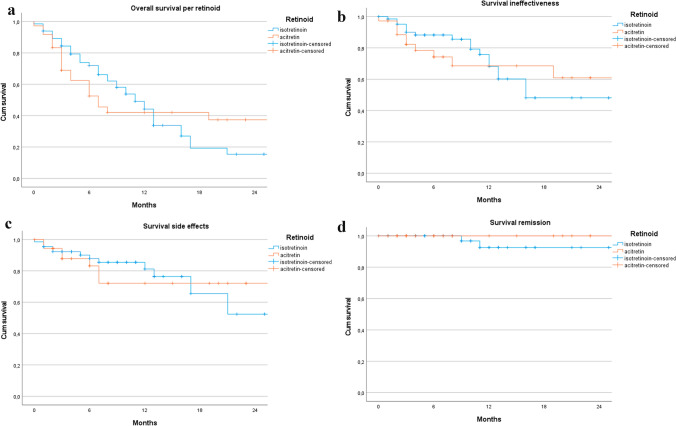
In total, 102 patients were included. Overall drug survival of (low-dose) isotretinoin (n = 66) at 12 and 24 months was 44.2% and 15.5%, respectively. Termination of treatment was mostly due to ineffectiveness (26%). Presence of widespread comedones (p = 0.03) and the use of concomitant systemic medication (p = 0.04) were associated with a prolonged treatment duration. For acitretin (n = 36), the overall drug survival was 42.0% at 12 months and 37.4% at 24 months, and was also predominantly determined by ineffectiveness (28%). Interestingly, the scarring folliculitis phenotype (p < 0.05) was associated with prolonged drug survival time for acitretin treatment relative to the regular phenotype.
Comparable drug survival rates at 12 months for isotretinoin and acitretin were found. HS patients with widespread comedones and the scarring folliculitis phenotype could benefit from treatment with isotretinoin or acitretin, respectively.
队列研究表明,视黄醇类药物治疗化脓性汗腺炎(HS)的结果相互矛盾。由于 HS 的临床表现存在异质性,不同的好发部位和标志性特征,因此可以假设 HS 表型与特定视黄醇治疗的疗效相关。
本研究旨在评估口服视黄醇治疗 HS 的药物生存率,并确定延长治疗时间的预测因素。
在荷兰进行了一项回顾性、双中心研究,纳入了 2011 年至 2021 年间接受口服视黄醇治疗的成年 HS 患者。通过 Kaplan-Meier 生存曲线进行药物生存分析。此外,还使用 Cox 回归模型确定延长药物生存的预测因素。
共纳入 102 例患者。(低剂量)异维 A 酸(n=66)在 12 个月和 24 个月的总体药物生存率分别为 44.2%和 15.5%。治疗终止主要是因为无效(26%)。广泛存在粉刺(p=0.03)和同时使用全身药物(p=0.04)与延长治疗时间相关。阿维 A 酸(n=36)在 12 个月的总体药物生存率为 42.0%,24 个月时为 37.4%,也主要由无效决定(28%)。有趣的是,相对于普通表型,瘢痕性滤泡炎表型(p<0.05)与阿维 A 酸治疗的药物生存时间延长相关。
发现异维 A 酸和阿维 A 酸在 12 个月时的药物生存率相当。广泛存在粉刺的 HS 患者和瘢痕性滤泡炎表型的患者可能受益于异维 A 酸或阿维 A 酸的治疗。