Yang Lidan, Dai Yuzhao, He He, Liu Zhi, Liao Shenling, Zhang Yu, Liao Ga, An Zhenmei
Department of Laboratory Medicine, West China Hospital, Sichuan University, Chengdu, China.
Department of Endocrinology and Metabolism, West China Hospital, Sichuan University, Chengdu, China.
Front Microbiol. 2022 Aug 22;13:969757. doi: 10.3389/fmicb.2022.969757. eCollection 2022.
Metabolic associated fatty liver disease (MAFLD) affects nearly a quarter of the world's population. Our study aimed to characterize the gut microbiome and overall changes in the fecal and serum metabolomes in MAFLD patients.
Thirty-two patients diagnosed with MAFLD and 30 healthy individuals (control group, CG) were included in this study, the basic clinical characteristics and laboratory test results including routine biochemistry, etc. were recorded for all, and their serum and fecal samples were collected. A portion of the fecal samples was subjected to 16S rDNA sequencing, and the other portion of the fecal samples and serum samples were subjected to non-targeted metabolomic detection based on liquid chromatography-mass spectrometry (LC-MS). Statistical analysis of clinical data was performed using SPSS software package version 25.0 (SPSS Inc., Chicago, IL, United States). The analysis of 16S rDNA sequencing results was mainly performed by R software (V. 2.15.3), and the metabolomics data analysis was mainly performed by CD 3.1 software. Two-tailed value < 0.05 was considered statistically significant.
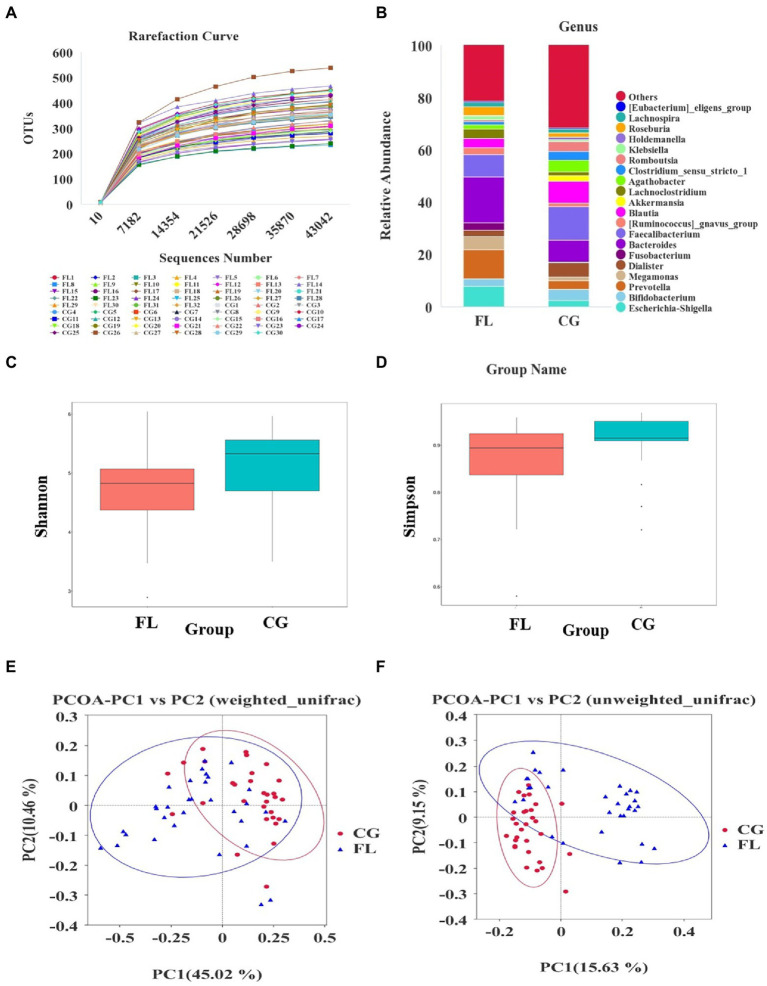
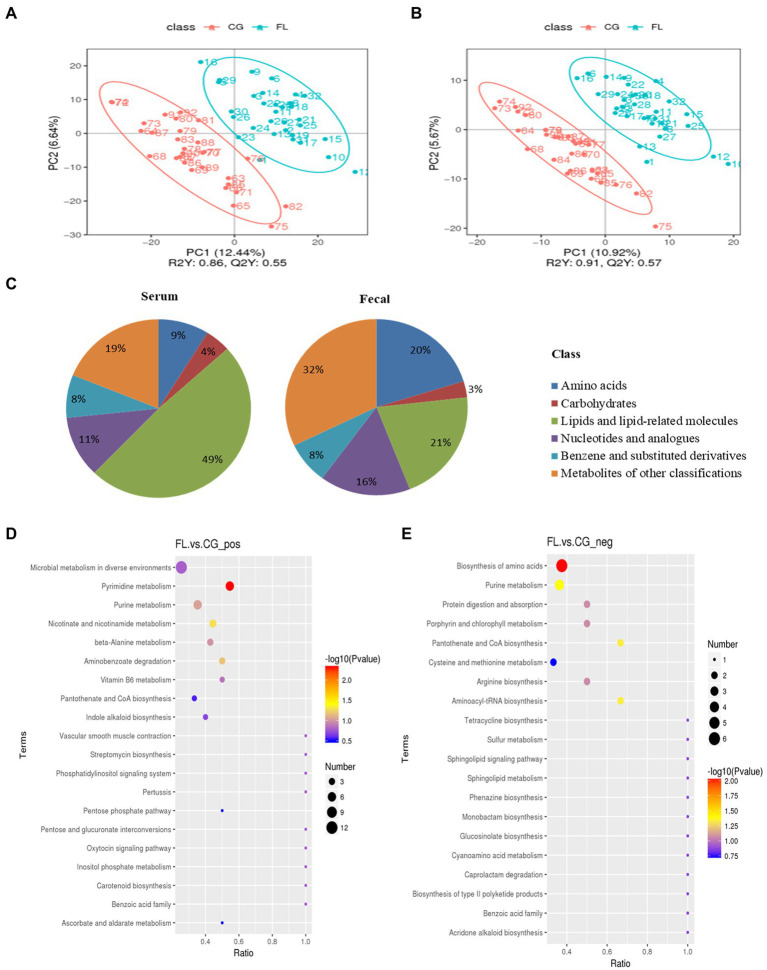
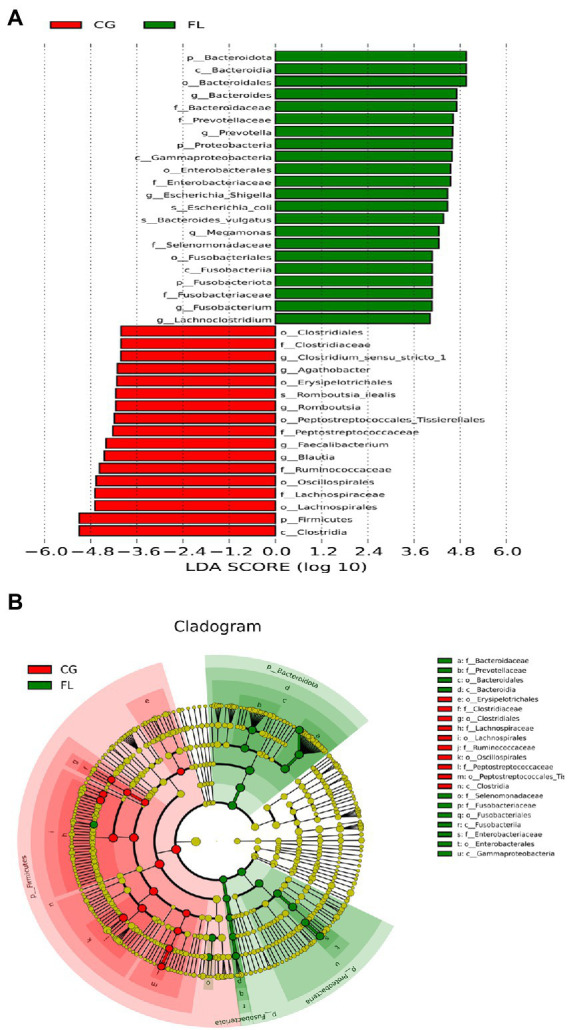
The 16S sequencing data suggested that the species richness and diversity of MAFLD patients were reduced compared with controls. At the phylum level, the relative abundance of , , and increased and decreased in MAFLD patients. At the genus level, the relative abundances of , , , etc. increased. 2,770 metabolites were detected in stool samples and 1,245 metabolites were detected in serum samples. The proportion of differential lipid metabolites in serum (49%) was higher than that in feces (21%). There were 22 differential metabolites shared in feces and serum. And the association analysis indicated that LPC 18:0 was positively correlated with , ; neohesperidin was also positively correlated with , , and .
Microbial sequencing data suggested decreased species richness and diversity and altered β-diversity in feces. Metabolomic analysis identified overall changes in fecal and serum metabolites dominated by lipid molecules. And the association analysis with gut microbes provided potentially pivotal gut microbiota-metabolite combinations in MAFLD patients, which might provide new clues for further research on the disease mechanism and the development of new diagnostic markers and treatments.
代谢相关脂肪性肝病(MAFLD)影响着全球近四分之一的人口。我们的研究旨在描述MAFLD患者的肠道微生物群以及粪便和血清代谢组的总体变化。
本研究纳入了32例诊断为MAFLD的患者和30名健康个体(对照组,CG),记录了所有人的基本临床特征和实验室检查结果,包括常规生化检查等,并采集了他们的血清和粪便样本。一部分粪便样本进行16S rDNA测序,另一部分粪便样本和血清样本基于液相色谱-质谱联用(LC-MS)进行非靶向代谢组学检测。使用SPSS 25.0软件包(SPSS公司,美国伊利诺伊州芝加哥)对临床数据进行统计分析。16S rDNA测序结果的分析主要通过R软件(版本2.15.3)进行,代谢组学数据分析主要通过CD 3.1软件进行。双侧P值<0.05被认为具有统计学意义。
16S测序数据表明,与对照组相比,MAFLD患者的物种丰富度和多样性降低。在门水平上,MAFLD患者中拟杆菌门、放线菌门和变形菌门的相对丰度增加,厚壁菌门减少。在属水平上,双歧杆菌属、粪杆菌属、普雷沃菌属等的相对丰度增加。在粪便样本中检测到2770种代谢物,在血清样本中检测到1245种代谢物。血清中差异脂质代谢物的比例(49%)高于粪便中的比例(21%)。粪便和血清中共有22种差异代谢物。关联分析表明,溶血磷脂酰胆碱18:0与甘油三酯、总胆固醇呈正相关;新橙皮苷也与甘油三酯、总胆固醇和低密度脂蛋白胆固醇呈正相关。
微生物测序数据表明粪便中的物种丰富度和多样性降低,β-多样性改变。代谢组学分析确定了以脂质分子为主导的粪便和血清代谢物的总体变化。与肠道微生物的关联分析提供了MAFLD患者潜在的关键肠道微生物群-代谢物组合,这可能为该疾病机制的进一步研究以及新诊断标志物和治疗方法的开发提供新线索。