Laboratory of Immunopathology and Immunosenescence, Department of Biomedicine, Neurosciences and Advanced Technologies, University of Palermo, 90133 Palermo, Italy.
Oncoimmunology Group, Navarrabiomed, Instituto de Investigación Sanitaria de Navarra (IdiSNA), 31008 Pamplona, Spain.
Int J Mol Sci. 2022 Aug 31;23(17):9880. doi: 10.3390/ijms23179880.
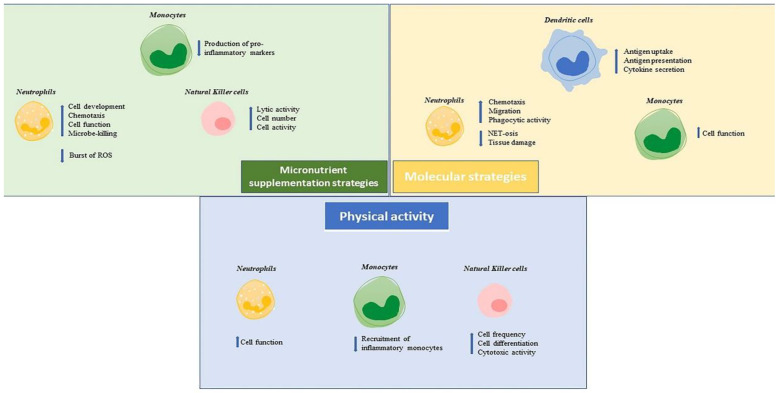
Vaccination, being able to prevent millions of cases of infectious diseases around the world every year, is the most effective medical intervention ever introduced. However, immunosenescence makes vaccines less effective in providing protection to older people. Although most studies explain that this is mainly due to the immunosenescence of T and B cells, the immunosenescence of innate immunity can also be a significant contributing factor. Alterations in function, number, subset, and distribution of blood neutrophils, monocytes, and natural killer and dendritic cells are detected in aging, thus potentially reducing the efficacy of vaccines in older individuals. In this paper, we focus on the immunosenescence of the innate blood immune cells. We discuss possible strategies to counteract the immunosenescence of innate immunity in order to improve the response to vaccination. In particular, we focus on advances in understanding the role and the development of new adjuvants, such as TLR agonists, considered a promising strategy to increase vaccination efficiency in older individuals.
疫苗接种每年能够预防全球数百万例传染病,是有史以来最有效的医学干预措施。然而,免疫衰老使疫苗对老年人的保护效果降低。尽管大多数研究表明这主要归因于 T 和 B 细胞的免疫衰老,但固有免疫的免疫衰老也可能是一个重要的促成因素。在衰老过程中,血液中性粒细胞、单核细胞、自然杀伤细胞和树突状细胞的功能、数量、亚群和分布都发生了改变,从而可能降低老年人疫苗的效力。本文重点关注固有血液免疫细胞的免疫衰老。我们讨论了可能的策略来对抗固有免疫的免疫衰老,以改善疫苗接种的反应。特别是,我们专注于理解新佐剂(如 TLR 激动剂)的作用和发展,这些佐剂被认为是提高老年人疫苗接种效率的有前途的策略。