Research Department, Royal College of Surgeons in Ireland-Bahrain, Busaiteen 15503, Bahrain.
Department of Internal Medicine, King Hamad University Hospital, Busaiteen 24343, Bahrain.
Nutrients. 2022 Aug 25;14(17):3491. doi: 10.3390/nu14173491.
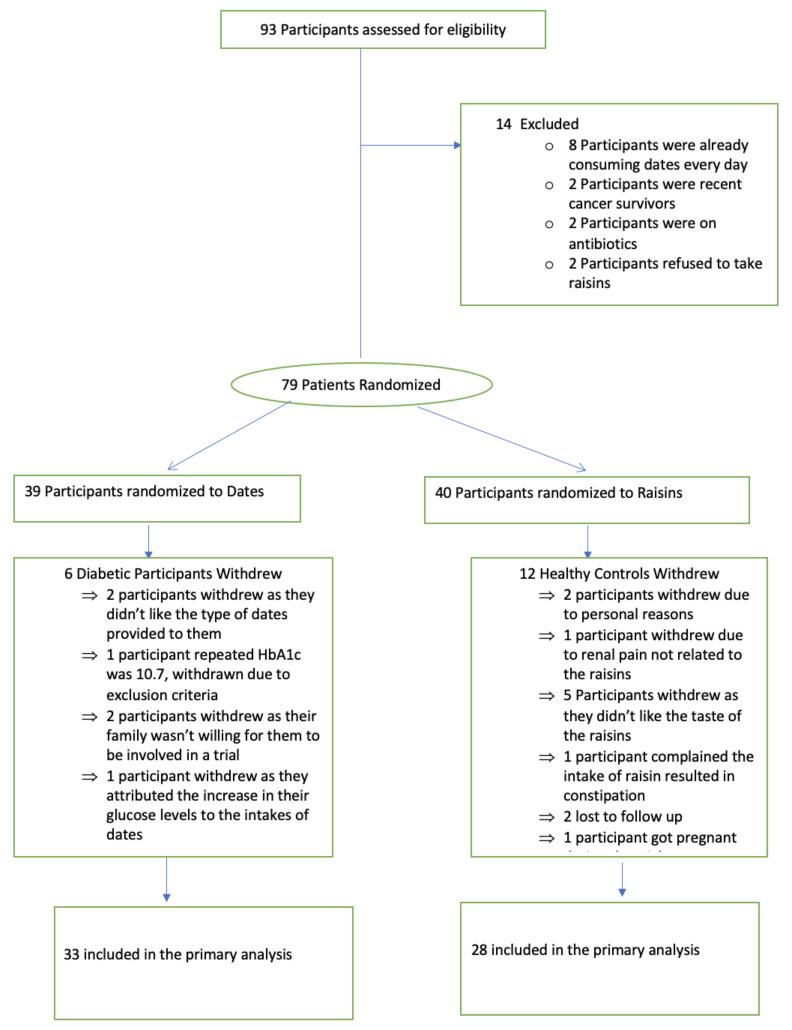
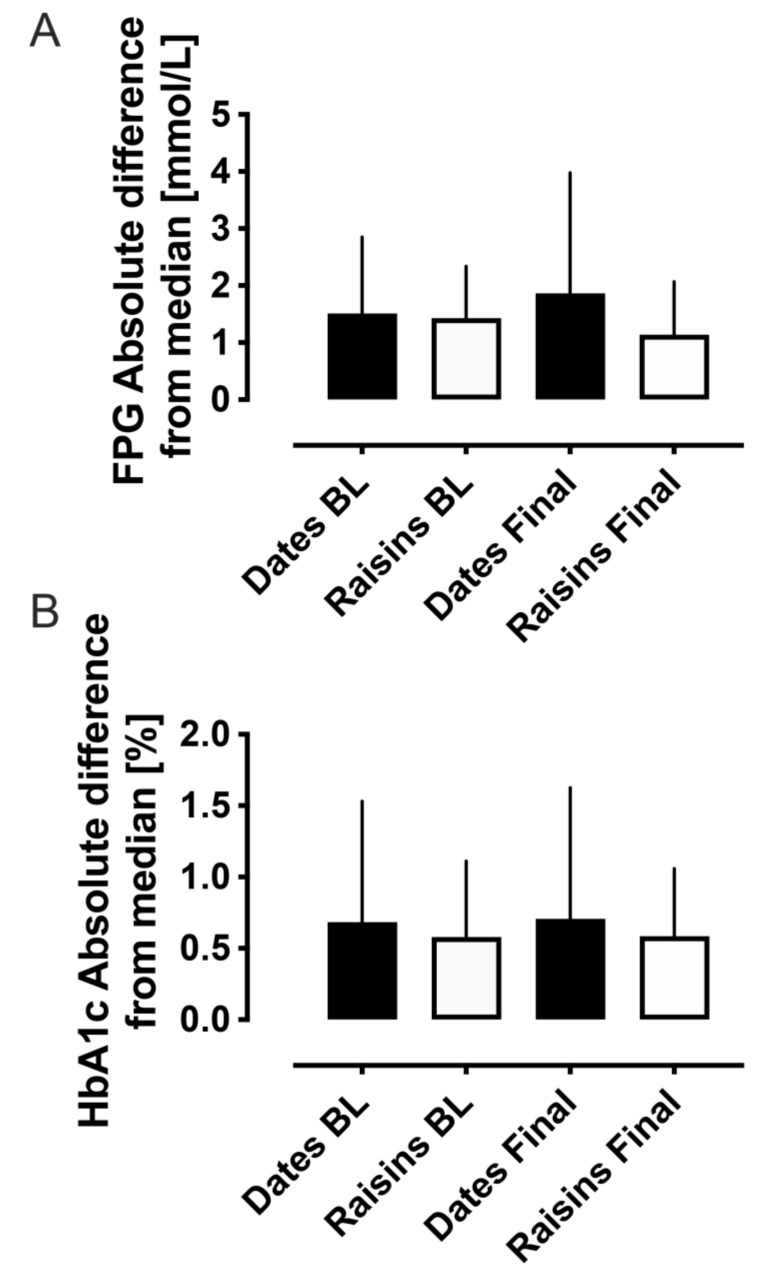
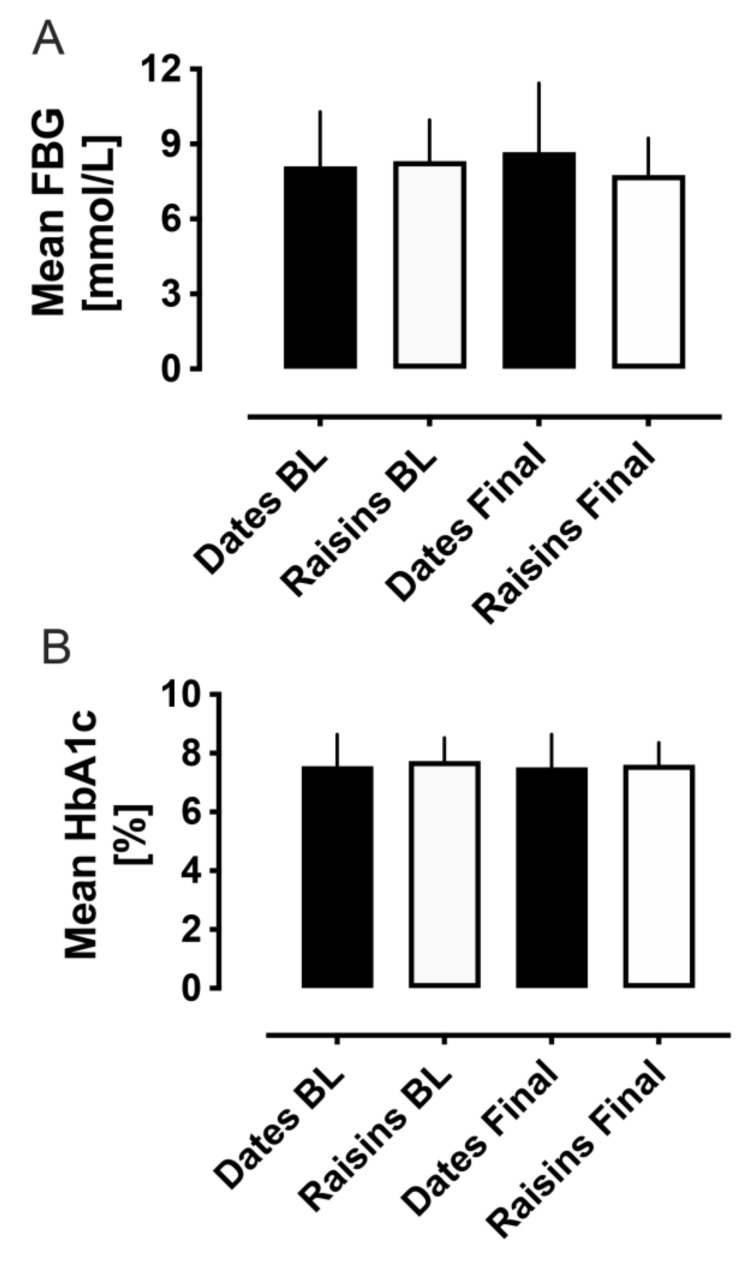
Objective. Date fruit has been reported to have benefits in type 2 diabetes (T2D), though there is a concern, given the high sugar content, about its effects on glycemic control. Design and Setting. Prospective, interventional, randomized, parallel study. Participants. In total, 79 patients with T2D (39 male and 40 female). Intervention. Participants were randomly allocated to either 60 g date fruit or 60 g raisins daily of the equivalent glycemic index (amount split, given as midmorning and midafternoon snack) for 12 weeks. Main Outcome Measures. The primary outcome was to investigate the effect of date fruit on HbA1c and fasting blood glucose, and their variability, in patients with T2D in comparison to the same glycemic load of raisins. The secondary outcomes were to determine whether date fruit affected cardiovascular risk by measuring fasting lipids, C-reactive protein (CRP), blood pressure, and insulin resistance (IR) as measured by Homeostatic Model Assessment (HOMA-IR). Results. In total, 61 (27 female and 34 male) of 79 patients completed the study. There was no difference between or within groups for HbA1c or HbA1c variability, fasting glucose or glucose variability, insulin resistance (HOMA-IR), insulin sensitivity (HOMA-S), beta cell function (HOMA-B), the disposition index, lipids, systolic (SBP) or diastolic blood pressure (DBP), or C-reactive protein (CRP) (p > 0.05). Conclusion. No improvement in glycemic indices was seen following supplementation of 60 g daily date fruit or raisins, though neither had a deleterious effect on glycemic control over a 12-week period, indicating their safety when consumed in T2D. Additionally, no beneficial therapeutic effects of date fruit on other cardiovascular indices in T2D were seen.
已有报道称,椰枣对 2 型糖尿病(T2D)有益,尽管鉴于其高含糖量,人们担心它会对血糖控制产生影响。
前瞻性、干预性、随机、平行研究。
共有 79 名 T2D 患者(39 名男性和 40 名女性)参与。
参与者被随机分配每天食用 60 克椰枣或 60 克葡萄干(等量的血糖指数,分为上午和下午的零食),持续 12 周。
主要结局是比较 T2D 患者食用椰枣对糖化血红蛋白(HbA1c)和空腹血糖及其变异性的影响,与同等血糖负荷的葡萄干进行比较。次要结局是通过测量空腹血脂、C 反应蛋白(CRP)、血压和胰岛素抵抗(HOMA-IR)来确定椰枣是否会影响心血管风险,HOMA-IR 用于评估胰岛素抵抗,HOMA-S 用于评估胰岛素敏感性,HOMA-B 用于评估β细胞功能,而 disposition index 用于评估胰岛素分泌功能。
共有 79 名患者中的 61 名(27 名女性和 34 名男性)完成了研究。两组之间或组内的 HbA1c 或 HbA1c 变异性、空腹血糖或血糖变异性、胰岛素抵抗(HOMA-IR)、胰岛素敏感性(HOMA-S)、β细胞功能(HOMA-B)、处置指数、血脂、收缩压(SBP)或舒张压(DBP)或 C 反应蛋白(CRP)均无差异(p>0.05)。
每天补充 60 克椰枣或葡萄干并没有改善血糖指数,尽管在 12 周内对血糖控制没有不利影响,表明在 T2D 患者中食用是安全的。此外,椰枣对 T2D 患者其他心血管指数也没有有益的治疗作用。