Brede Benjamin, Verrelst Jochem, Gastellu-Etchegorry Jean-Philippe, Clevers Jan G P W, Goudzwaard Leo, den Ouden Jan, Verbesselt Jan, Herold Martin
Laboratory of Geo-Information Science and Remote Sensing, Wageningen University & Research, Droevendaalsesteeg 3, 6708 PB Wageningen, The Netherlands.
Image Processing Laboratory (IPL), Parc Científic, Universitat de València, 46980 Paterna, València, Spain.
Remote Sens (Basel). 2020 Mar 12;12(6):915. doi: 10.3390/rs12060915.
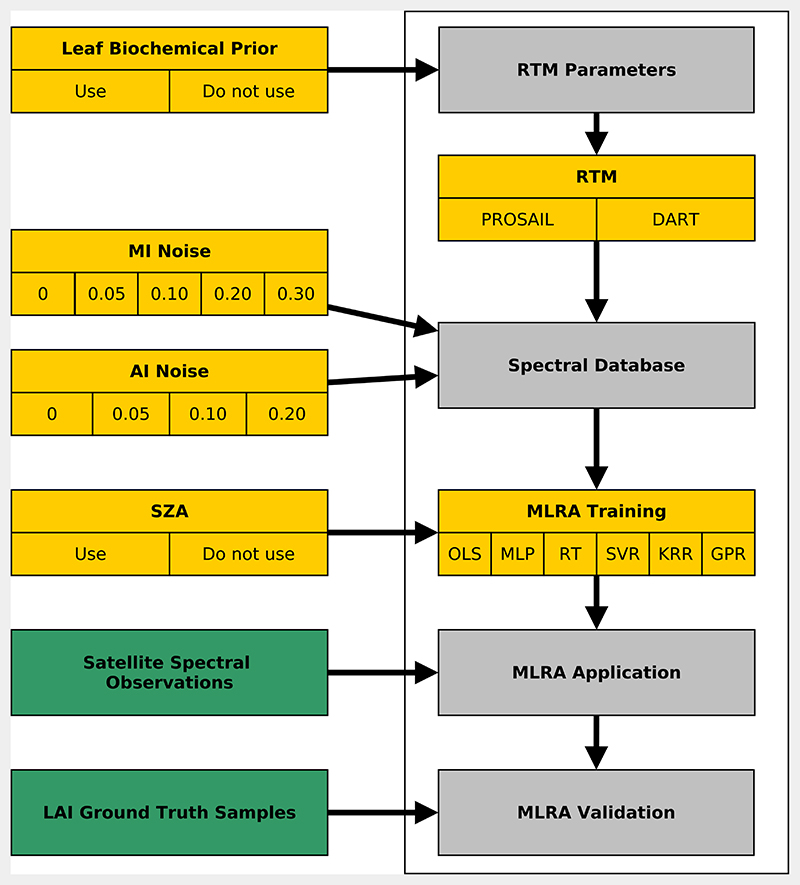
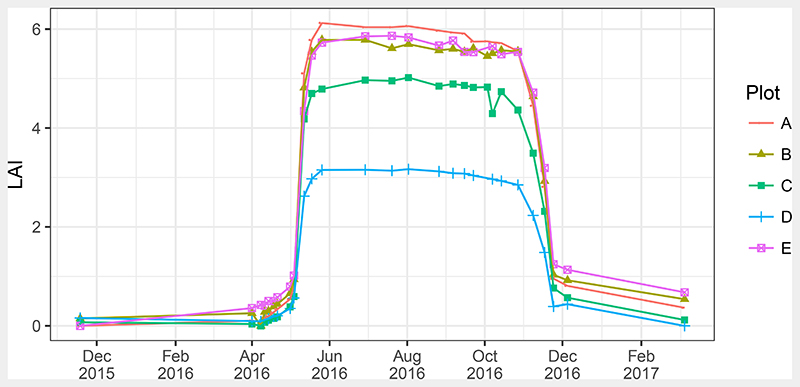
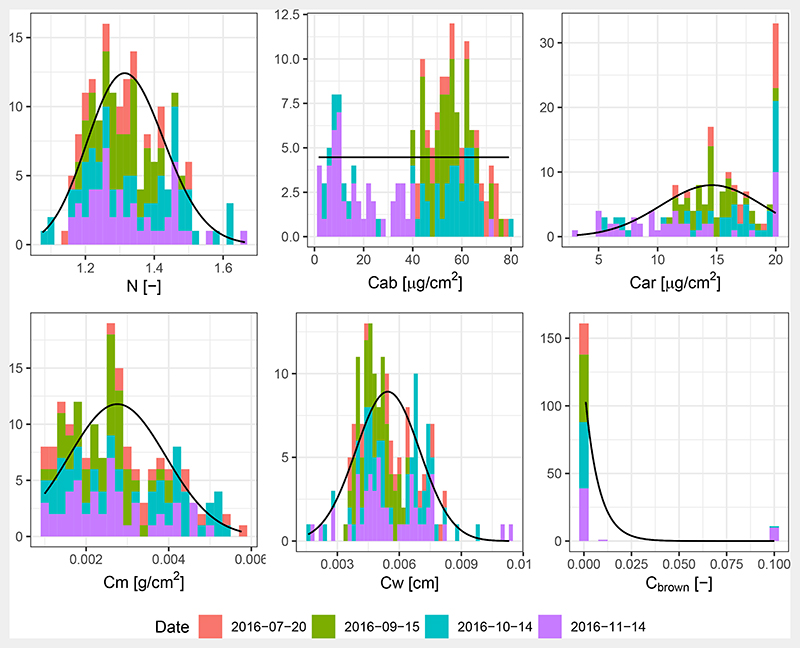
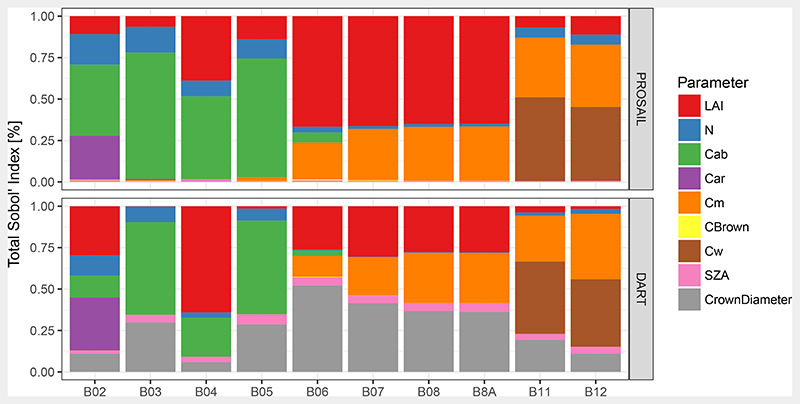
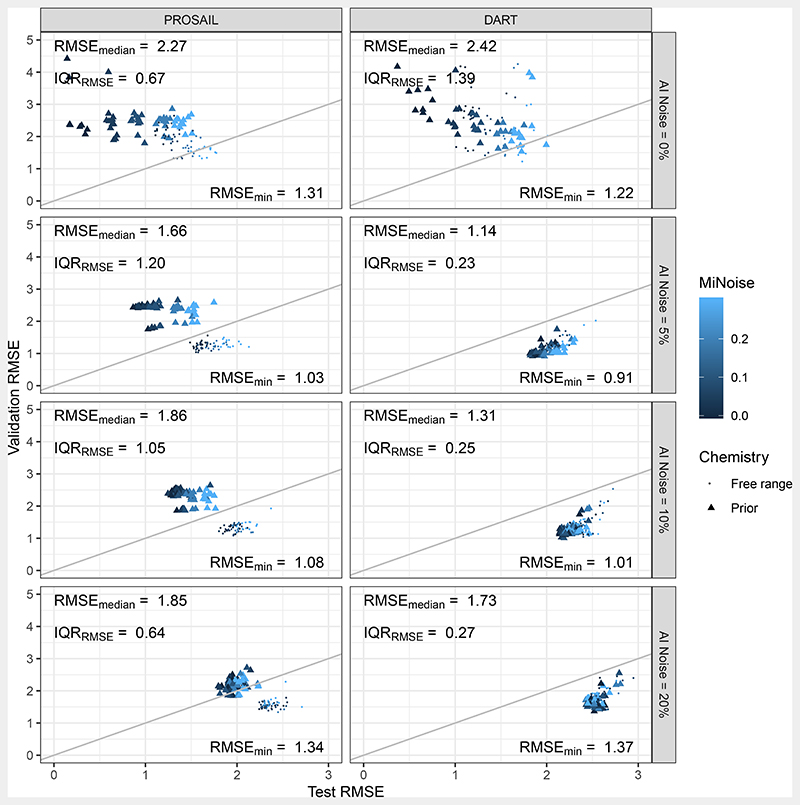
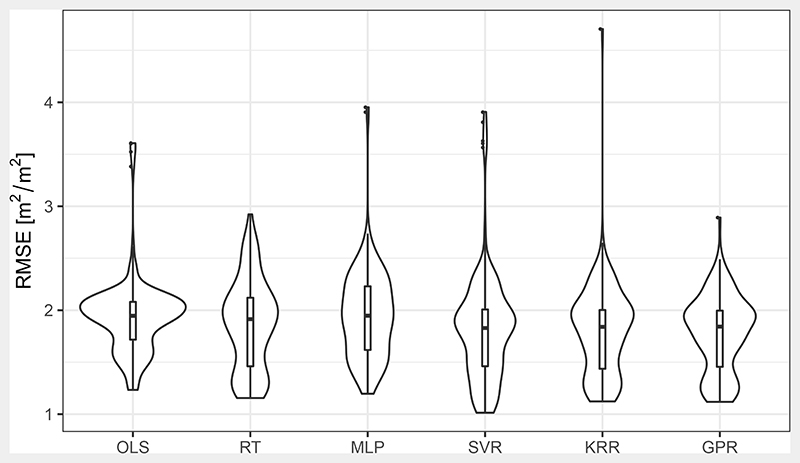
The European Space Agency (ESA)'s Sentinel-2A (S2A) mission is providing time series that allow the characterisation of dynamic vegetation, especially when combined with the National Aeronautics and Space Administration (NASA)/United States Geological Survey (USGS) Landsat 7 (L7) and Landsat 8 (L8) missions. Hybrid retrieval workflows combining non-parametric Machine Learning Regression Algorithms (MLRAs) and vegetation Radiative Transfer Models (RTMs) were proposed as fast and accurate methods to infer biophysical parameters such as Leaf Area Index (LAI) from these data streams. However, the exact design of optimal retrieval workflows is rarely discussed. In this study, the impact of five retrieval workflow features on LAI prediction performance of MultiSpectral Instrument (MSI), Enhanced Thematic Mapper Plus (ETM+) and Operational Land Imager (OLI) observations was analysed over a Dutch beech forest site for a one-year period. The retrieval workflow features were the (1) addition of prior knowledge of leaf chemistry (two alternatives), (2) the choice of RTM (two alternatives), (3) the addition of Gaussian noise to RTM produced training data (four and five alternatives), (4) possibility of using Sun Zenith Angle (SZA) as an additional MLRA training feature (two alternatives), and (5) the choice of MLRA (six alternatives). The features were varied in a full grid resulting in 960 inversion models in order to find the overall impact on performance as well as possible interactions among the features. A combination of a Terrestrial Laser Scanning (TLS) time series with litter-trap derived LAI served as independent validation. The addition of absolute noise had the most significant impact on prediction performance. It improved the median prediction Root Mean Square Error (RMSE) by 1.08 m m when 5 % noise was added compared to inversions with 0 % absolute noise. The choice of the MLRA was second most important in terms of median prediction performance, which differed by 0.52 m m between the best and worst model. The best inversion model achieved an RMSE of 0.91 m m and explained 84.9% of the variance of the reference time series. The results underline the need to explicitly describe the used noise model in future studies. Similar studies should be conducted in other study areas, both forest and crop systems, in order to test the noise model as an integral part of hybrid retrieval workflows.
欧洲航天局(ESA)的哨兵 - 2A(S2A)任务正在提供时间序列数据,这些数据有助于对动态植被进行特征描述,特别是当与美国国家航空航天局(NASA)/美国地质调查局(USGS)的陆地卫星7(L7)和陆地卫星8(L8)任务的数据相结合时。有人提出将非参数机器学习回归算法(MLRAs)和植被辐射传输模型(RTMs)相结合的混合反演工作流程,作为从这些数据流中快速准确地推断诸如叶面积指数(LAI)等生物物理参数的方法。然而,很少有人讨论最优反演工作流程的确切设计。在本研究中,在荷兰的一片山毛榉林地上,分析了为期一年的五种反演工作流程特征对多光谱仪器(MSI)、增强型专题绘图仪Plus(ETM +)和业务陆地成像仪(OLI)观测的LAI预测性能的影响。反演工作流程特征包括:(1)添加叶片化学的先验知识(两种选择);(2)RTM的选择(两种选择);(3)向RTM生成的训练数据中添加高斯噪声(四种和五种选择);(4)将太阳天顶角(SZA)用作额外的MLRA训练特征的可能性(两种选择);(5)MLRA的选择(六种选择)。这些特征在一个全网格中变化,从而产生960个反演模型,以便找出对性能的总体影响以及各特征之间可能的相互作用。将地面激光扫描(TLS)时间序列与通过凋落物收集器得出的LAI相结合,作为独立验证。添加绝对噪声对预测性能的影响最为显著。与添加0%绝对噪声的反演相比,添加5%噪声时,预测均方根误差(RMSE)的中位数提高了1.08 m²。就预测性能中位数而言,MLRA的选择是第二重要的,最佳模型和最差模型之间相差0.52 m²。最佳反演模型的RMSE为0.91 m²,解释了参考时间序列方差的84.9%。结果强调了在未来研究中明确描述所使用噪声模型的必要性。应该在其他研究区域,包括森林和作物系统中进行类似研究,以测试噪声模型作为混合反演工作流程不可或缺的一部分的情况。