Department of Cardiology, Guangdong Cardiovascular Institute, Guangdong Provincial People's Hospital, Guangdong Academy of Medical Sciences, Guangzhou 510080, China.
Research Department of Medical Sciences, Guangdong Provincial People's Hospital, Guangdong Academy of Medical Sciences, Guangzhou 510080, China.
Cardiovasc Ther. 2022 Aug 25;2022:9512401. doi: 10.1155/2022/9512401. eCollection 2022.
The association of total choline (TC) intake and its metabolite trimethylamine-N-oxide (TMAO) with hypertension and blood pressure (BP) has not been elucidated.
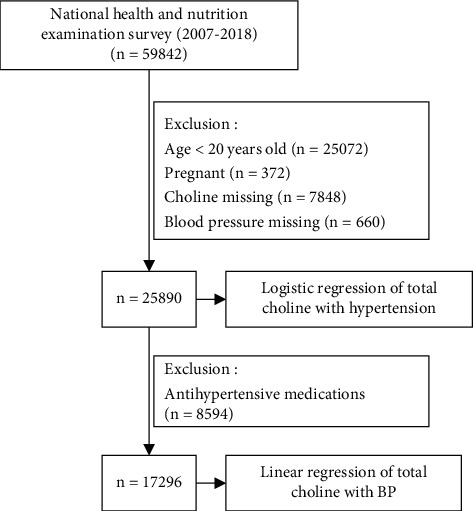
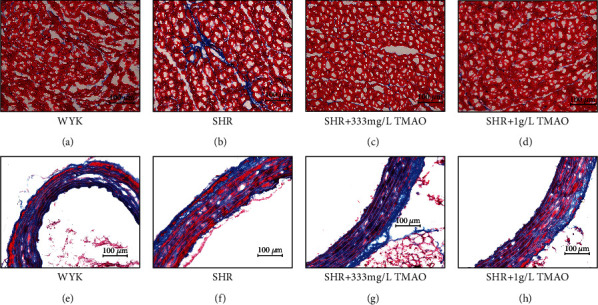
For the population study, the association of TC intake with hypertension, as well as blood pressure, was determined through logistic along with multiple linear regression analysis from the National Health and Nutrition Examination Survey 2007 to 2018, respectively. For the animal experimental study, spontaneously hypertensive rats (SHRs) were assigned to the water group or water containing 333 mg/L or 1 g/L TMAO group. After 22 weeks treatment of TMAO, blood pressure measurement, echocardiography, and histopathology of the heart and arteries were evaluated.
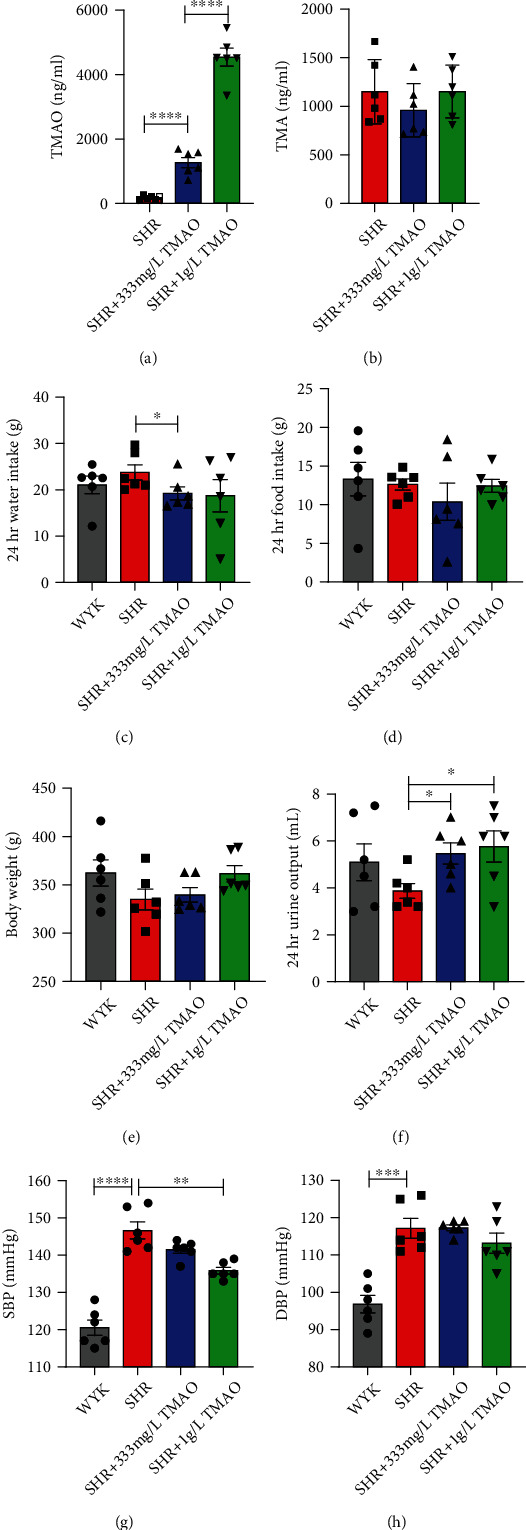
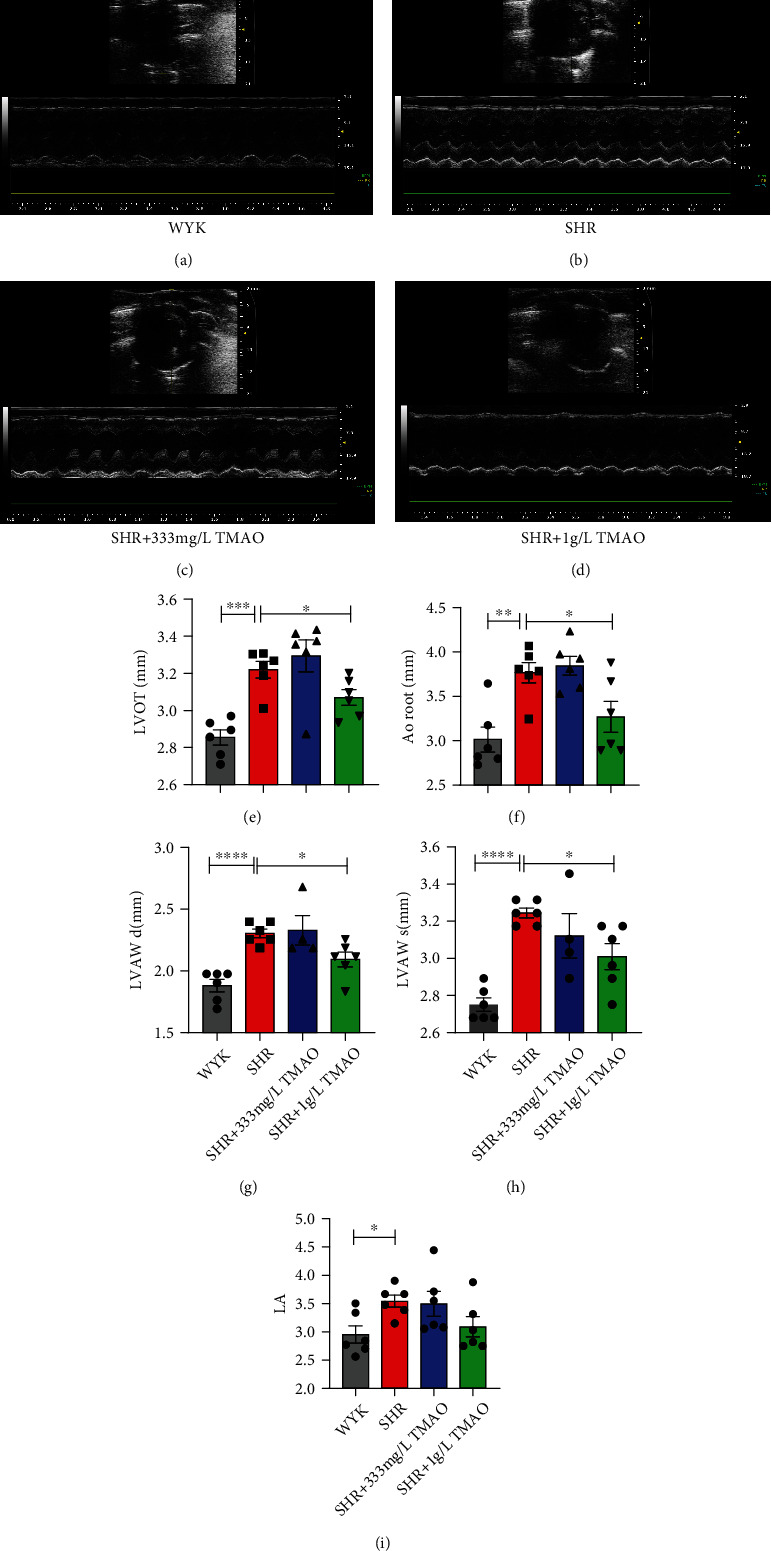
No significant association of TC with hypertension was observed but the trend for ORs of hypertension was decreased with the increased level of TC. Negative association between TC and BP was significant in quintile 4 and quintile 5 range of TC, and the negative trend was significant. The SHR-TMAO groups showed significant higher urine output levels in contrast with the SHR-water group. No difference of diastolic BP was observed, but there was a trend towards lower systolic BP with the increase doses of TMAO in the SHR group. The SHR 1 g/L TMAO rats had a remarkably lower systolic blood pressure than the SHR-water group. Echocardiography showed a diastolic dysfunction alleviating effect in the 1 g/L TMAO group.
High TC intake was not linked to elevated risk of hypertension. An inverse relationship of choline intake with systolic BP was observed. The mechanism for the beneficial effect of TC might be associated with the diuretic effect of its metabolite TMAO.
总胆碱(TC)摄入量及其代谢物三甲胺 N-氧化物(TMAO)与高血压和血压之间的关系尚未阐明。
在人群研究中,通过 2007 年至 2018 年全国健康与营养调查的逻辑和多元线性回归分析,分别确定 TC 摄入量与高血压以及血压之间的关系。在动物实验研究中,自发性高血压大鼠(SHR)被分为水组或含 333mg/L 或 1g/L TMAO 的水组。在 TMAO 治疗 22 周后,测量血压、进行超声心动图检查,并评估心脏和动脉的组织病理学。
TC 与高血压之间没有显著关联,但高血压的 OR 随着 TC 水平的升高而降低。TC 五分位 4 和 5 范围内与 BP 呈负相关,且负相关趋势具有统计学意义。与 SHR 水组相比,SHR-TMAO 组的尿排量水平显著升高。虽然舒张压无差异,但 SHR 组 TMAO 剂量增加时收缩压有降低趋势。与 SHR 水组相比,SHR 1g/L TMAO 组大鼠的收缩压显著降低。超声心动图显示 1g/L TMAO 组舒张功能障碍有缓解作用。
高 TC 摄入量与高血压风险增加无关。胆碱摄入量与收缩压呈负相关。TC 的有益作用机制可能与其代谢物 TMAO 的利尿作用有关。