Ramesh Vishwajith, Bilal Erhan
Department of Biomedical Informatics, University of California, San Diego, CA, USA.
T.J. Watson Research Center, IBM Research, Yorktown Heights, NY, USA.
NPJ Digit Med. 2022 Sep 9;5(1):138. doi: 10.1038/s41746-022-00674-x.
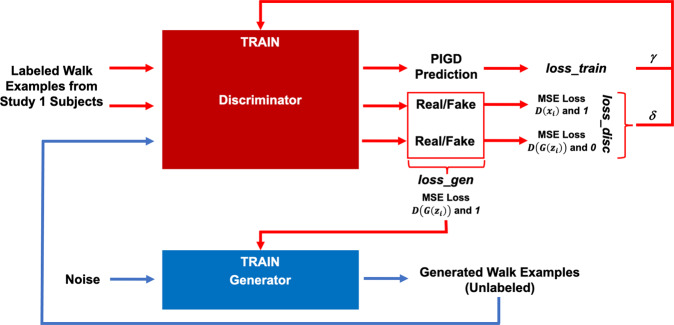
Parkinson's disease is a neurodegenerative disorder characterized by several motor symptoms that develop gradually: tremor, bradykinesia, limb rigidity, and gait and balance problems. While there is no cure, levodopa therapy has been shown to mitigate symptoms. A patient on levodopa experiences cycles in the severity of their symptoms, characterized by an ON state-when the drug is active-and an OFF state-when symptoms worsen as the drug wears off. The longitudinal progression of the disease is monitored using episodic assessments performed by trained physicians in the clinic, such as the Unified Parkinson's Disease Rating Scale (UPDRS). Lately, there has been an effort in the field to develop continuous, objective measures of motor symptoms based on wearable sensors and other remote monitoring devices. In this work, we present an effort towards such a solution that uses a single wearable inertial sensor to automatically assess the postural instability and gait disorder (PIGD) of a Parkinson's disease patient. Sensor data was collected from two independent studies of subjects performing the UPDRS test and then used to train and validate a convolutional neural network model. Given the typical limited size of such studies we also employed the use of generative adversarial networks to improve the performance of deep-learning models that usually require larger amounts of data for training. We show that for a 2-min walk test, our method's predicted PIGD scores can be used to identify a patient's ON/OFF states better than a physician evaluated on the same criteria. This result paves the way for more reliable, continuous tracking of Parkinson's disease symptoms.
帕金森病是一种神经退行性疾病,其特征是逐渐出现多种运动症状:震颤、运动迟缓、肢体僵硬以及步态和平衡问题。虽然无法治愈,但左旋多巴疗法已被证明可减轻症状。服用左旋多巴的患者症状严重程度会出现周期性变化,其特征为“开”状态(药物起效时)和“关”状态(药物作用消退症状加重时)。该疾病的纵向进展通过临床中训练有素的医生进行的阶段性评估来监测,例如统一帕金森病评定量表(UPDRS)。最近,该领域一直在努力基于可穿戴传感器和其他远程监测设备开发连续、客观的运动症状测量方法。在这项工作中,我们致力于提供这样一种解决方案,即使用单个可穿戴惯性传感器自动评估帕金森病患者的姿势不稳和步态障碍(PIGD)。传感器数据来自两项对进行UPDRS测试的受试者的独立研究,然后用于训练和验证卷积神经网络模型。鉴于此类研究的典型规模有限,我们还采用了生成对抗网络来提高深度学习模型的性能,而深度学习模型通常需要大量数据进行训练。我们表明,对于2分钟步行测试,我们方法预测的PIGD分数在识别患者的“开”/“关”状态方面比按照相同标准评估的医生表现更好。这一结果为更可靠、持续地跟踪帕金森病症状铺平了道路。