Chen Zhiyuan, Deng Xiaowei, Fang Liqun, Sun Kaiyuan, Wu Yanpeng, Che Tianle, Zou Junyi, Cai Jun, Liu Hengcong, Wang Yan, Wang Tao, Tian Yuyang, Zheng Nan, Yan Xuemei, Sun Ruijia, Xu Xiangyanyu, Zhou Xiaoyu, Ge Shijia, Liang Yuxia, Yi Lan, Yang Juan, Zhang Juanjuan, Ajelli Marco, Yu Hongjie
School of Public Health, Fudan University, Key Laboratory of Public Health Safety, Ministry of Education, Shanghai, China.
State Key Laboratory of Pathogen and Biosecurity, Beijing Institute of Microbiology and Epidemiology, Beijing, China.
Lancet Reg Health West Pac. 2022 Dec;29:100592. doi: 10.1016/j.lanwpc.2022.100592. Epub 2022 Sep 7.
In early March 2022, a major outbreak of the severe acute respiratory syndrome coronavirus 2 (SARS-CoV-2) Omicron variant spread rapidly throughout Shanghai, China. Here we aimed to provide a description of the epidemiological characteristics and spatiotemporal transmission dynamics of the Omicron outbreak under the population-based screening and lockdown policies implemented in Shanghai.
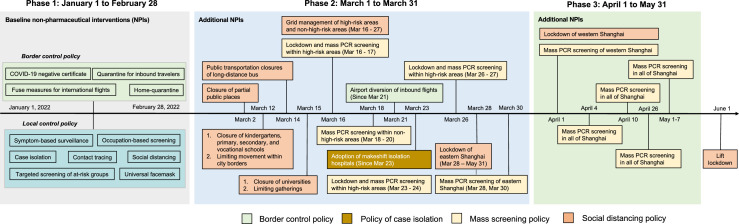
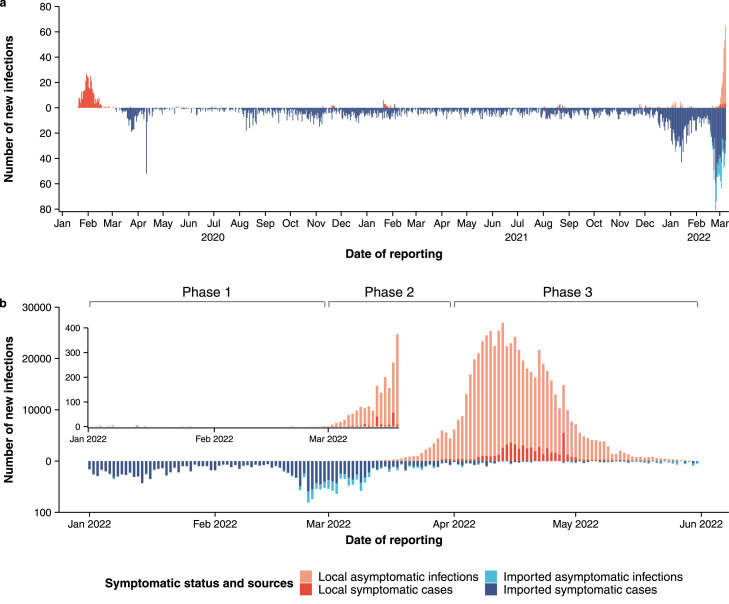
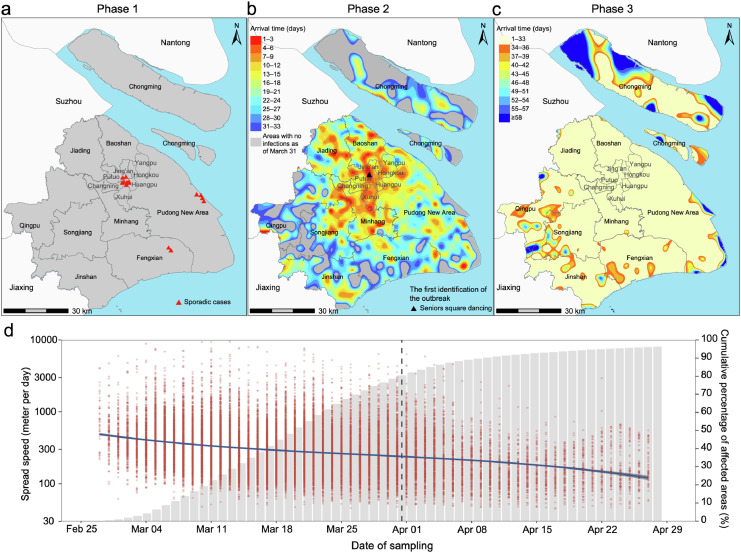
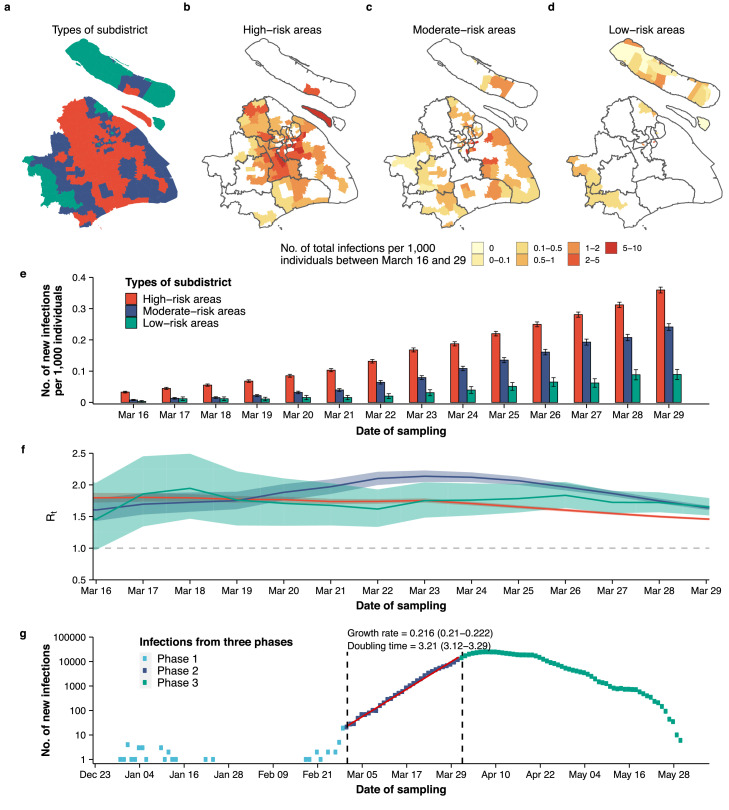
We extracted individual information on SARS-CoV-2 infections reported between January 1 and May 31, 2022, and on the timeline of the adopted non-pharmaceutical interventions. The epidemic was divided into three phases: i) sporadic infections (January 1-February 28), ii) local transmission (March 1-March 31), and iii) city-wide lockdown (April 1 to May 31). We described the epidemic spread during these three phases and the subdistrict-level spatiotemporal distribution of the infections. To evaluate the impact on the transmission of SARS-CoV-2 of the adopted targeted interventions in Phase 2 and city-wide lockdown in Phase 3, we estimated the dynamics of the net reproduction number ( ).
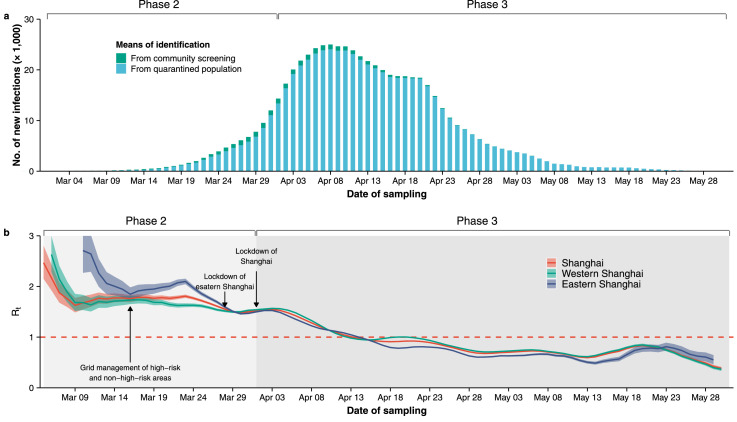
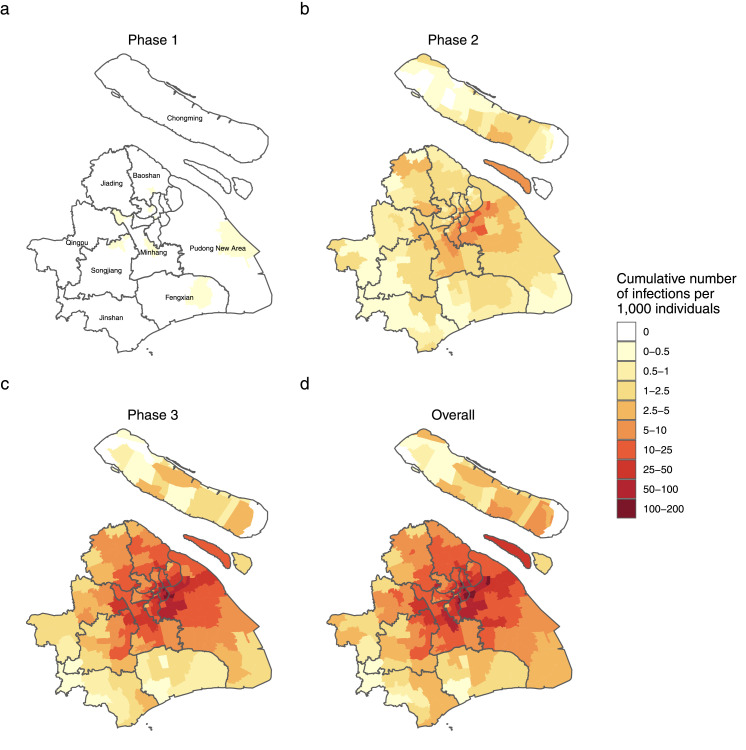
A surge in imported infections in Phase 1 triggered cryptic local transmission of the Omicron variant in early March, resulting in the largest outbreak in mainland China since the original wave. A total of 626,000 SARS-CoV-2 infections were reported in 99.5% (215/216) of the subdistricts of Shanghai until the end of May. The spatial distribution of the infections was highly heterogeneous, with 37% of the subdistricts accounting for 80% of all infections. A clear trend from the city center towards adjacent suburban and rural areas was observed, with a progressive slowdown of the epidemic spread (from 463 to 244 meters/day) prior to the citywide lockdown. During Phase 2, remained well above 1 despite the implementation of multiple targeted interventions. The citywide lockdown imposed on April 1 led to a marked decrease in transmission, bringing below the epidemic threshold in the entire city on April 14 and ultimately leading to containment of the outbreak.
Our results highlight the risk of widespread outbreaks in mainland China, particularly under the heightened pressure of imported infections. The targeted interventions adopted in March 2022 were not capable of halting transmission, and the implementation of a strict, prolonged city-wide lockdown was needed to successfully contain the outbreak, highlighting the challenges for containing Omicron outbreaks.
Key Program of the National Natural Science Foundation of China (82130093); Shanghai Rising-Star Program (22QA1402300).
2022年3月初,严重急性呼吸综合征冠状病毒2(SARS-CoV-2)奥密克戎变种的一次大规模疫情在中国上海迅速蔓延。在此,我们旨在描述在上海实施的基于人群的筛查和封控政策下奥密克戎疫情的流行病学特征及时空传播动态。
我们提取了2022年1月1日至5月31日期间报告的SARS-CoV-2感染的个体信息以及所采取的非药物干预措施的时间线。疫情分为三个阶段:i)散发病例(1月1日至2月28日),ii)局部传播(3月1日至3月31日),以及iii)全市封控(4月1日至5月31日)。我们描述了这三个阶段的疫情传播情况以及感染在街道层面的时空分布。为评估在第2阶段采取的针对性干预措施和第3阶段全市封控对SARS-CoV-2传播的影响,我们估计了净繁殖数( )的动态变化。
第1阶段输入性感染激增引发了3月初奥密克戎变种的隐匿性局部传播,导致中国大陆自疫情最初波次以来最大规模的疫情爆发。截至5月底,上海99.5%(215/216)的街道共报告了62.6万例SARS-CoV-2感染病例。感染的空间分布高度不均一,37%的街道占所有感染病例的80%。观察到从市中心向相邻郊区和农村地区的明显趋势,在全市封控前疫情传播逐渐放缓(从每天463米降至244米)。在第2阶段,尽管实施了多项针对性干预措施, 仍远高于1。4月1日实施的全市封控导致传播显著下降,4月14日全市 降至疫情阈值以下,最终疫情得到控制。
我们的结果凸显了中国大陆广泛爆发疫情的风险,特别是在输入性感染压力增大的情况下。2022年3月采取的针对性干预措施无法阻止传播,需要实施严格、持久的全市封控才能成功控制疫情,凸显了控制奥密克戎疫情的挑战。
国家自然科学基金重点项目(82130093);上海市启明星计划(22QA1402300)。