Duan Shaojie, Ren Zhiying, Xia Hui, Wang Ziyao, Zheng Tao, Liu Zunjing
Graduate School of Beijing University of Chinese Medicine, Beijing, China.
Department of Neurology, China-Japan Friendship Hospital, Beijing, China.
Front Neurol. 2022 Aug 26;13:955298. doi: 10.3389/fneur.2022.955298. eCollection 2022.
The relationship between sleep and migraine is well known to be bidirectional. However, few studies have systematically assessed the association between sleep quality and the risk of developing migraine, and its gender and age differences are unclear. And there is currently limited evidence on the associations between sleep quality and migraine-related burdens.
The objectives of this study were to: (1) explore the association between sleep quality and the risk of developing migraine, and its gender and age differences; (2) investigate the associations between sleep quality and the total pain burden, severity, disability, headache impact, quality of life, anxiety, and depression of migraine patients.
This study consecutively enrolled 134 migraine patients and 70 sex- and age-matched healthy control subjects. Sleep quality was assessed through the Pittsburgh Sleep Quality Index (PSQI). Logistic regression and linear regression analyses were used to explore the associations between sleep quality with the risk of developing migraine and the migraine-related burdens.
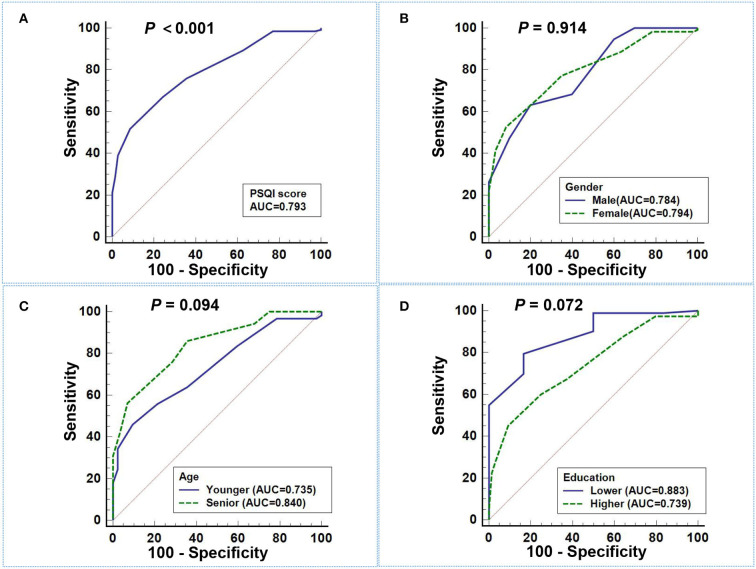
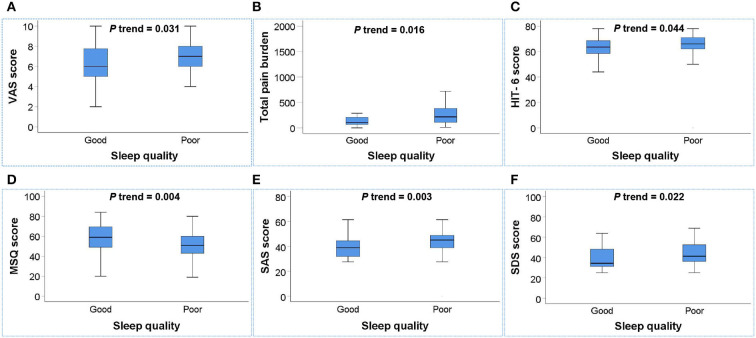
The prevalence of poor sleep quality in migraine patients was significantly higher than that in subjects without migraine ( < 0.001). After adjusting for various confounding factors, the risk of migraine with poor sleep quality remained 3.981 times that of those with good sleep quality. The subgroup analysis showed that there were significant additive interactions between poor sleep quality and the risk of migraine in gender, age, and education level ( for interaction < 0.05), and the stronger correlations were found in females, populations with ages more than 35 years old, and with lower education levels. In addition, multivariate linear regression analysis showed that poor sleep quality was significantly and independently associated with the total pain burden, severity, headache impact, quality of life, anxiety, and depression in migraine patients ( trend < 0.05).
Poor sleep quality was significantly independently associated with an increased risk of developing migraine and the migraine-related burdens. Strengthening PSQI assessment is valuable for the early prevention and treatment of migraine patients.
睡眠与偏头痛之间的关系是众所周知的双向关系。然而,很少有研究系统地评估睡眠质量与偏头痛发病风险之间的关联,其性别和年龄差异尚不清楚。目前关于睡眠质量与偏头痛相关负担之间关联的证据有限。
本研究的目的是:(1)探讨睡眠质量与偏头痛发病风险之间的关联及其性别和年龄差异;(2)研究睡眠质量与偏头痛患者的总疼痛负担、严重程度、残疾程度、头痛影响、生活质量、焦虑和抑郁之间的关联。
本研究连续纳入了134例偏头痛患者和70例性别及年龄匹配的健康对照者。通过匹兹堡睡眠质量指数(PSQI)评估睡眠质量。采用逻辑回归和线性回归分析来探讨睡眠质量与偏头痛发病风险及偏头痛相关负担之间的关联。
偏头痛患者睡眠质量差的患病率显著高于无偏头痛的受试者(<0.001)。在调整各种混杂因素后,睡眠质量差的偏头痛风险仍是睡眠质量好的患者的3.981倍。亚组分析表明,睡眠质量差与偏头痛风险在性别、年龄和教育水平方面存在显著的相加交互作用(交互作用P<0.05),且在女性、年龄大于35岁的人群和教育水平较低的人群中相关性更强。此外,多因素线性回归分析表明,睡眠质量差与偏头痛患者的总疼痛负担、严重程度、头痛影响、生活质量、焦虑和抑郁显著且独立相关(趋势P<0.05)。
睡眠质量差与偏头痛发病风险增加及偏头痛相关负担显著独立相关。加强PSQI评估对偏头痛患者的早期预防和治疗具有重要价值。