Mehdizadeh Milad, Fallah Zavareh Mohsen, Nordfjaern Trond
Norwegian University of Science and Technology (NTNU), Department of Psychology, Trondheim, Norway.
Kharazmi University, Department of Civil Engineering, Faculty of Engineering, Tehran, Iran.
J Transp Health. 2022 Sep;26:101390. doi: 10.1016/j.jth.2022.101390. Epub 2022 May 13.
The present study investigated the extent of reduction in the generation of non-essential trips (i.e., for shopping, personal, social, and entertainment reasons) due to the COVID-19 pandemic and the role of psychological factors (including deliberate planning and personal moral obligations) in explaining the change.
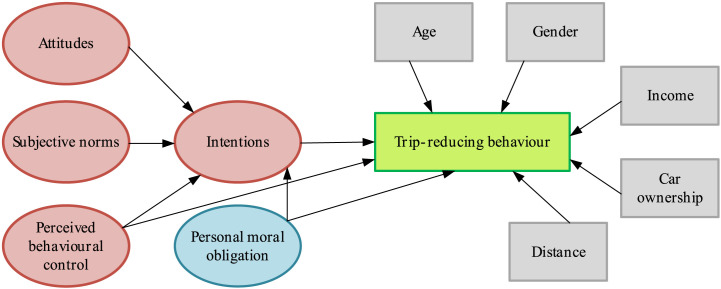
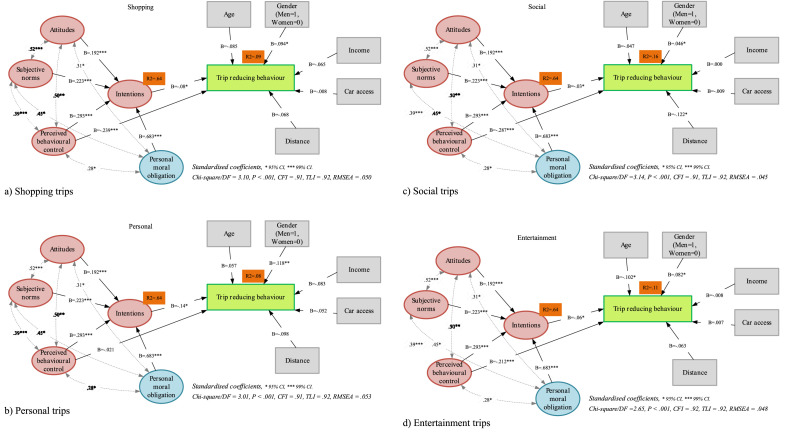
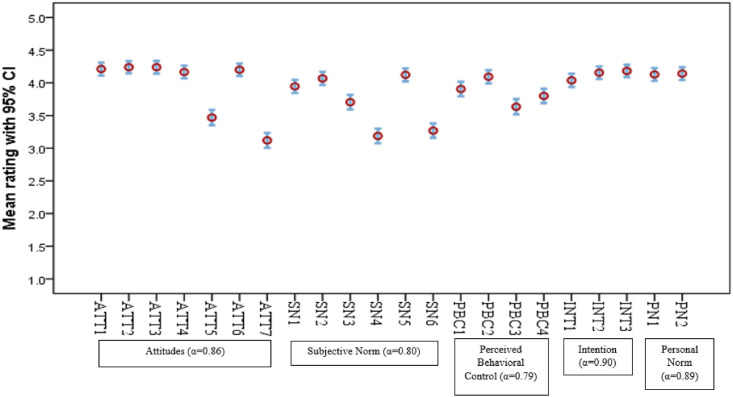
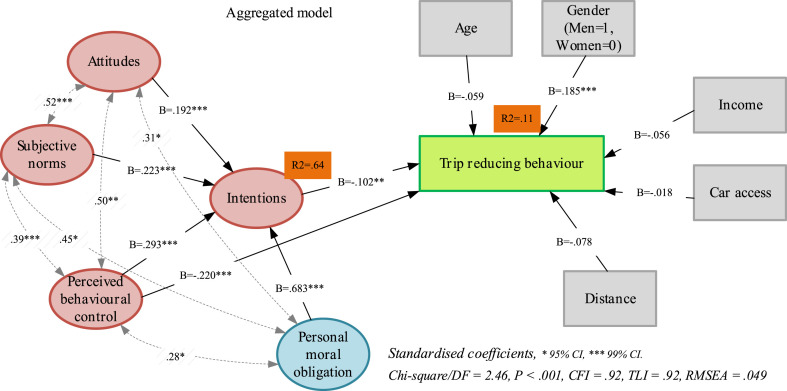
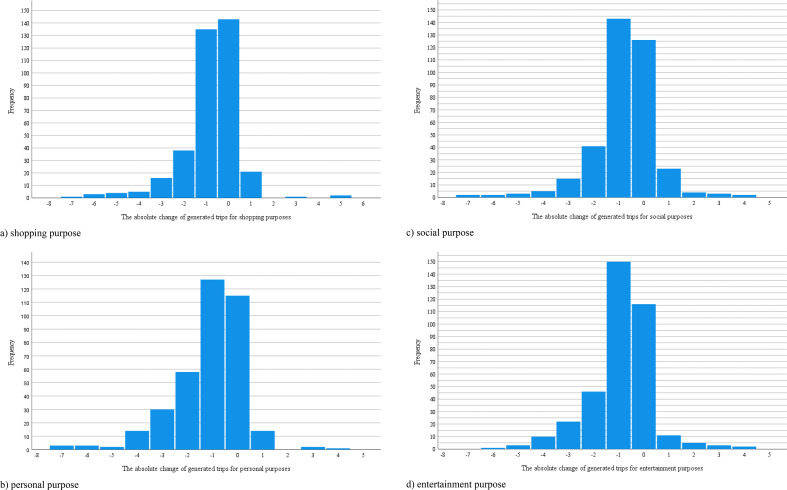
We collected data through an internet survey conducted from April to June 2020. We recruited the respondents (N = 369) from a young segment of the population in Iran. The hypothesised model framework included the components of the theory of planned behaviour (including attitudes, subjective norms, perceived behavioural control, and intention to reduce non-essential trips) along with personal moral obligation. The framework also consisted of socio-demographic characteristics of age, gender, income, car ownership and trip distance. A structural equation model was developed to explain trip reduction at an aggregated level for four non-essential trip purposes (i.e., shopping, personal, social, and entertainment). In the aggregated model, trip-reducing behaviour represents the change in the number of trips for all non-essential purposes. We also tested the same framework, to explain trip reduction for each of the trip purposes, separately.
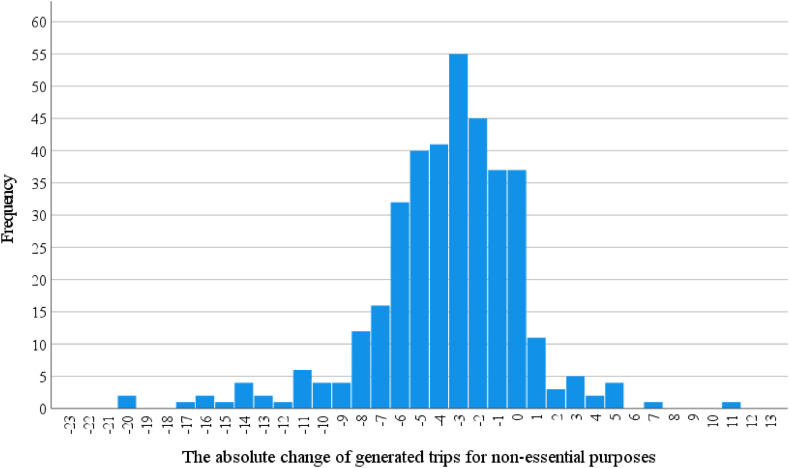
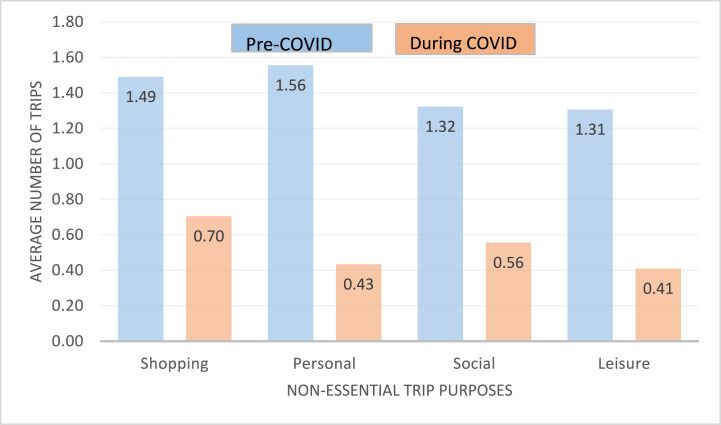
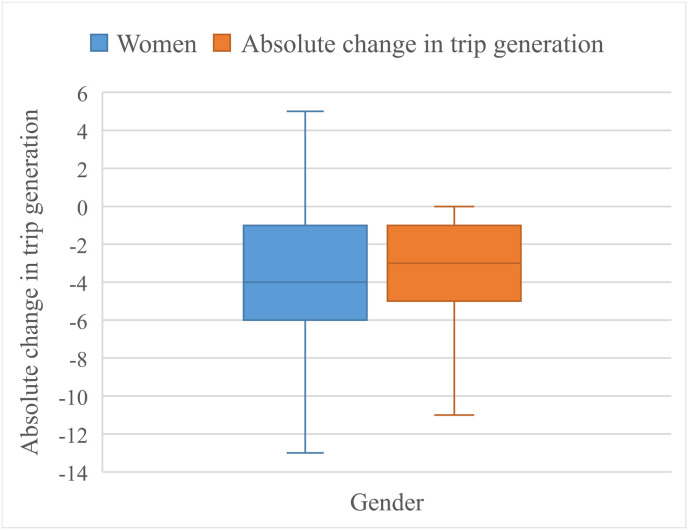
On average, the study participants reduced their non-essential trips by 60% during the pandemic compared with in the pre-COVID-19 period. Men were less likely than women to reduce the rate of their trips during the pandemic. The SEM demonstrated that the theory of planned behaviour predicted trip-generation behaviour during the abnormal situation represented by the pandemic. Perceived behavioural control both directly and indirectly impacted trip reduction. However, personal moral obligations failed to provide a direct explanation for trip generation reduction. According to the hypothesised model, the results for different trip purposes were also mostly in line with those from the aggregated model.
The findings imply that participants in our sample made deliberate and planned psychological decisions (aligned with the theory of planned behaviour) regarding potential travel behavioural decisions during the COVID-19 pandemic. The findings also highlighted that perceived behavioural control grows in importance alongside growth in difficult circumstances.
本研究调查了由于新冠疫情导致的非必要出行(即出于购物、个人、社交和娱乐原因的出行)减少的程度,以及心理因素(包括刻意规划和个人道德义务)在解释这种变化中所起的作用。
我们通过2020年4月至6月进行的一项网络调查收集数据。我们从伊朗年轻人群体中招募了受访者(N = 369)。假设的模型框架包括计划行为理论的组成部分(包括态度、主观规范、感知行为控制以及减少非必要出行的意图)以及个人道德义务。该框架还包括年龄、性别、收入、汽车拥有情况和出行距离等社会人口特征。我们开发了一个结构方程模型,以在总体层面解释四种非必要出行目的(即购物、个人、社交和娱乐)的出行减少情况。在总体模型中,减少出行行为代表所有非必要目的出行次数的变化。我们还分别测试了相同的框架,以解释每种出行目的的出行减少情况。
平均而言,与新冠疫情前相比,研究参与者在疫情期间将非必要出行减少了60%。在疫情期间,男性减少出行率的可能性低于女性。结构方程模型表明,计划行为理论预测了疫情所代表的异常情况下的出行生成行为。感知行为控制直接和间接地影响了出行减少。然而,个人道德义务未能直接解释出行生成减少的情况。根据假设模型,不同出行目的的结果也大多与总体模型的结果一致。
研究结果表明,我们样本中的参与者在新冠疫情期间就潜在的出行行为决策做出了刻意和有计划的心理决策(与计划行为理论一致)。研究结果还强调,随着困难情况的增加,感知行为控制的重要性也在增加。