• 文献检索
  • 文档翻译
  • 深度研究
  • 学术资讯
  • Suppr Zotero 插件Zotero 插件
  • 邀请有礼
  • 套餐&价格
  • 历史记录
应用&插件
Suppr Zotero 插件Zotero 插件浏览器插件Mac 客户端Windows 客户端微信小程序
定价
高级版会员购买积分包购买API积分包
服务
文献检索文档翻译深度研究API 文档MCP 服务
关于我们
关于 Suppr公司介绍联系我们用户协议隐私条款
关注我们

Suppr 超能文献

核心技术专利:CN118964589B侵权必究
粤ICP备2023148730 号-1Suppr @ 2026

文献检索

告别复杂PubMed语法,用中文像聊天一样搜索,搜遍4000万医学文献。AI智能推荐,让科研检索更轻松。

立即免费搜索

文件翻译

保留排版,准确专业,支持PDF/Word/PPT等文件格式,支持 12+语言互译。

免费翻译文档

深度研究

AI帮你快速写综述,25分钟生成高质量综述,智能提取关键信息,辅助科研写作。

立即免费体验

新冠病毒感染患者的化学感觉功能障碍与炎症生物标志物之间的关联:系统评价和荟萃分析。

Association between chemosensory dysfunctions and inflammatory biomarkers in patients with SARS-CoV-2 infection: a systematic review and meta-analysis.

机构信息

Graduate Program in Dentistry, Hospital Universitário, Federal University of Sergipe, Rua Cláudio Batista, s/n. Sanatório, Aracaju, Sergipe, CEP: 49060-100, Brazil.

Investigative Pathology Laboratory, Federal University of Sergipe, Aracaju, Sergipe, Brazil.

出版信息

Inflammopharmacology. 2022 Dec;30(6):2079-2087. doi: 10.1007/s10787-022-01066-z. Epub 2022 Sep 12.

DOI:10.1007/s10787-022-01066-z
PMID:36097300
原文链接:https://pmc.ncbi.nlm.nih.gov/articles/PMC9467422/
Abstract

BACKGROUND

There is evidence that chemosensory dysfunctions, including smell and taste disorders, are common findings in patients with SARS-CoV-2 infection. However, the underlying biological mechanisms and the role of inflammatory markers are still poorly understood.

AIM

To investigate the inflammatory biomarkers levels in patients with COVID-19 presenting chemosensory dysfunctions.

METHODS

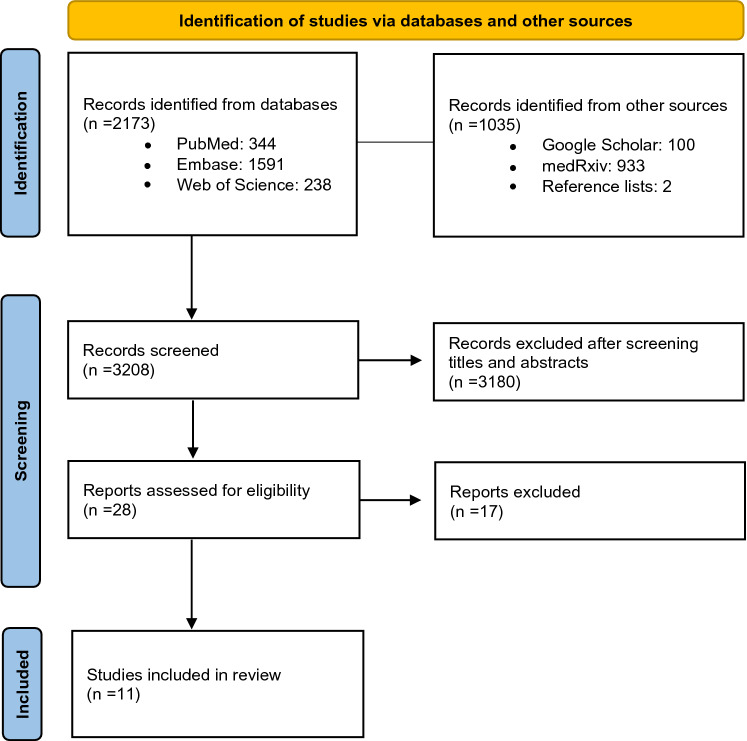
This review was conducted according to the Preferred Reporting Items for Systematic Reviews and Meta-Analyses (PRISMA) guideline. A systematic literature search was performed from January 1, 2020, to May 12, 2022. Observational studies that provided data on hematological, biochemical, infection-related indices and cellular immunity, and coagulation function in patients with COVID-19 experiencing smell and/or taste disorders were considered eligible. Effect sizes were reported as standardized mean difference (SMD) with 95% confidence intervals (CI). A negative effect size indicated that the inflammatory biomarker levels were lower among patients with chemosensory dysfunctions.

RESULTS

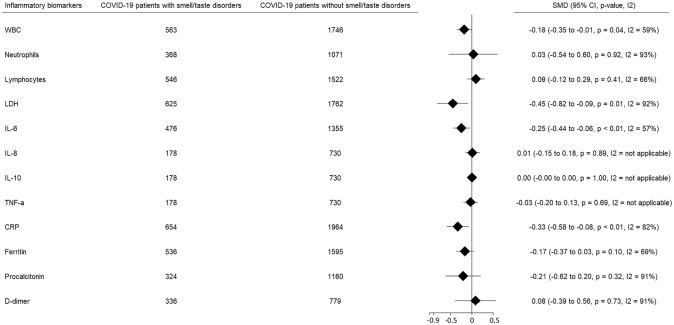
Eleven studies were included. Patients with chemosensory disturbances had lower levels of leukocytes (SMD - 0.18, 95% CI - 0.35 to - 0.01, p = 0.04), lactate dehydrogenase (SMD - 0.45, 95% CI - 0.82 to - 0.09, p = 0.01), IL-6 (SMD - 0.25, 95% CI - 0.44 to - 0.06, p < 0.01), and C-reactive protein (SMD - 0.33, 95% CI - 0.58 to - 0.08, p < 0.01) than patients without chemosensory disturbances.

CONCLUSION

Patients with SARS-CoV-2 infection who have olfactory and gustatory disorders have a lower inflammatory response than patients who do not have chemosensory alterations. The presence of these symptoms may indicate a more favorable clinical course for COVID-19.

摘要

背景

有证据表明,包括嗅觉和味觉障碍在内的化学感觉功能障碍是 SARS-CoV-2 感染患者的常见发现。然而,其潜在的生物学机制和炎症标志物的作用仍知之甚少。

目的

研究出现化学感觉功能障碍的 COVID-19 患者的炎症生物标志物水平。

方法

本综述按照系统评价和荟萃分析的首选报告项目(PRISMA)指南进行。从 2020 年 1 月 1 日至 2022 年 5 月 12 日进行了系统的文献检索。纳入的观察性研究提供了 COVID-19 患者出现嗅觉和/或味觉障碍时的血液学、生化、感染相关指标以及细胞免疫和凝血功能数据。效应量以标准化均数差(SMD)和 95%置信区间(CI)表示。负的效应量表示化学感觉功能障碍患者的炎症生物标志物水平较低。

结果

共纳入 11 项研究。与无化学感觉障碍的患者相比,有化学感觉障碍的患者白细胞(SMD -0.18,95%CI -0.35 至 -0.01,p=0.04)、乳酸脱氢酶(SMD -0.45,95%CI -0.82 至 -0.09,p=0.01)、IL-6(SMD -0.25,95%CI -0.44 至 -0.06,p<0.01)和 C 反应蛋白(SMD -0.33,95%CI -0.58 至 -0.08,p<0.01)水平较低。

结论

与无化学感觉障碍的 SARS-CoV-2 感染患者相比,出现嗅觉和味觉障碍的患者炎症反应较低。这些症状的存在可能表明 COVID-19 的临床病程更有利。
https://cdn.ncbi.nlm.nih.gov/pmc/blobs/cbf8/9467422/35b5b9a7e73f/10787_2022_1066_Fig2_HTML.jpg
https://cdn.ncbi.nlm.nih.gov/pmc/blobs/cbf8/9467422/e2d1317fb034/10787_2022_1066_Fig1_HTML.jpg
https://cdn.ncbi.nlm.nih.gov/pmc/blobs/cbf8/9467422/35b5b9a7e73f/10787_2022_1066_Fig2_HTML.jpg
https://cdn.ncbi.nlm.nih.gov/pmc/blobs/cbf8/9467422/e2d1317fb034/10787_2022_1066_Fig1_HTML.jpg
https://cdn.ncbi.nlm.nih.gov/pmc/blobs/cbf8/9467422/35b5b9a7e73f/10787_2022_1066_Fig2_HTML.jpg

相似文献

1
Association between chemosensory dysfunctions and inflammatory biomarkers in patients with SARS-CoV-2 infection: a systematic review and meta-analysis.新冠病毒感染患者的化学感觉功能障碍与炎症生物标志物之间的关联:系统评价和荟萃分析。
Inflammopharmacology. 2022 Dec;30(6):2079-2087. doi: 10.1007/s10787-022-01066-z. Epub 2022 Sep 12.
2
[Incidence and prognosis of olfactory and gustatory dysfunctions related to infection of SARS-CoV-2 Omicron strain: a national multi-center survey of 35 566 population].[新型冠状病毒奥密克戎毒株感染相关嗅觉和味觉功能障碍的发病率及预后:一项针对35566人的全国多中心调查]
Zhonghua Er Bi Yan Hou Tou Jing Wai Ke Za Zhi. 2023 Jun 7;58(6):579-588. doi: 10.3760/cma.j.cn115330-20230316-00117.
3
Taste and smell as chemosensory dysfunctions in COVID-19 infection.味觉和嗅觉作为新冠病毒感染中的化学感觉功能障碍
Am J Dent. 2020 Jun;33(3):135-137.
4
Association of chemosensory dysfunction and COVID-19 in patients presenting with influenza-like symptoms.味觉和嗅觉功能障碍与以流感样症状就诊的 COVID-19 患者的关联。
Int Forum Allergy Rhinol. 2020 Jul;10(7):806-813. doi: 10.1002/alr.22579. Epub 2020 Jun 1.
5
Decrease and Recovery of Olfactory and Gustatory Function in a Case of SARS-CoV-2 Infection.SARS-CoV-2 感染病例中嗅觉和味觉功能的减退与恢复。
ORL J Otorhinolaryngol Relat Spec. 2021;83(2):130-134. doi: 10.1159/000512875. Epub 2020 Dec 2.
6
Covid-19 affects taste independent of taste-smell confusions: results from a combined chemosensory home test and online survey from a large global cohort.Covid-19 对味觉的影响独立于味觉-嗅觉混淆:来自大型全球队列的联合化学感觉家庭测试和在线调查的结果。
Chem Senses. 2023 Jan 1;48. doi: 10.1093/chemse/bjad020.
7
Post-COVID-19 patients suffer from chemosensory, trigeminal, and salivary dysfunctions.新冠后患者会遭受嗅觉味觉、三叉神经和唾液腺功能紊乱。
Sci Rep. 2024 Feb 11;14(1):3455. doi: 10.1038/s41598-024-53919-y.
8
Chemosensory deficits are best predictor of serologic response among individuals infected with SARS-CoV-2.在感染 SARS-CoV-2 的个体中,化学感觉缺陷是血清学反应的最佳预测指标。
PLoS One. 2022 Dec 14;17(12):e0274611. doi: 10.1371/journal.pone.0274611. eCollection 2022.
9
Risk Factors for Olfactory and Gustatory Dysfunctions in Patients with SARS-CoV-2 Infection.SARS-CoV-2 感染患者嗅觉和味觉功能障碍的危险因素。
Neuroepidemiology. 2021;55(2):154-161. doi: 10.1159/000514888. Epub 2021 Apr 1.
10
Smell and taste disorders in COVID-19: From pathogenesis to clinical features and outcomes.新型冠状病毒肺炎相关的嗅觉和味觉障碍:从发病机制到临床特征和结局。
Neurosci Lett. 2021 Mar 23;748:135694. doi: 10.1016/j.neulet.2021.135694. Epub 2021 Feb 15.

引用本文的文献

1
Neurological manifestations of acute SARS-CoV-2 infection in a reference hospital in Bahia, Brazil.巴西巴伊亚州一家参考医院中急性SARS-CoV-2感染的神经学表现
Braz J Infect Dis. 2025 May 26;29(4):104542. doi: 10.1016/j.bjid.2025.104542.
2
Clinical presentations, systemic inflammation response and ANDC scores in hospitalized patients with COVID-19.COVID-19 住院患者的临床表现、全身炎症反应和 ANDC 评分。
Sci Rep. 2024 Sep 28;14(1):22480. doi: 10.1038/s41598-024-73001-x.
3
Differentiation of Prior SARS-CoV-2 Infection and Postacute Sequelae by Standard Clinical Laboratory Measurements in the RECOVER Cohort.

本文引用的文献

1
Prevalence of olfactory dysfunction and quality of life in hospitalised patients 1 year after SARS-CoV-2 infection: a cohort study.SARS-CoV-2 感染 1 年后住院患者嗅觉功能障碍及生活质量的患病率:一项队列研究。
BMJ Open. 2022 Jan 25;12(1):e054598. doi: 10.1136/bmjopen-2021-054598.
2
Loss of Smell in COVID-19 Patients: New Biomarkers.新冠患者的嗅觉丧失:新的生物标志物
Indian J Otolaryngol Head Neck Surg. 2022 Oct;74(Suppl 2):3167-3172. doi: 10.1007/s12070-021-02892-3. Epub 2021 Oct 7.
3
COVID-19 in young and middle-aged adults: predictors of poor outcome and clinical differences.
RECOVER 队列中通过标准临床实验室测量对 SARS-CoV-2 既往感染和急性后期后遗症的区分。
Ann Intern Med. 2024 Sep;177(9):1209-1221. doi: 10.7326/M24-0737. Epub 2024 Aug 13.
4
Long-term effects of SARS-CoV-2 infection in patients with and without chemosensory disorders at disease onset: a psychophysical and magnetic resonance imaging exploratory study.发病时伴有和不伴有化学感觉障碍的 SARS-CoV-2 感染患者的长期影响:一项心理物理学和磁共振成像探索性研究。
Neurol Sci. 2024 Jun;45(6):2409-2418. doi: 10.1007/s10072-024-07429-4. Epub 2024 Mar 5.
5
The immune mechanism of the nasal epithelium in COVID-19-related olfactory dysfunction.COVID-19 相关嗅觉功能障碍中鼻上皮的免疫机制。
Front Immunol. 2023 Jul 17;14:1045009. doi: 10.3389/fimmu.2023.1045009. eCollection 2023.
6
Prevalence of Self-Reported Anosmia and Ageusia in Elderly Patients Who Had Been Previously Hospitalized by SARS-CoV-2: The LONG-COVID-EXP Multicenter Study.曾因感染新型冠状病毒严重急性呼吸综合征(SARS-CoV-2)而住院的老年患者中自我报告的嗅觉丧失和味觉丧失的患病率:长期新冠后遗症多中心研究
J Clin Med. 2023 Jun 29;12(13):4391. doi: 10.3390/jcm12134391.
7
Acute and long-term immune responses to SARS-CoV-2 infection in unvaccinated children and young adults with inborn errors of immunity.未接种疫苗的先天性免疫缺陷儿童和年轻人中对 SARS-CoV-2 感染的急性和长期免疫反应。
Front Immunol. 2023 Jan 20;14:1084630. doi: 10.3389/fimmu.2023.1084630. eCollection 2023.
COVID-19 在年轻和中年人群中的表现:不良预后的预测因素和临床差异。
Infection. 2022 Feb;50(1):179-189. doi: 10.1007/s15010-021-01684-9. Epub 2021 Aug 31.
4
Correlation of olfactory dysfunction with lung involvement and severity of COVID-19.嗅觉功能障碍与 COVID-19 肺部受累及严重程度的相关性。
Ir J Med Sci. 2022 Aug;191(4):1843-1848. doi: 10.1007/s11845-021-02732-x. Epub 2021 Aug 10.
5
Association Between Olfactory Dysfunction and Critical Illness and Mortality in COVID-19: A Meta-analysis.嗅觉功能障碍与 COVID-19 危重症及死亡率之间的关联:一项荟萃分析。
Otolaryngol Head Neck Surg. 2022 Feb;166(2):388-392. doi: 10.1177/01945998211017442. Epub 2021 May 25.
6
Olfactory and gustatory dysfunctions in SARS-CoV-2 infection: A systematic review.新型冠状病毒感染中的嗅觉和味觉功能障碍:一项系统综述。
Brain Behav Immun Health. 2021 Aug;15:100268. doi: 10.1016/j.bbih.2021.100268. Epub 2021 May 18.
7
COVID-19-Induced Anosmia and Ageusia Are Associated With Younger Age and Lower Blood Eosinophil Counts.COVID-19 引起的嗅觉丧失和味觉丧失与年龄较小和血嗜酸性粒细胞计数较低有关。
Am J Rhinol Allergy. 2021 Nov;35(6):830-839. doi: 10.1177/19458924211004800. Epub 2021 Apr 4.
8
Role of interleukin 6 as a predictive factor for a severe course of Covid-19: retrospective data analysis of patients from a long-term care facility during Covid-19 outbreak.白细胞介素 6 作为 COVID-19 重症病程预测因子的作用:COVID-19 爆发期间长期护理机构患者的回顾性数据分析。
BMC Infect Dis. 2021 Mar 29;21(1):308. doi: 10.1186/s12879-021-05945-8.
9
Self-reported Taste and Smell Disorders in Patients with COVID-19: Distinct Features in China.新冠病毒患者自报的味觉和嗅觉障碍:中国的独特特征。
Curr Med Sci. 2021 Feb;41(1):14-23. doi: 10.1007/s11596-021-2312-7. Epub 2021 Feb 13.
10
The relation between serum D-dimer, ferritin and vitamin D levels, and dysgeusia symptoms, in patients with coronavirus disease 2019.血清 D-二聚体、铁蛋白和维生素 D 水平与 2019 年冠状病毒病患者味觉障碍症状的关系。
J Laryngol Otol. 2021 Jan;135(1):45-49. doi: 10.1017/S0022215120002765. Epub 2021 Jan 7.