Global Programs, Canadian Red Cross, Ottawa, Canada.
Department of International Health, Johns Hopkins Bloomberg School of Public Health, Johns Hopkins University, Baltimore, Maryland, USA.
Glob Health Action. 2022 Jun 30;15(sup1):2006424. doi: 10.1080/16549716.2021.2006424.
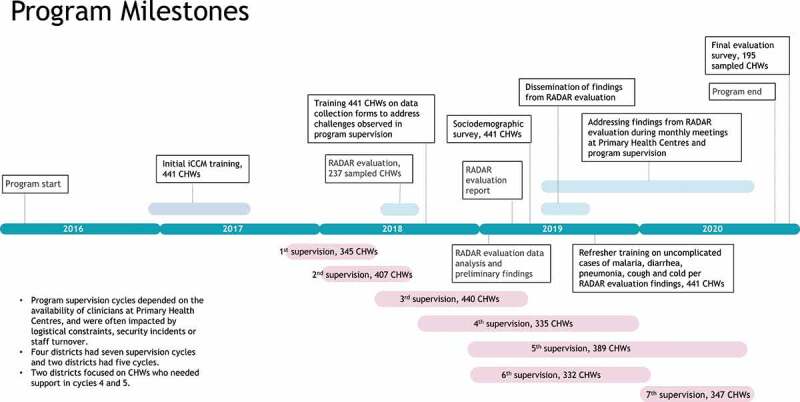
Many countries have adopted integrated community case management (iCCM) to reduce mortality among children under five years from common childhood illnesses. The 2016-2020 Malian Red Cross iCCM program trained 441 Community Health Workers (CHWs) to treat malaria, pneumonia, diarrhea, and malnutrition for children under five years of age in six districts. Implementation strength and quality of care (QoC) were assessed through the program's supervision function, using the Malian Ministry of Health's system.
This paper compares methods and results of program supervision data and an independent evaluation to assess the effectiveness of program implementation and supervision and inform program improvement. It also presents the benefits and limitations of each method.
An independent QoC evaluation was conducted using tools developed by the Real Accountability: Data Analysis for Results (RADAR) project, hereafter referred to as the . RADAR evaluation data collected in July and August 2018 were compared with program supervision data collected mostly between May and December 2018.
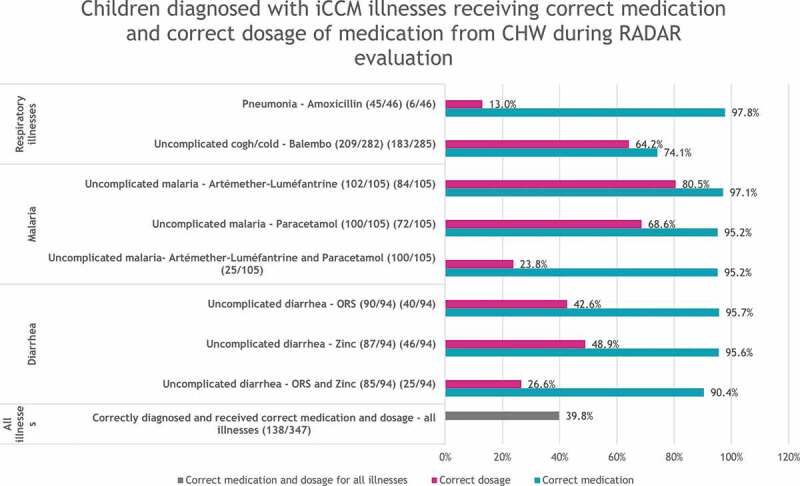
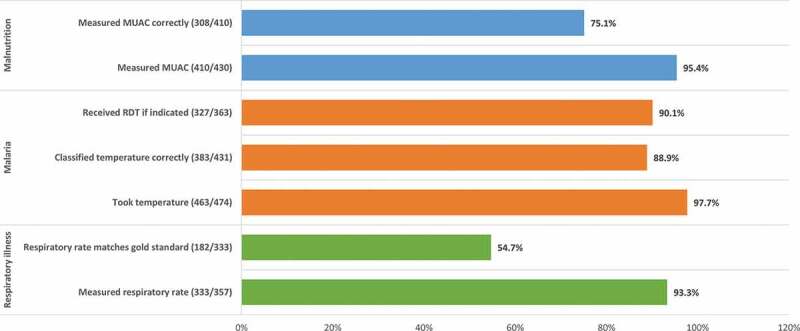
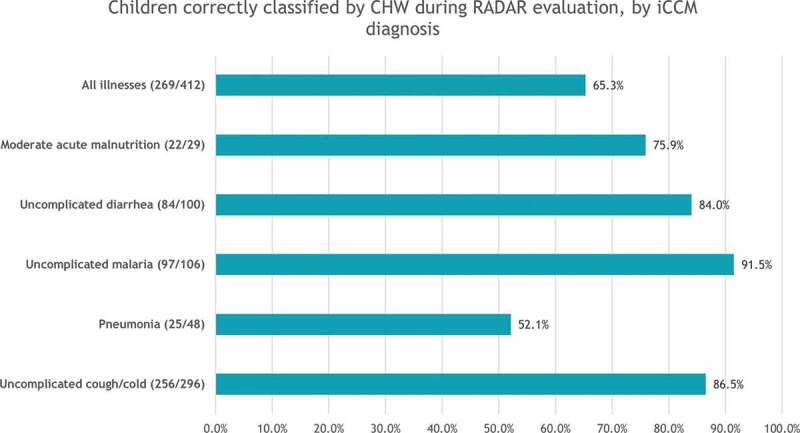
The RADAR evaluation provided detailed findings on correct assessment, classification, and treatment per illness, medication type, and dosage. Program supervision combined the findings for all illnesses, medication type, and dosage due to limitations in the data collection process. Six indicators were comparable between both methods. Findings were similar for temperature and mid-upper arm circumference measurements but diverged between program supervision and the RADAR evaluation, respectively, on correct classification for all illnesses (87.1% vs. 65.3%), correct treatment for all illnesses (69.5% vs. 39.8%), correct respiratory rate counting (88.5% vs. 54.7%), and administering the first dose by CHW (75.4% vs. 65.0%). Findings from the RADAR evaluation guided improvements in program supervision.
A robust program supervision system can serve as a credible method to assess QoC. However, a rigorous independent QoC evaluation provides a valuable benchmark to gauge the effectiveness of the supervisory process.
许多国家已采用综合社区病例管理(iCCM)来降低五岁以下儿童因常见儿童疾病导致的死亡率。2016-2020 年期间,马里红十字会 iCCM 项目培训了 441 名社区卫生工作者(CHW),以治疗六个地区五岁以下儿童的疟疾、肺炎、腹泻和营养不良。通过该项目的监督职能,利用马里卫生部的系统,评估了实施力度和护理质量(QoC)。
本文比较了项目监督数据和独立评估的方法和结果,以评估方案实施和监督的效果,并为方案改进提供信息。本文还介绍了每种方法的优缺点。
使用 Real Accountability: Data Analysis for Results (RADAR) 项目开发的工具进行了独立的 QoC 评估,简称 RADAR 评估。2018 年 7 月和 8 月收集的 RADAR 评估数据与 2018 年 5 月至 12 月期间主要收集的项目监督数据进行了比较。
RADAR 评估提供了关于正确评估、分类和治疗每种疾病、药物类型和剂量的详细结果。由于数据收集过程的限制,项目监督综合了所有疾病、药物类型和剂量的结果。这两种方法有六个指标是可比的。温度和中上臂围的测量结果相似,但在所有疾病的正确分类(87.1%比 65.3%)、所有疾病的正确治疗(69.5%比 39.8%)、正确的呼吸频率计数(88.5%比 54.7%)和 CHW 首次给药(75.4%比 65.0%)方面,项目监督和 RADAR 评估的结果存在差异。RADAR 评估的结果为改进项目监督提供了指导。
一个健全的项目监督系统可以作为评估 QoC 的可靠方法。然而,严格的独立 QoC 评估为衡量监督过程的有效性提供了一个有价值的基准。