Graduate Institute of Injury Prevention and Control, Taipei Medical University, Taipei, Taiwan.
Department of Physical Medicine and Rehabilitation, Wan Fang Hospital, Taipei Medical University, Taipei, Taiwan.
J Neuroeng Rehabil. 2022 Sep 14;19(1):99. doi: 10.1186/s12984-022-01076-6.
Robot-assisted gait training (RAGT) is a practical treatment that can complement conventional rehabilitation by providing high-intensity repetitive training for patients with stroke. RAGT systems are usually either of the end-effector or exoskeleton types. We developed a novel hybrid RAGT system that leverages the advantages of both types.
This single-blind randomized controlled trial evaluated the beneficial effects of the novel RAGT system both immediately after the intervention and at the 3-month follow-up in nonambulatory patients with subacute stroke.
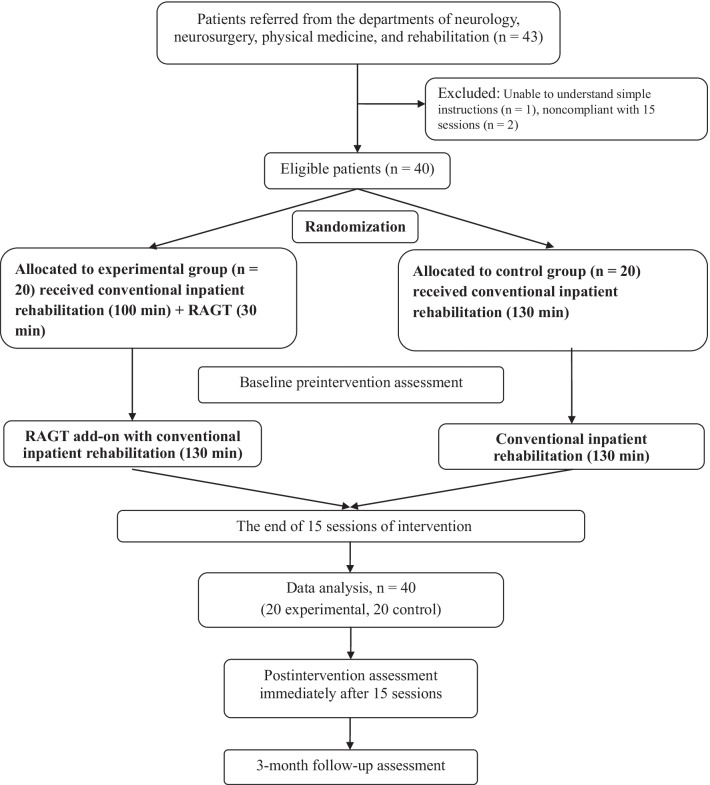
We recruited 40 patients with subacute stroke who were equally randomized to receive conventional rehabilitation either alone or with the addition of 15 RAGT sessions. We assessed lower-extremity motor function, balance, and gait performance by using the following tools: active range of motion (AROM), manual muscle test (MMT), the Fugl-Meyer Assessment (FMA) lower-extremity subscale (FMA-LE) and total (FMA-total), Postural Assessment Scale for Stroke (PASS), Berg Balance Scale (BBS), Tinetti Performance-Oriented Mobility Assessment (POMA) balance and gait subscores, and the 3-m and 6-m walking speed and Timed Up and Go (TUG) tests. These measurements were performed before and after the intervention and at the 3-month follow-up.
Both groups demonstrated significant within-group changes in the AROM, MMT, FMA-LE, FMA-total, PASS, BBS, POMA, TUG, and 3-m and 6-m walking speed tests before and after intervention and at the 3-month follow-up (p < 0.05). The RAGT group significantly outperformed the control group only in the FMA-LE (p = 0.014) and total (p = 0.002) assessments.
Although the novel hybrid RAGT is effective, strong evidence supporting its clinical effectiveness relative to controls in those with substantial leg dysfunction after stroke remains elusive. Trial registration The study was registered with an International Standard Randomized Controlled Trial Number, ISRCTN, ISRCTN15088682. Registered retrospectively on September 16, 2016, at https://www.isrctn.com/ISRCTN15088682.
机器人辅助步态训练(RAGT)是一种实用的治疗方法,可以通过为中风患者提供高强度重复训练来补充常规康复。RAGT 系统通常是末端执行器或外骨骼类型。我们开发了一种新型混合 RAGT 系统,利用了这两种类型的优势。
这项单盲随机对照试验评估了新型 RAGT 系统在亚急性中风非卧床患者中的干预即刻和 3 个月随访时的有益效果。
我们招募了 40 名亚急性中风患者,将他们平均随机分为接受常规康复治疗或在常规康复治疗的基础上增加 15 次 RAGT 治疗。我们使用以下工具评估下肢运动功能、平衡和步态表现:主动关节活动度(AROM)、徒手肌力测试(MMT)、Fugl-Meyer 评估(FMA)下肢子量表(FMA-LE)和总评分(FMA-total)、卒中姿势评估量表(PASS)、Berg 平衡量表(BBS)、Tinetti 运动表现移动评估量表(POMA)平衡和步态子评分以及 3 米和 6 米步行速度和计时起立行走测试(TUG)。这些测量在干预前后和 3 个月随访时进行。
两组患者在干预前后和 3 个月随访时的 AROM、MMT、FMA-LE、FMA-total、PASS、BBS、POMA、TUG 和 3 米和 6 米步行速度测试中均显示出组内显著变化(p<0.05)。RAGT 组仅在 FMA-LE(p=0.014)和总评分(p=0.002)评估中显著优于对照组。
虽然新型混合 RAGT 是有效的,但在中风后下肢功能严重障碍的患者中,相对于对照组,其临床有效性的有力证据仍然难以获得。
该研究在国际标准随机对照试验编号(ISRCTN)下注册,ISRCTN,ISRCTN15088682。于 2016 年 9 月 16 日在 https://www.isrctn.com/ISRCTN15088682 进行了回顾性注册。