Discipline of Paediatrics and Child Health, School of Clinical Medicine, UNSW Medicine & Health, UNSW Sydney, Kensington, NSW, Australia.
Behavioural Sciences Unit, Kids Cancer Centre, Sydney Children's Hospitala, High Street, Randwick, NSW, 2031, Australia.
BMC Cancer. 2022 Sep 15;22(1):985. doi: 10.1186/s12885-022-10072-x.
Pediatric acute lymphoblastic leukemia (ALL) therapy is accompanied by treatment-related toxicities (TRTs) and impaired quality of life. In Australia and New Zealand, children with ALL are treated with either Children's Oncology Group (COG) or international Berlin-Frankfurt-Munster (iBFM) Study Group-based therapy. We conducted a prospective registry study to document symptomatic TRTs (venous thrombosis, neurotoxicity, pancreatitis and bone toxicity), compare TRT outcomes to retrospective TRT data, and measure the impact of TRTs on children's general and cancer-related health-related quality of life (HRQoL) and parents' emotional well-being.
Parents of children with newly diagnosed ALL were invited to participate in the ASSET (Acute Lymphoblastic Leukaemia Subtypes and Side Effects from Treatment) study and a prospective, longitudinal HRQoL study. TRTs were reported prospectively and families completed questionnaires for general (Healthy Utility Index Mark 3) and cancer specific (Pediatric Quality of Life Inventory (PedsQL)-Cancer Module) health related quality of life as well the Emotion Thermometer to assess emotional well-being.
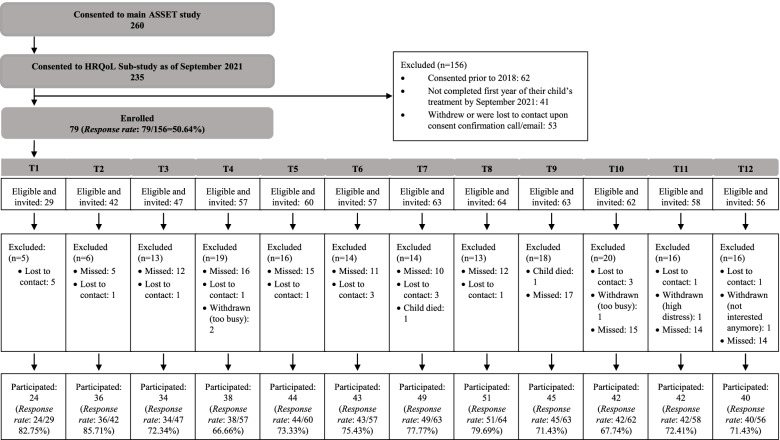
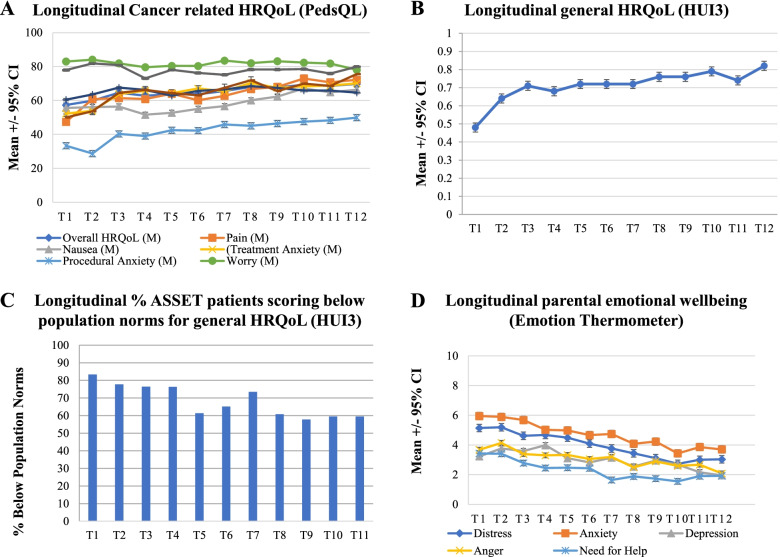
Beginning in 2016, 260 pediatric patients with ALL were enrolled on the TRT registry with a median age at diagnosis of 59 months (range 1-213 months), 144 males (55.4%), majority with Pre-B cell immunophenotype, n = 226 (86.9%), 173 patients (66.5%) treated according to COG platform with relatively equal distribution across risk classification sub-groups. From 2018, 79 families participated in the HRQoL study through the first year of treatment. There were 74 TRT recorded, reflecting a 28.5% risk of developing a TRT. Individual TRT incidence was consistent with previous studies, being 7.7% for symptomatic VTE, 11.9% neurotoxicity, 5.4% bone toxicity and 5.0% pancreatitis. Children's HRQoL was significantly lower than population norms throughout the first year of treatment. An improvement in general HRQoL, measured by the HUI3, contrasted with the lack of improvement in cancer-related HRQoL measured by the PedsQL Cancer Module over the first 12 months. There were no persisting differences in the HRQoL impact of COG compared to iBFM therapy.
It is feasible to prospectively monitor TRT incidence and longitudinal HRQoL impacts during ALL therapy. Early phases of ALL therapy, regardless of treatment platform, result in prolonged reductions in cancer-related HRQoL.
儿科急性淋巴细胞白血病(ALL)的治疗伴随着治疗相关毒性(TRTs)和生活质量受损。在澳大利亚和新西兰,ALL 患儿接受儿童肿瘤学组(COG)或国际柏林-法兰克福-明斯特(iBFM)研究组为基础的治疗。我们进行了一项前瞻性登记研究,以记录有症状的 TRTs(静脉血栓形成、神经毒性、胰腺炎和骨毒性),将 TRT 结果与回顾性 TRT 数据进行比较,并测量 TRTs 对儿童一般和癌症相关健康相关生活质量(HRQoL)和父母情绪健康的影响。
新诊断为 ALL 的儿童的父母被邀请参加 ASSET(急性淋巴细胞白血病亚型和治疗相关副作用)研究和一项前瞻性、纵向 HRQoL 研究。TRTs 被前瞻性报告,家庭完成了一般(健康效用指数标记 3)和癌症特定(儿科生活质量问卷(PedsQL)-癌症模块)健康相关生活质量的问卷,以及情绪温度计来评估情绪健康。
从 2016 年开始,共有 260 名 ALL 患儿入组 TRT 登记处,中位诊断年龄为 59 个月(范围 1-213 个月),144 名男性(55.4%),大多数为 Pre-B 细胞免疫表型,n=226(86.9%),173 名患者(66.5%)根据 COG 平台治疗,风险分类亚组分布相对均衡。从 2018 年开始,79 个家庭通过第一年的治疗参与了 HRQoL 研究。共记录了 74 例 TRT,反映了发生 TRT 的 28.5%风险。个别 TRT 的发生率与以往研究一致,症状性 VTE 为 7.7%,神经毒性为 11.9%,骨毒性为 5.4%,胰腺炎为 5.0%。在整个第一年的治疗过程中,儿童的 HRQoL 明显低于人群正常值。HUI3 测量的一般 HRQoL 改善与 PedsQL 癌症模块测量的癌症相关 HRQoL 在头 12 个月没有改善形成对比。COG 与 iBFM 治疗相比,HRQoL 影响没有持续差异。
前瞻性监测 ALL 治疗期间 TRT 发生率和纵向 HRQoL 影响是可行的。ALL 治疗的早期阶段,无论治疗平台如何,都会导致癌症相关 HRQoL 的长期降低。