Sun Jing, Liu Peng-Fei, Liu Jia-Ni, Lu Cong, Tong Li-Tao, Wang Yong-Quan, Liu Jia-Meng, Fan Bei, Wang Feng-Zhong
Risk Assessment Laboratory of Agricultural Products Processing Quality and Safety, Key Laboratory of Agricultural Products Quality and Safety Collection, Storage and Transportation Control (Ministry of Agriculture and Rural Affairs), Institute of Agricultural Products Processing, Chinese Academy of Agricultural Sciences, Beijing, China.
Agricultural Product Storage and Processing Institute, Gansu Academy of Agricultural Sciences, Lanzhou, China.
Front Pharmacol. 2022 Aug 30;13:948987. doi: 10.3389/fphar.2022.948987. eCollection 2022.
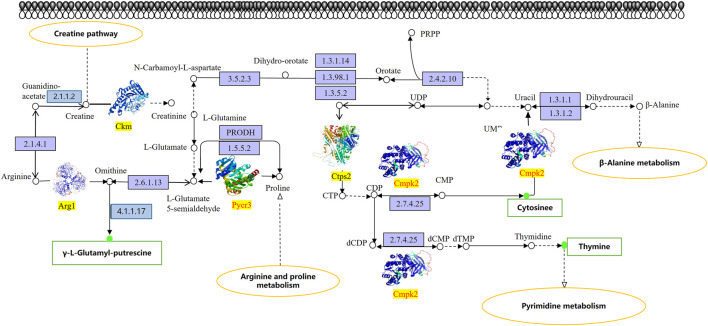
As a dietary and medicinal plant, (DF) is widely utilized in China for improving stomach disease for centuries. However, the underlying mechanisms against gastric mucosal injury have not been fully disclosed. Here, metabolomics and proteomics were integrated to clarify the in-depth molecular mechanisms using cyclophosphamide-induced gastric mucosal injury model in mice. As a result, three metabolic pathways, such as creatine metabolism, arginine and proline metabolism, and pyrimidine metabolism were hit contributing to DF protective benefits. Additionally, γ-L-glutamyl-putrescine, cytosine, and thymine might be the eligible biomarkers to reflect gastric mucosal injury tatus, and DF anti-gastric mucosal injury effects were mediated by the so-called target proteins such as Ckm, Arg1, Ctps2, Pycr3, and Cmpk2. This finding provided meaningful information for the molecular mechanisms of DF and also offered a promising strategy to clarify the therapeutic mechanisms of functional foods.
作为一种药食两用植物,(DF)在中国数百年间一直被广泛用于改善胃部疾病。然而,其抗胃黏膜损伤的潜在机制尚未完全阐明。在此,利用环磷酰胺诱导的小鼠胃黏膜损伤模型,整合代谢组学和蛋白质组学以阐明其深入的分子机制。结果发现,肌酸代谢、精氨酸和脯氨酸代谢以及嘧啶代谢这三条代谢途径受到影响,从而产生了DF的保护作用。此外,γ-L-谷氨酰腐胺、胞嘧啶和胸腺嘧啶可能是反映胃黏膜损伤状态的合适生物标志物,DF的抗胃黏膜损伤作用是由Ckm、Arg1、Ctps2、Pycr3和Cmpk2等所谓的靶蛋白介导的。这一发现为DF的分子机制提供了有意义的信息,也为阐明功能性食品的治疗机制提供了一个有前景的策略。