Wang Xiran, Zhao Jianling, Xiang Zhongzheng, Wang Xuetao, Zeng Yuanyuan, Luo Ting, Yan Xi, Zhang Zhuang, Wang Feng, Liu Lei
Department of Head and Neck and Mammary Oncology, West China Hospital, Sichuan University, Chengdu, China.
Department of Radiotherapy, West China Hospital, Sichuan University, Chengdu, China.
Front Oncol. 2022 Sep 2;12:964455. doi: 10.3389/fonc.2022.964455. eCollection 2022.
To investigate the values of a 3D-printed bolus ensuring the precise postmastectomy chest wall radiation therapy for breast cancer.
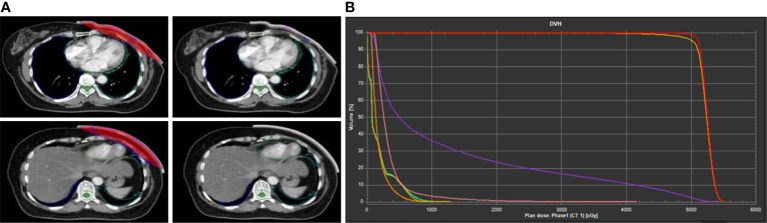
In the preclinical study on the anthropomorphic phantom, the 3D-printed bolus was used for dosimetry and fitness evaluation. The dosimetric parameters of planning target volume (PTV) were assessed, including D, D, D, D, homogeneity index (HI), conformity index (CI), and organs at risk (OARs). The absolute percentage differences (|%diff|) between the theory and fact skin dose were also estimated, and the follow-up was conducted for potential skin side effects.
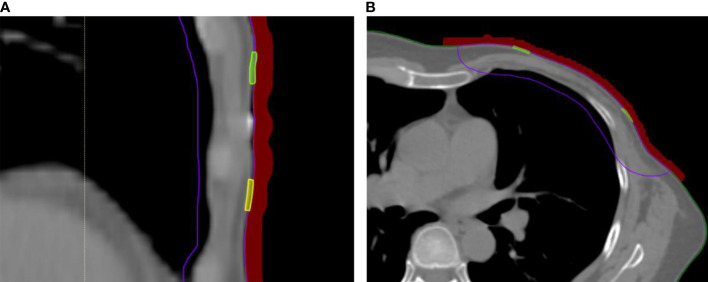
In preclinical studies, a 3D-printed bolus can better ensure the radiation coverage of PTV (HI 0.05, CI 99.91%), the dose accuracy (|%diff| 0.99%), and skin fitness (mean air gap 1.01 mm). Of the 27 eligible patients, we evaluated the radiation dose parameter (median(min-max): D 4967(4789-5099) cGy, D 5447(5369-5589) cGy, D 5236(5171-5323) cGy, D 5053(4936-5156) cGy, HI 0.07 (0.06-0.17), and CI 99.94% (97.41%-100%)) and assessed the dose of OARs (ipsilateral lung: D 1341(1208-1385) cGy, V 48.06%(39.75%-48.97%), V 24.55%(21.58%-26.93%), V 18.40%(15.96%-19.16%); heart: D 339(138-640) cGy, V 1.10%(0%-6.14%), V 0.38%(0%-4.39%); spinal cord PRV: D 639(389-898) cGy). The skin doses were D 208.85(203.16-212.53) cGy, D 209.53(204.14-214.42) cGy, and |%diff| 1.77% (0.89-2.94%). Of the 360 patients enrolled in the skin side effect follow-up study (including the above 27 patients), grade 1 was the most common toxicity (321, 89.2%), some of which progressing to grade 2 or grade 3 (32, 8.9% or 7, 1.9%); the radiotherapy interruption rate was 1.1%.
A 3D-printed bolus can guarantee the precise radiation dose on skin surface, good fitness to skin, and controllable acute skin toxicity, which possesses a great clinical application value in postmastectomy chest call radiation therapy for breast cancer.
探讨3D打印组织填充物在乳腺癌乳房切除术后胸壁精确放射治疗中的价值。
在人体模型的临床前研究中,3D打印组织填充物用于剂量测定和贴合度评估。评估计划靶区(PTV)的剂量学参数,包括D、D、D、D、均匀性指数(HI)、适形指数(CI)和危及器官(OARs)。还估计了理论与实际皮肤剂量之间的绝对百分比差异(|%diff|),并对潜在的皮肤副作用进行随访。
在临床前研究中,3D打印组织填充物能更好地确保PTV的放射覆盖(HI 0.05,CI 99.91%)、剂量准确性(|%diff| 0.99%)和皮肤贴合度(平均气隙1.01毫米)。在27例符合条件的患者中,我们评估了放射剂量参数(中位数(最小值-最大值):D 4967(4789-5099)cGy,D 5447(5369-5589)cGy,D 5236(5171-5323)cGy,D 5053(4936-5156)cGy,HI 0.07(0.06-0.17),CI 99.94%(97.41%-100%)),并评估了OARs的剂量(同侧肺:D 1341(1208-1385)cGy,V 48.06%(39.75%-48.97%),V 24.55%(21.58%-26.93%),V 18.40%(15.96%-19.16%);心脏:D 339(138-640)cGy,V 1.10%(0%-6.14%),V 0.38%(0%-4.39%);脊髓PRV:D 639(389-898)cGy)。皮肤剂量为D 208.85(203.16-212.53)cGy,D 209.53(204.14-214.42)cGy,|%diff| 1.77%(0.89-2.94%)。在纳入皮肤副作用随访研究的360例患者中(包括上述27例患者),1级是最常见的毒性反应(321例,89.2%),其中一些进展为2级或3级(32例,8.9%或7例,1.9%);放疗中断率为1.1%。
3D打印组织填充物能保证皮肤表面精确的放射剂量、与皮肤良好的贴合度以及可控的急性皮肤毒性,在乳腺癌乳房切除术后胸壁放射治疗中具有很大的临床应用价值。