Center for AIE Research, Shenzhen Key Laboratory of Polymer Science and Technology, Guangdong Research Center for Interfacial Engineering of Functional Materials, College of Materials Science and Engineering, Shenzhen University, Shenzhen 518060, China.
School of Science and Engineering, Shenzhen Institute of Aggregate Science and Technology, The Chinese University of Hong Kong, Shenzhen 518172, China.
Biosensors (Basel). 2022 Sep 4;12(9):722. doi: 10.3390/bios12090722.
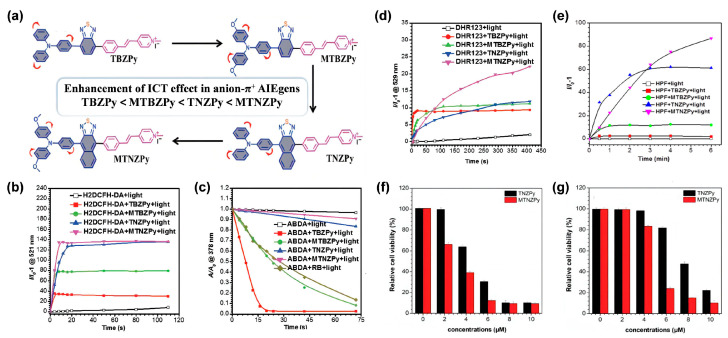
Photodynamic therapy (PDT), emerging as a minimally invasive therapeutic modality with precise controllability and high spatiotemporal accuracy, has earned significant advancements in the field of cancer and other non-cancerous diseases treatment. Thereinto, type I PDT represents an irreplaceable and meritorious part in contributing to these delightful achievements since its distinctive hypoxia tolerance can perfectly compensate for the high oxygen-dependent type II PDT, particularly in hypoxic tissues. Regarding the diverse type I photosensitizers (PSs) that light up type I PDT, aggregation-induced emission (AIE)-active type I PSs are currently arousing great research interest owing to their distinguished AIE and aggregation-induced generation of reactive oxygen species (AIE-ROS) features. In this review, we offer a comprehensive overview of the cutting-edge advances of novel AIE-active type I PSs by delineating the photophysical and photochemical mechanisms of the type I pathway, summarizing the current molecular design strategies for promoting the type I process, and showcasing current bioapplications, in succession. Notably, the strategies to construct highly efficient type I AIE PSs were elucidated in detail from the two aspects of introducing high electron affinity groups, and enhancing intramolecular charge transfer (ICT) intensity. Lastly, we present a brief conclusion, and a discussion on the current limitations and proposed opportunities.
光动力疗法(PDT)作为一种具有精确可控性和高时空准确性的微创治疗方式,在癌症和其他非癌性疾病的治疗领域取得了重大进展。其中,I 型 PDT 因其独特的缺氧耐受性,能够完美弥补高氧依赖性的 II 型 PDT 的不足,特别是在缺氧组织中,是促成这些可喜成就的不可或缺和值得称赞的部分。对于引发 I 型 PDT 的多种 I 型光敏剂(PSs),聚集诱导发射(AIE)活性的 I 型 PS 由于其出色的 AIE 和聚集诱导产生活性氧(AIE-ROS)的特性,目前引起了极大的研究兴趣。在这篇综述中,我们通过描述 I 型途径的光物理和光化学机制,总结促进 I 型过程的当前分子设计策略,并依次展示当前的生物应用,全面概述了新型 AIE 活性 I 型 PS 的最新进展。值得注意的是,我们从引入高电子亲和基团和增强分子内电荷转移(ICT)强度两个方面,详细阐述了构建高效 I 型 AIE PS 的策略。最后,我们对当前的局限性和提出的机遇进行了简要总结和讨论。