Shen Yinchen, Wang Hanying, Xu Xiaoyin, Chen Chong, Zhu Shaopin, Cheng Lu, Fang Junwei, Liu Kun, Xu Xun
Department of Ophthalmology, Shanghai General Hospital, School of Medicine, Shanghai Jiao Tong University, Shanghai, China.
National Clinical Research Center for Eye Diseases, Shanghai, China.
Front Pharmacol. 2022 Sep 19;13:991879. doi: 10.3389/fphar.2022.991879. eCollection 2022.
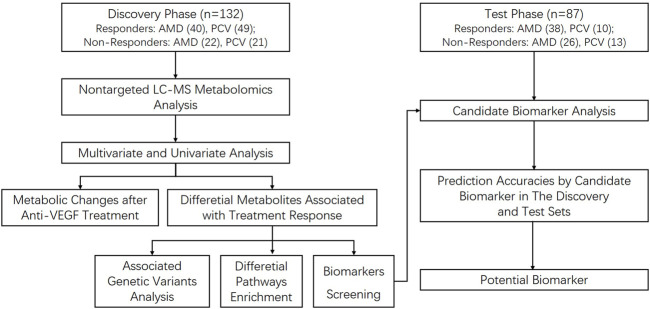
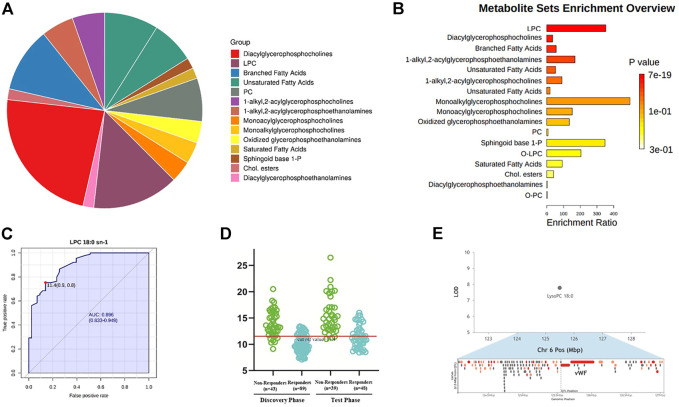
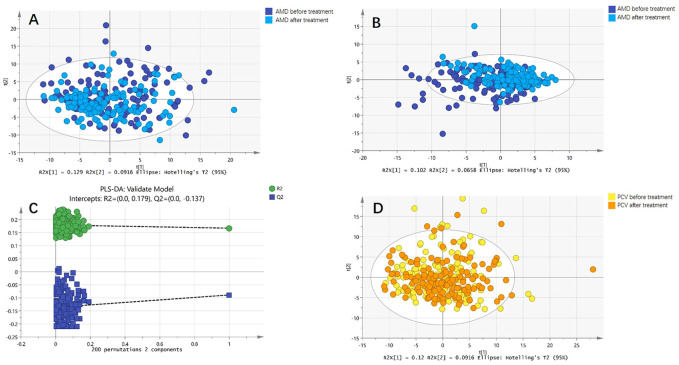
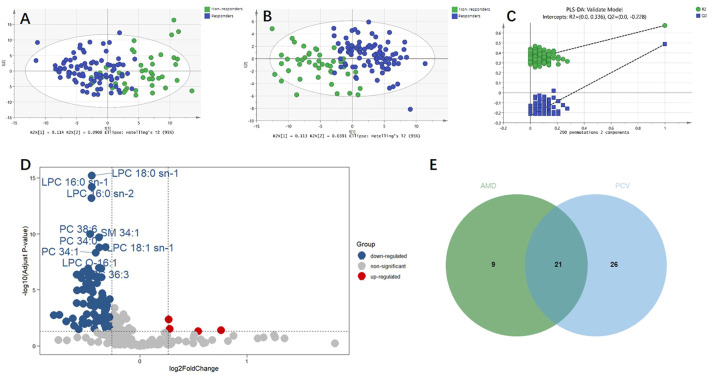
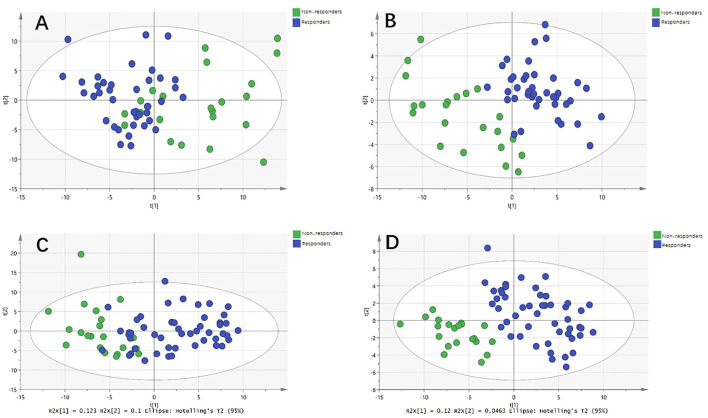
Neovascular age-related macular degeneration (nAMD) and polypoidal choroidal vasculopathy (PCV) are major causes of blindness in aged people. 30% of the patients show unsatisfactory response to anti-vascular endothelial growth factor (anti-VEGF) drugs. This study aims to investigate the relationship between serum metabolome and treatment response to anti-VEGF therapy. A prospective longitudinal study was conducted between March 2017 and April 2019 in 13 clinical sites in China. The discovery group were enrolled from Shanghai General Hospital. The validation group consisted of patients from the other 12 sites. Participants received at least one intravitreal injection of 0.5 mg anti-VEGF drug, conbercept, and were divided into two groups - responders and non-responders. Serum samples of both groups were processed for UHPLC-MS/MS analysis. We constructed principal component analysis (PCA) and partial least squares discriminant analysis (PLS-DA) models to investigate the metabolic differences between two groups using SIMCA-P. Area under curve (AUC) was calculated to screen the biomarkers to predict treatment response. Metabolites sub-classes and enriched pathways were obtained using MetaboAnalyst5.0. 219 eyes from 219 patients (nAMD = 126; PCV = 93) were enrolled. A total of 248 metabolites were detected. PCA and PLS-DA models of the discovery group demonstrated that the metabolic profiles of responders and non-responders clearly differed. Eighty-five differential metabolites were identified, including sub-classes of diacylglycerophosphocholines, lysophosphatidylcholine (LPC), fatty acids, phosphocholine, etc. Responders and non-responders differed most significantly in metabolism of LPC ( = 7.16 × 10^-19) and diacylglycerophosphocholine ( = 6.96 × 10^-17). LPC 18:0 exhibited the highest AUC, which is 0.896 with 95% confidence internal between 0.833 and 0.949, to discriminate responders. The predictive accuracy of LPC 18:0 was 72.4% in the validation group. This study suggests that differential metabolites may be useful for guiding treatment options for nAMD and PCV. Metabolism of LPC and diacylglycerophosphocholine were found to affect response to conbercept treatment. LPC 18:0 was a potential biomarker to discriminate responders from non-responders.
新生血管性年龄相关性黄斑变性(nAMD)和息肉状脉络膜血管病变(PCV)是老年人失明的主要原因。30%的患者对抗血管内皮生长因子(抗VEGF)药物反应不佳。本研究旨在探讨血清代谢组与抗VEGF治疗反应之间的关系。2017年3月至2019年4月在中国13个临床站点进行了一项前瞻性纵向研究。发现组从上海交通大学医学院附属瑞金医院招募。验证组由来自其他12个站点的患者组成。参与者接受至少一次玻璃体内注射0.5mg抗VEGF药物康柏西普,并分为两组——反应者和无反应者。对两组的血清样本进行超高效液相色谱-串联质谱(UHPLC-MS/MS)分析。我们构建了主成分分析(PCA)和偏最小二乘判别分析(PLS-DA)模型,使用SIMCA-P软件研究两组之间的代谢差异。计算曲线下面积(AUC)以筛选预测治疗反应的生物标志物。使用MetaboAnalyst5.0获得代谢物亚类和富集途径。纳入了219例患者的219只眼(nAMD = 126;PCV = 93)。共检测到248种代谢物。发现组的PCA和PLS-DA模型表明,反应者和无反应者的代谢谱明显不同。鉴定出85种差异代谢物,包括二酰基甘油磷酸胆碱、溶血磷脂酰胆碱(LPC)、脂肪酸、磷酸胆碱等亚类。反应者和无反应者在LPC(P = 7.16 × 10^-19)和二酰基甘油磷酸胆碱(P = 6.96 × 10^-17)的代谢方面差异最为显著。LPC 18:0的AUC最高,为0.896,95%置信区间在0.833至0.949之间,可用于区分反应者。在验证组中,LPC 18:0的预测准确率为72.4%。本研究表明,差异代谢物可能有助于指导nAMD和PCV的治疗选择。发现LPC和二酰基甘油磷酸胆碱的代谢会影响康柏西普治疗的反应。LPC 18:0是区分反应者和无反应者的潜在生物标志物。