Biobehavioral Laboratory, School of Nursing, 14742UT Health San Antonio, San Antonio, TX, USA.
School of Medicine, 14742UT Health San Antonio, San Antonio, TX, USA.
Cancer Control. 2022 Jan-Dec;29:10732748221130964. doi: 10.1177/10732748221130964.
This study aimed to demonstrate potential translation of pre-clinical studies to a home-based exercise intervention in mediating inflammatory cytokine markers and tumor progression in men under active surveillance for prostate cancer.
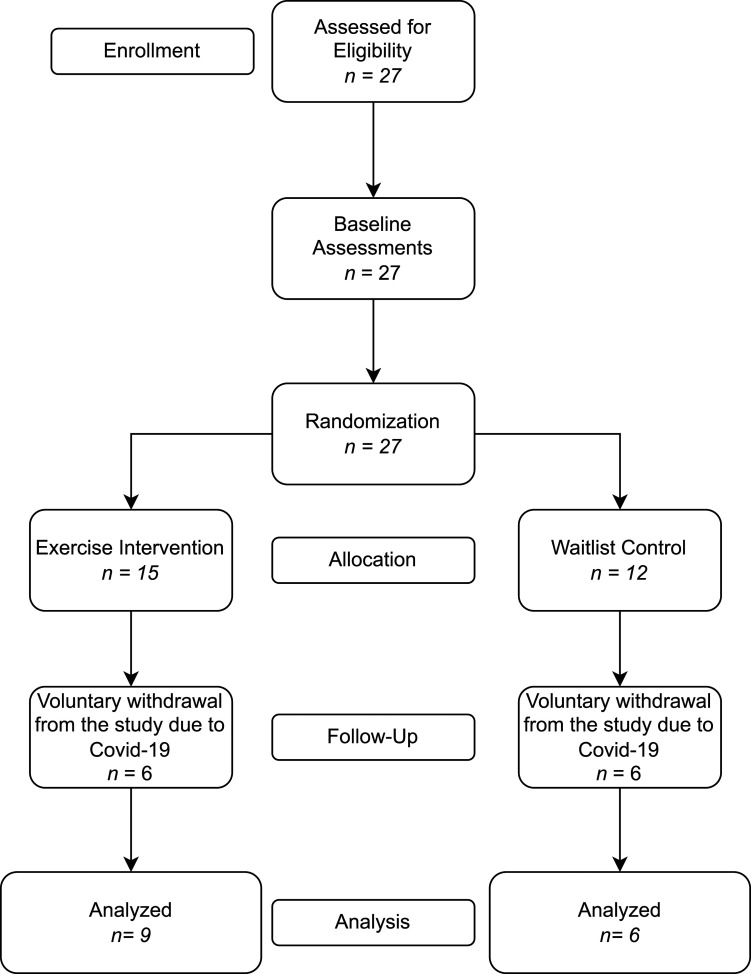
A 2-arm randomized control parallel group design was used. The exercise intervention consisted of 24 weeks of an aerobic and resistance home-based exercise program and results were compared to a waitlist control group. Data were collected at baseline and end of study for eotaxin, interferon-γ (INF-γ), interleukin-12 (IL-12), interleukin-1α (IL-1α), interleukin-5 (IL-5), interleukin-6 (IL-6), tumor necrosis factor alpha (TNF-α), and vascular endothelial growth factor (VEGF), distanced walked during a 6-minute walk test (6MWT), body mass index, and health-related quality of life.
Non-significant decreases were observed in all biomarkers, especially VEGF (pre: 125.16 ± 198.66, post: 80.29 ± 124.30, P = .06) and INF-γ (pre: 152.88 ± 312.71, post: 118.93 ± 158.79, P = .08), in the intervention group; only IL- α (pre: 332.15 ± 656.77, post: 255.12 ± 502.09, P = .20) decreased in the control group while all other biomarkers increased from baseline to end of study. A non-significant increase in 6MWT distance was observed in the intervention group, while a decrease was seen in the control group. Significant decreases in physical function, emotional wellbeing, and total composite scale on the FACIT-F were observed in the intervention group, possibly due to the isolation restrictions of COVID-19. Physical function on the SF-36 significantly increased in the control group.
Future studies with powered samples are needed to confirm the trends observed for inflammatory biomarkers and functional fitness.
本研究旨在展示将临床前研究转化为基于家庭的运动干预在调节男性前列腺癌主动监测患者炎症细胞因子标志物和肿瘤进展方面的潜力。
采用 2 臂随机对照平行组设计。运动干预包括 24 周的有氧和抗阻家庭运动方案,并与等待名单对照组进行比较。在基线和研究结束时收集 eotaxin、干扰素-γ(INF-γ)、白细胞介素-12(IL-12)、白细胞介素-1α(IL-1α)、白细胞介素-5(IL-5)、白细胞介素-6(IL-6)、肿瘤坏死因子-α(TNF-α)和血管内皮生长因子(VEGF)、6 分钟步行测试(6MWT)中行走的距离、体重指数和健康相关生活质量的数据。
干预组所有生物标志物(尤其是 VEGF(前:125.16 ± 198.66,后:80.29 ± 124.30,P =.06)和 INF-γ(前:152.88 ± 312.71,后:118.93 ± 158.79,P =.08))均呈非显著性下降;对照组仅 IL- α(前:332.15 ± 656.77,后:255.12 ± 502.09,P =.20)下降,而所有其他生物标志物均从基线增加到研究结束。干预组 6MWT 距离呈非显著性增加,而对照组则减少。干预组的身体功能、情感健康和 FACIT-F 总综合评分显著下降,可能是由于 COVID-19 的隔离限制。对照组的 SF-36 身体功能显著增加。
需要进行有足够样本量的未来研究来证实观察到的炎症生物标志物和功能适应性趋势。