Department I of Internal Medicine, Center for Integrated Oncology Aachen Bonn Cologne Duesseldorf, German CLL Study Group, CECAD Cluster of Excellence, University of Cologne, Cologne, Germany.
Blood. 2022 Jul 21;140(3):236-252. doi: 10.1182/blood.2021012251.
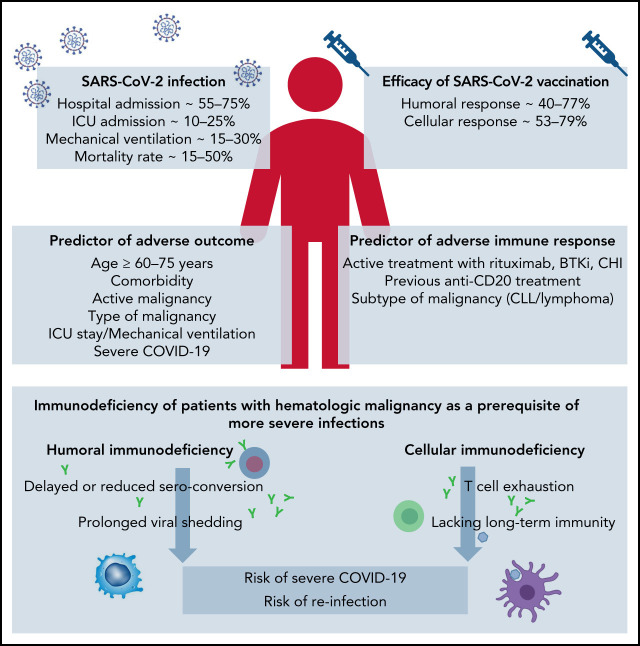
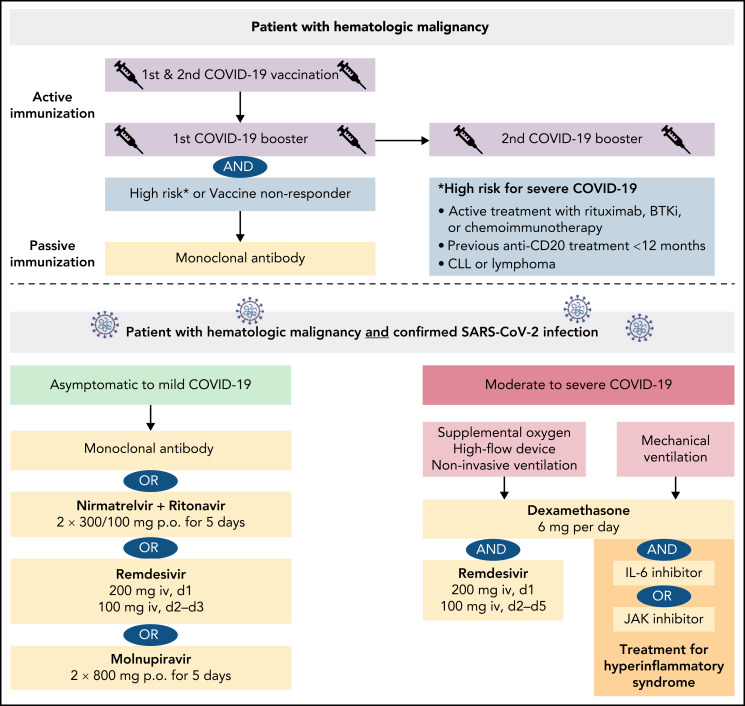
The coronavirus infectious disease (COVID-19) shows a remarkable symptomatic heterogeneity. Several risk factors including advanced age, previous illnesses, and a compromised immune system contribute to an unfavorable outcome. In patients with hematologic malignancy, the immune response to severe acute respiratory syndrome coronavirus 2 (SARS-CoV-2) is significantly reduced explaining why the mortality rate of hematologic patients hospitalized for a SARS-CoV-2 infection is about 34%. Active immunization is an essential pillar to prevent SARS-CoV-2 infections in patients with hematologic malignancy. However, the immune response to SARS-CoV-2 vaccines may be significantly impaired, as only half of patients with hematologic malignancy develop a measurable antiviral antibody response. The subtype of hematologic malignancy and B cell-depleting treatment predict a poor immune response to vaccination. Recently, antiviral drugs and monoclonal antibodies for pre-exposure or postexposure prophylaxis and for early treatment of COVID-19 have become available. These therapies should be offered to patients at high risk for severe COVID-19 and vaccine nonresponders. Importantly, as the virus evolves, some therapies may lose their clinical efficacy against new variants. Therefore, the ongoing pandemic will remain a major challenge for patients with hematologic malignancy and their caregivers who need to constantly monitor the scientific progress in this area.
冠状病毒传染病(COVID-19)表现出显著的症状异质性。一些风险因素,包括年龄较大、既往疾病和免疫系统受损,导致预后不良。在血液恶性肿瘤患者中,对严重急性呼吸综合征冠状病毒 2(SARS-CoV-2)的免疫反应明显降低,这解释了为什么因 SARS-CoV-2 感染而住院的血液系统恶性肿瘤患者的死亡率约为 34%。主动免疫是预防血液恶性肿瘤患者 SARS-CoV-2 感染的重要支柱。然而,SARS-CoV-2 疫苗的免疫反应可能会受到显著抑制,因为只有一半的血液恶性肿瘤患者会产生可测量的抗病毒抗体反应。血液恶性肿瘤的亚型和 B 细胞耗竭治疗预测疫苗接种的免疫反应不佳。最近,用于暴露前或暴露后预防以及 COVID-19 早期治疗的抗病毒药物和单克隆抗体已经问世。这些治疗方法应提供给有发生严重 COVID-19 和疫苗无应答风险的患者。重要的是,随着病毒的演变,一些治疗方法可能会对新变体失去临床疗效。因此,持续的大流行仍然是血液恶性肿瘤患者及其护理人员的主要挑战,他们需要不断监测该领域的科学进展。