Faculty of Health Sciences, University of Ljubljana, Zdravstvena pot 5, 1000, Ljubljana, Slovenia.
Alpineon, d.o.o., Ulica Iga Grudna 15, 1000, Ljubljana, Slovenia.
Sci Rep. 2022 Oct 8;12(1):16916. doi: 10.1038/s41598-022-21612-7.
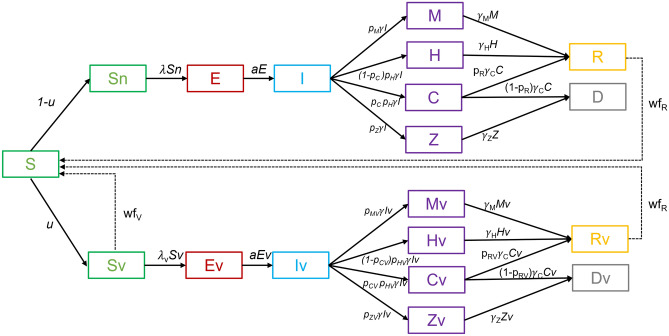
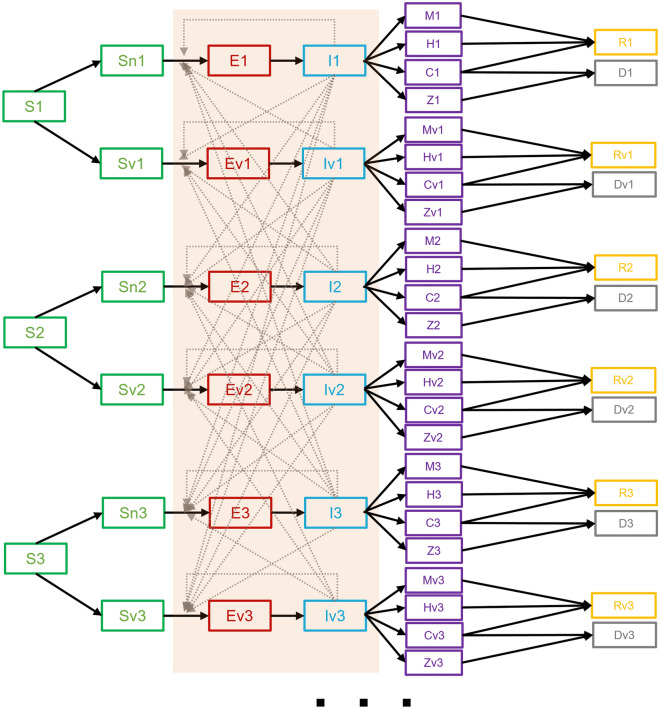
In the absence of a systematic approach to epidemiological modeling in Slovenia, various isolated mathematical epidemiological models emerged shortly after the outbreak of the COVID-19 epidemic. We present an epidemiological model adapted to the COVID-19 situation in Slovenia. The standard SEIR model was extended to distinguish between age groups, symptomatic or asymptomatic disease progression, and vaccinated or unvaccinated populations. Evaluation of the model forecasts for 2021 showed the expected behavior of epidemiological modeling: our model adequately predicts the situation up to 4 weeks in advance; the changes in epidemiologic dynamics due to the emergence of a new viral variant in the population or the introduction of new interventions cannot be predicted by the model, but when the new situation is incorporated into the model, the forecasts are again reliable. Comparison with ensemble forecasts for 2022 within the European Covid-19 Forecast Hub showed better performance of our model, which can be explained by a model architecture better adapted to the situation in Slovenia, in particular a refined structure for vaccination, and better parameter tuning enabled by the more comprehensive data for Slovenia. Our model proved to be flexible, agile, and, despite the limitations of its compartmental structure, heterogeneous enough to provide reasonable and prompt short-term forecasts and possible scenarios for various public health strategies. The model has been fully operational on a daily basis since April 2020, served as one of the models for decision-making during the COVID-19 epidemic in Slovenia, and is part of the European Covid-19 Forecast Hub.
在斯洛文尼亚缺乏系统的流行病学建模方法的情况下,COVID-19 疫情爆发后不久,就出现了各种孤立的数学流行病学模型。我们提出了一种适用于斯洛文尼亚 COVID-19 情况的流行病学模型。标准的 SEIR 模型扩展到区分年龄组、有症状或无症状疾病进展以及接种疫苗或未接种疫苗的人群。对 2021 年模型预测的评估表明,该模型表现出了预期的流行病学建模行为:我们的模型能够提前 4 周左右准确预测情况;由于新病毒变异在人群中的出现或新干预措施的引入而导致的流行病学动态变化无法通过模型预测,但当新情况纳入模型时,预测结果再次可靠。与欧洲 COVID-19 预测中心的 2022 年综合预测进行比较表明,我们的模型表现更好,这可以归因于模型架构更好地适应了斯洛文尼亚的情况,特别是接种疫苗的结构更加精细,以及更全面的斯洛文尼亚数据能够更好地调整参数。我们的模型被证明是灵活的、敏捷的,尽管其分组结构存在局限性,但它具有足够的异质性,可以提供合理且及时的短期预测以及各种公共卫生策略的可能情景。该模型自 2020 年 4 月以来一直每天运行,是斯洛文尼亚 COVID-19 疫情期间决策模型之一,也是欧洲 COVID-19 预测中心的一部分。