Long School of Medicine, University of Texas Health Science Center at San Antonio, San Antonio, TX, 78249, USA.
Department of Otolaryngology - Head and Neck Surgery, Jacobs School of Medicine, Buffalo, NY, 14226, USA.
Eur Arch Otorhinolaryngol. 2023 Feb;280(2):505-509. doi: 10.1007/s00405-022-07689-w. Epub 2022 Oct 9.
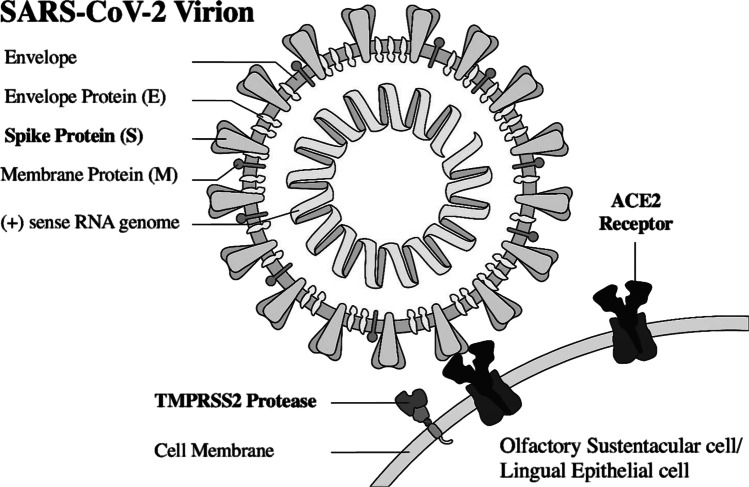
Severe acute respiratory syndrome coronavirus type 2 (SARS-CoV-2) is the causative agent of COVID-19 which was detected in late 2019 in Wuhan, China. As of September 2022, there have been over 612 million confirmed cases of COVID-19 with over 6.5 million associated deaths. In many cases, anosmia and dysgeusia have been identified as primary symptoms of COVID-19 infection in patients. While the loss of smell (anosmia) and loss of taste (dysgeusia) due to COVID-19 infection is transient in most patients, many report that these symptoms persist following recovery. Understanding the pathogenesis of these symptoms is paramount to early treatment of the infection. We conducted a literature review of Google Scholar and PubMed to find and analyze studies discussing anosmia and dysgeusia in the context of COVID-19 to understand the progression and management of these symptoms. The mechanism for dysgeusia is largely unknown; however, pathogenesis of anosmia includes inflammation and cytokine release resulting from the infection that alters neuronal signaling, thus inducing the loss of smell that patients experience. Anosmia may be managed and potentially resolved sooner with a combination therapy of olfactory training and budesonide irrigation of the nasal cavity. It is important to note that the variants of SARS-CoV-2 are genetically distinguished from the original virion due to a mutation in their spike proteins, giving them a different symptom profile regarding anosmia and dysgeusia. This variability in symptomatology is an area of study that needs to be further explored.
严重急性呼吸综合征冠状病毒 2 型(SARS-CoV-2)是导致 COVID-19 的病原体,该病毒于 2019 年底在中国武汉被发现。截至 2022 年 9 月,全球已确诊超过 6.12 亿例 COVID-19 病例,相关死亡人数超过 650 万。在许多情况下,嗅觉丧失(嗅觉障碍)和味觉障碍已被确定为 COVID-19 感染患者的主要症状。虽然大多数患者因 COVID-19 感染而导致的嗅觉丧失(嗅觉障碍)和味觉丧失(味觉障碍)是短暂的,但许多患者报告称,这些症状在康复后仍持续存在。了解这些症状的发病机制对于早期治疗感染至关重要。我们对 Google Scholar 和 PubMed 进行了文献回顾,以查找和分析讨论 COVID-19 背景下嗅觉障碍和味觉障碍的研究,以了解这些症状的进展和管理。味觉障碍的发病机制在很大程度上尚不清楚;然而,嗅觉障碍的发病机制包括感染引起的炎症和细胞因子释放,改变神经元信号,从而导致患者经历的嗅觉丧失。嗅觉障碍可以通过嗅觉训练和鼻腔布地奈德冲洗的联合治疗来进行管理,并可能更快得到解决。值得注意的是,由于其刺突蛋白发生突变,SARS-CoV-2 的变体在遗传上与原始病毒粒子区分开来,因此在嗅觉障碍和味觉障碍方面具有不同的症状谱。这种症状表现的变异性是一个需要进一步探索的研究领域。