Department of Cariology and Endodontology, Peking University School and Hospital of Stomatology and National Clinical Research Center for Oral Diseases and National Engineering Research of Oral Biomaterials and Digital Medical Devices and Beijing Key Laboratory of Digital Stomatology, Beijing, China.
Intelligent Healthcare Unit, Beijing Baidu Netcom Science Technology Company Limited, Beijing, China.
Caries Res. 2022;56(5-6):455-463. doi: 10.1159/000527418. Epub 2022 Oct 10.
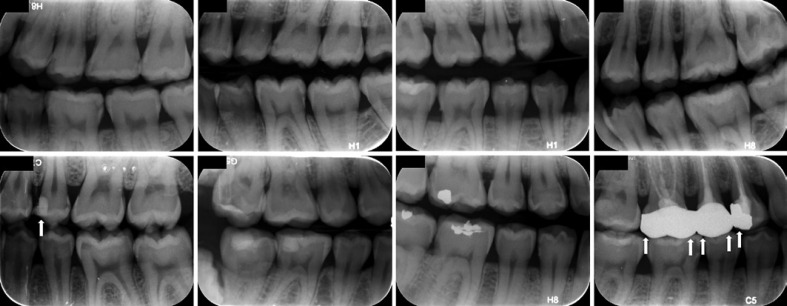
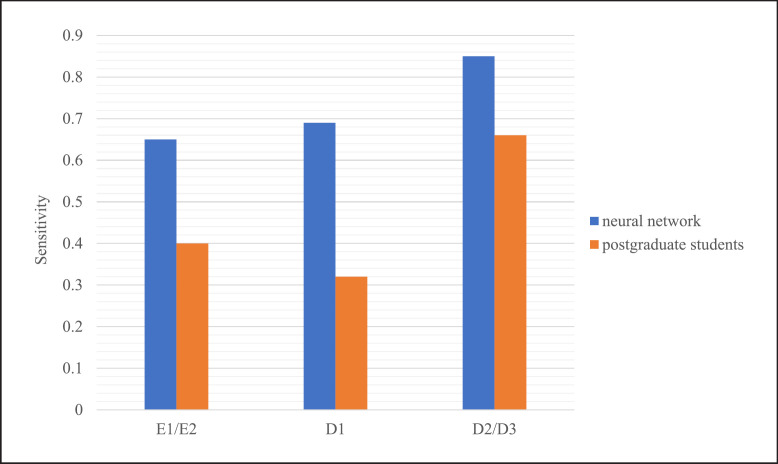
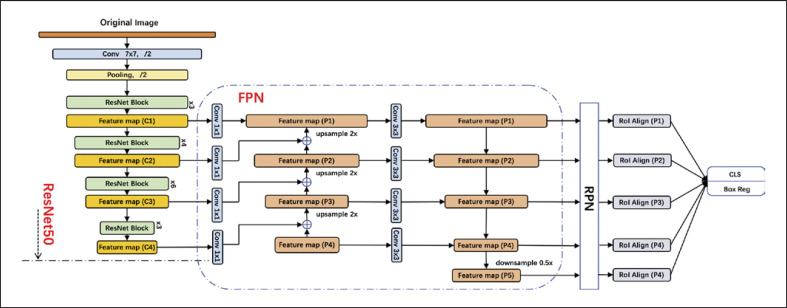
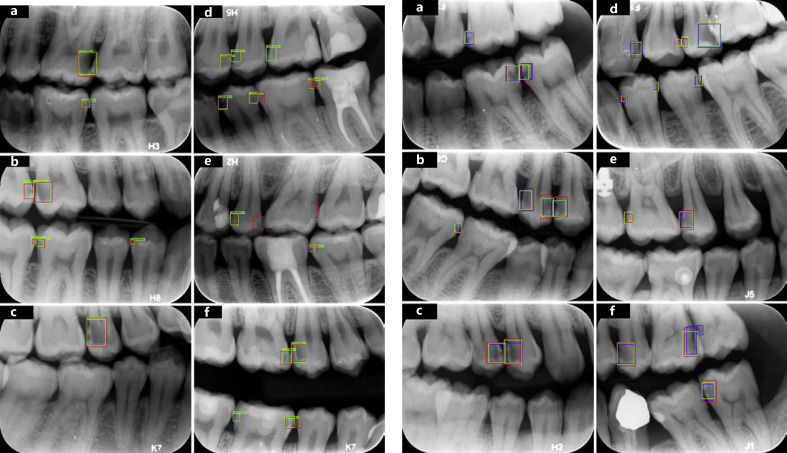
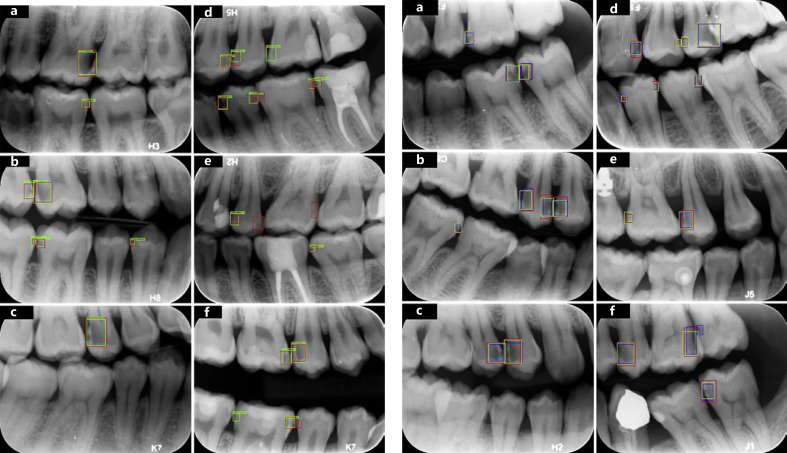
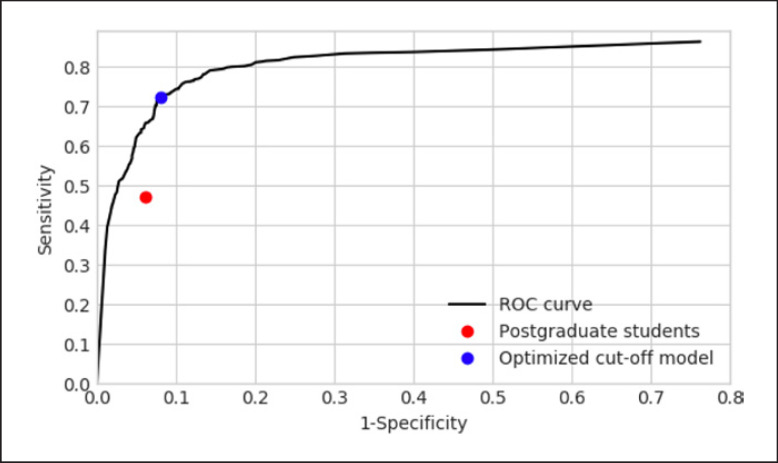
This study aimed to evaluate the validity of a deep learning-based convolutional neural network (CNN) for detecting proximal caries lesions on bitewing radiographs. A total of 978 bitewing radiographs, 10,899 proximal surfaces, were evaluated by two endodontists and a radiologist, of which 2,719 surfaces were diagnosed and annotated with proximal caries and 8,180 surfaces were sound. The data were randomly divided into two datasets, with 818 bitewings in the training and validation dataset and 160 bitewings in the test dataset. Each annotation in the test set was then classified into 5 stages according to the extent of the lesion (E1, E2, D1, D2, D3). Faster R-CNN, a deep learning-based object detection method, was trained to detect proximal caries in the training and validation dataset and then was assessed on the test dataset. The diagnostic accuracy, sensitivity, specificity, positive predictive value (PPV), negative predictive value (NPV), and receiver operating characteristic curve were calculated. The performance of the network in the overall and different stages of lesions was compared with that of postgraduate students on the test dataset. A total of 388 carious lesions and 1,435 sound surfaces were correctly identified by the neural network; hence, the accuracy was 0.87. Furthermore, 27.6% of lesions went undetected, and 7% of sound surfaces were misdiagnosed by the neural network. The sensitivity, specificity, PPV, and NPV of the neural network were 0.72, 0.93, 0.77, and 0.91, respectively. In contrast with the network, 52.8% of lesions went undetected by the students, yielding a sensitivity of only 0.47. The F1-score of the students was 0.57, while the F1-score of the network was 0.74 despite the accuracy of 0.82. A significant difference in the sensitivity was found between the model and the postgraduate students when detecting different stages of lesions (p < 0.05). For early lesions which limited in enamel and the outer third of dentin, the neural network had sensitivities all above or at 0.65, while students showed sensitivities below 0.40. From our results, we conclude that the CNN may be an assistant in detecting proximal caries on bitewings.
本研究旨在评估一种基于深度学习的卷积神经网络(CNN)在检测磨牙邻面龋病中的有效性。共有 978 张磨牙片,10899 个近面,由 2 名牙髓病专家和 1 名放射科医生进行评估,其中 2719 个面被诊断为邻面龋并进行了标注,8180 个面为正常。数据随机分为两组,训练和验证数据集包含 818 张磨牙片,测试数据集包含 160 张磨牙片。测试集中的每个标注根据病变程度(E1、E2、D1、D2、D3)分为 5 个阶段。基于深度学习的目标检测方法 Faster R-CNN 用于在训练和验证数据集中检测邻面龋病,然后在测试数据集中进行评估。计算诊断准确性、敏感度、特异性、阳性预测值(PPV)、阴性预测值(NPV)和受试者工作特征曲线。比较了网络在测试数据集上的整体表现和不同病变阶段的表现与研究生的表现。该神经网络正确识别了 388 个龋病病变和 1435 个正常表面,准确率为 0.87。此外,有 27.6%的病变未被检出,7%的正常表面被误诊。神经网络的敏感度、特异性、PPV 和 NPV 分别为 0.72、0.93、0.77 和 0.91。相比之下,学生们漏诊了 52.8%的病变,敏感度仅为 0.47。学生的 F1 得分为 0.57,而网络的 F1 得分为 0.74,准确率为 0.82。在检测不同阶段的病变时,模型和研究生的敏感度存在显著差异(p<0.05)。对于局限于牙釉质和牙本质外三分之一的早期病变,神经网络的敏感度均高于或等于 0.65,而学生的敏感度低于 0.40。根据我们的结果,我们得出结论,CNN 可能是一种辅助检测磨牙邻面龋病的方法。