Synthetic Organic Chemistry Laboratory, RIKEN Cluster for Pioneering Research, 2-1 Hirosawa, Wako, Saitama 351-0198, Japan.
Catalysis and Integrated Research Group, RIKEN Center for Sustainable Resource Science, 2-1 Hirosawa, Wako, Saitama 351-0198, Japan.
J Am Chem Soc. 2022 Nov 2;144(43):19651-19667. doi: 10.1021/jacs.2c05359. Epub 2022 Oct 10.
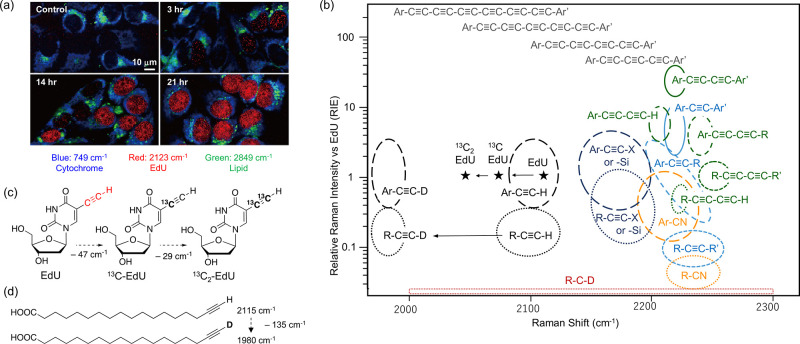
In chemical biology research, various fluorescent probes have been developed and used to visualize target proteins or molecules in living cells and tissues, yet there are limitations to this technology, such as the limited number of colors that can be detected simultaneously. Recently, Raman spectroscopy has been applied in chemical biology to overcome such limitations. Raman spectroscopy detects the molecular vibrations reflecting the structures and chemical conditions of molecules in a sample and was originally used to directly visualize the chemical responses of endogenous molecules. However, our initial research to develop "Raman tags" opens a new avenue for the application of Raman spectroscopy in chemical biology. In this Perspective, we first introduce the label-free Raman imaging of biomolecules, illustrating the biological applications of Raman spectroscopy. Next, we highlight the application of Raman imaging of small molecules using Raman tags for chemical biology research. Finally, we discuss the development and potential of Raman probes, which represent the next-generation probes in chemical biology.
在化学生物学研究中,已经开发并使用了各种荧光探针来可视化活细胞和组织中的靶蛋白或分子,但该技术存在一些局限性,例如同时检测的颜色数量有限。最近,拉曼光谱已应用于化学生物学领域,以克服这些局限性。拉曼光谱检测反映样品中分子结构和化学状态的分子振动,最初用于直接可视化内源性分子的化学响应。然而,我们最初开发“拉曼标签”的研究为拉曼光谱在化学生物学中的应用开辟了新途径。在本观点中,我们首先介绍了生物分子的无标记拉曼成像,说明了拉曼光谱在生物学中的应用。接下来,我们重点介绍了使用拉曼标签对小分子进行拉曼成像在化学生物学研究中的应用。最后,我们讨论了拉曼探针的发展和潜力,拉曼探针代表了化学生物学中的下一代探针。