Ren Chuanhong, Cao Yunlin, Xing Mengyun, Guo Yan, Li Jiajia, Xue Lei, Sun Chongde, Xu Changjie, Chen Kunsong, Li Xian
Zhejiang Provincial Key Laboratory of Horticultural Plant Integrative Biology, Zhejiang University, Hangzhou, China.
The State Agriculture Ministry Laboratory of Horticultural Plant Growth, Development and Quality Improvement, Zhejiang University, Hangzhou, China.
Front Plant Sci. 2022 Sep 26;13:998985. doi: 10.3389/fpls.2022.998985. eCollection 2022.
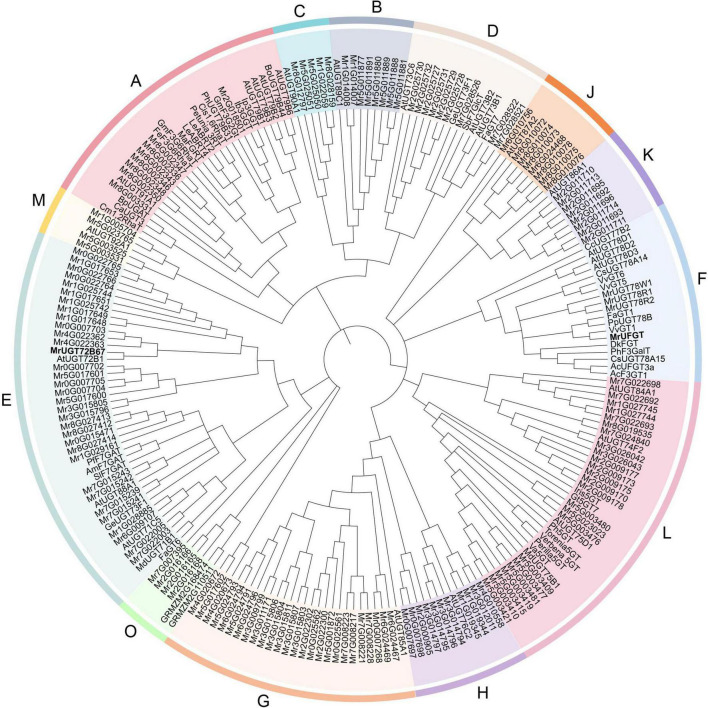
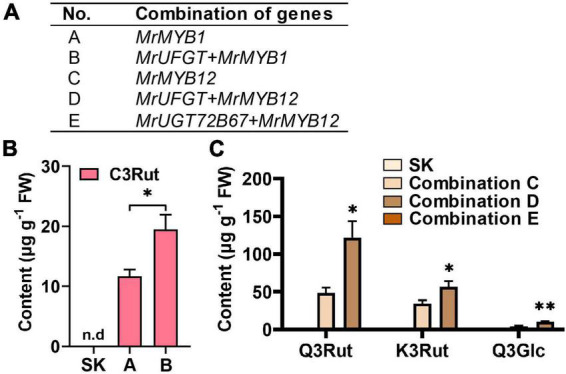
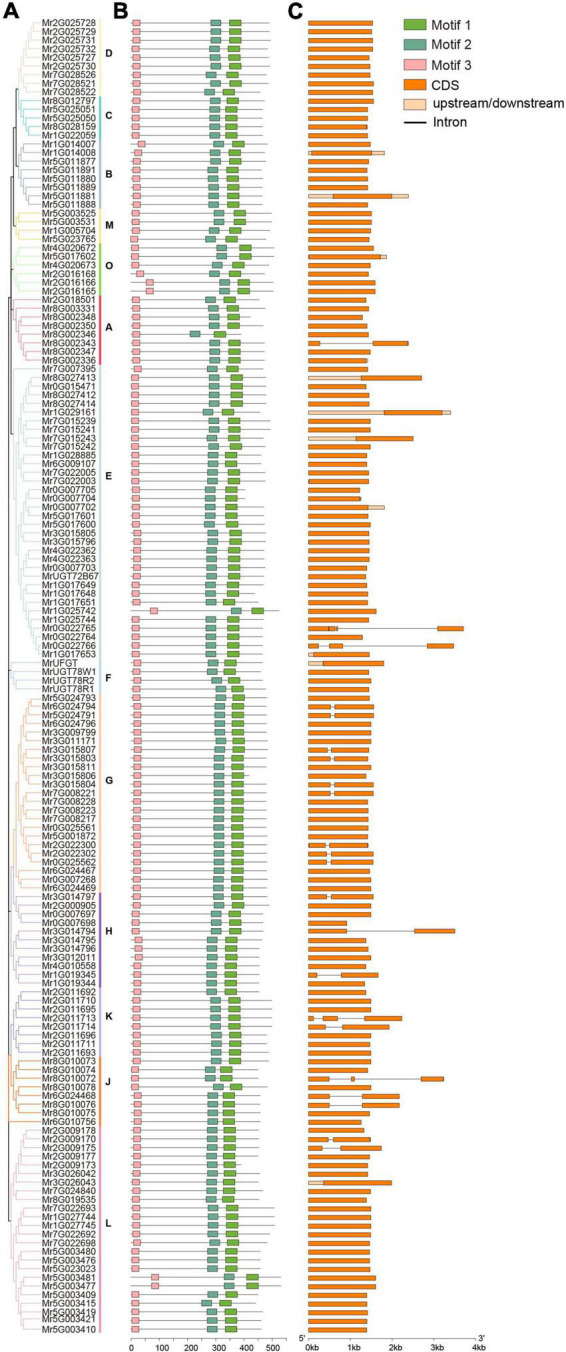
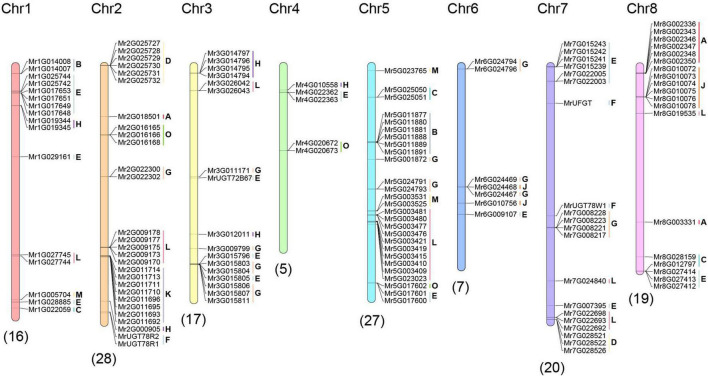
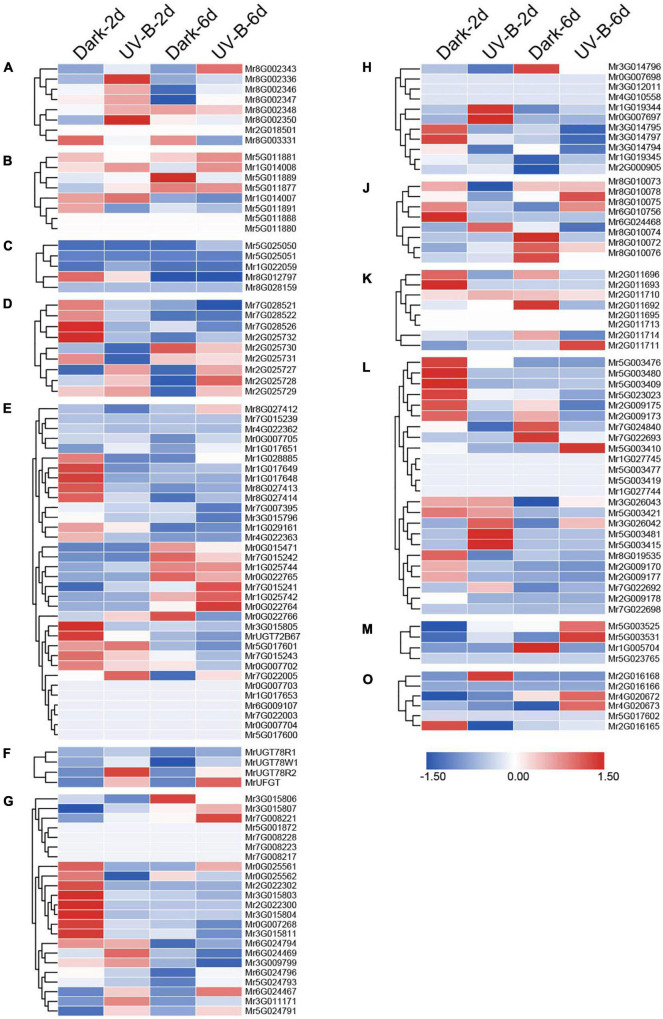
Glycosylation was catalyzed by UDP-glycosyltransferase (UGT) and was important for enriching diversity of flavonoids. Chinese bayberry () has significant nutritional and medical values because of diverse natural flavonoid glycosides. However, information of gene family was quite limited in . In the present study, a total of 152 genes clustered into 13 groups were identified in genome. Among them, 139 genes were marked on eight chromosomes and 13 members located on unmapped scaffolds. Gene duplication analysis indicated that expansion of gene family was mainly forced by tandem and proximal duplication events. Gene expression patterns in different tissues and under UV-B treatment were analyzed by transcriptome. Cyanidin 3--glucoside (C3Glc) and quercetin 3--glucoside (Q3Glc) were two main flavonoid glucosides accumulated in . UV-B treatment significantly induced C3Glc and Q3Glc accumulation in fruit. Based on comprehensively analysis of transcriptomic data and phylogenetic homology together with flavonoid accumulation patterns, MrUFGT (MrUGT78A26) and MrUGT72B67 were identified as UDP-glucosyltransferases. MrUFGT was mainly involved in C3Glc and Q3Glc accumulation in fruit, while MrUGT72B67 was mainly involved in Q3Glc accumulation in leaves and flowers. Gln375 and Gln391 were identified as important amino acids for glucosyl transfer activity of MrUFGT and MrUGT72B67 by site-directed mutagenesis, respectively. Transient expression in tested the function of MrUFGT and MrUGT72B67 as glucosyltransferases. The present study provided valuable source for identification of functional UGTs involved in secondary metabolites biosynthesis in .
糖基化由尿苷二磷酸糖基转移酶(UGT)催化,对丰富黄酮类化合物的多样性很重要。杨梅因其多样的天然黄酮苷而具有显著的营养和医学价值。然而,杨梅中UGT基因家族的信息相当有限。在本研究中,在杨梅基因组中总共鉴定出152个UGT基因,它们聚集成13个组。其中,139个UGT基因定位在8条染色体上,13个成员位于未定位的支架上。基因重复分析表明,UGT基因家族的扩展主要是由串联重复和近端重复事件驱动的。通过转录组分析了不同组织以及紫外线-B处理条件下的基因表达模式。矢车菊素3-O-葡萄糖苷(C3Glc)和槲皮素3-O-葡萄糖苷(Q3Glc)是杨梅中积累的两种主要黄酮苷。紫外线-B处理显著诱导了果实中C3Glc和Q3Glc的积累。基于对转录组数据、系统发育同源性以及黄酮类化合物积累模式的综合分析,鉴定出MrUFGT(MrUGT78A26)和MrUGT72B67为尿苷二磷酸葡萄糖基转移酶。MrUFGT主要参与果实中C3Glc和Q3Glc的积累,而MrUGT72B67主要参与叶片和花朵中Q3Glc的积累。通过定点诱变分别鉴定出Gln375和Gln391是MrUFGT和MrUGT72B67葡萄糖基转移活性的重要氨基酸。在烟草中瞬时表达验证了MrUFGT和MrUGT72B67作为葡萄糖基转移酶的功能。本研究为鉴定参与杨梅次生代谢物生物合成的功能性UGT提供了有价值的资源。