Department of Neurology, Corinne Goldsmith Dickinson Center for Multiple Sclerosis, Icahn School of Medicine at Mount Sinai, New York, NY, USA.
Department of Neurology, Johns Hopkins University, Baltimore, MD, USA.
Mult Scler. 2023 Feb;29(2):248-260. doi: 10.1177/13524585221127414. Epub 2022 Oct 13.
The multiple sclerosis (MS) community is highly interested in diet as a potential protective factor against disability, but empirical evidence remains limited.
Evaluate associations between patient-reported Mediterranean diet alignment and objective disability in a real-world MS cohort.
Data were analyzed from persons with MS, aged 18-65, who completed the Mediterranean Diet Adherence Screener (MEDAS), MS Functional Composite (MSFC; primary disability metric), and patient-reported outcomes (PROs; disability, gait disturbance, fatigue, anxiety, and depression) as part of our Comprehensive Annual Assessment Program. Multiple regression predicted MSFC (and PROs) with MEDAS after adjusting for demographic (age, sex, race, ethnicity, and socioeconomic status) and health-related (body mass index (BMI), exercise, sleep disturbance, hypertension, diabetes, hyperlipidemia, and smoking) covariates.
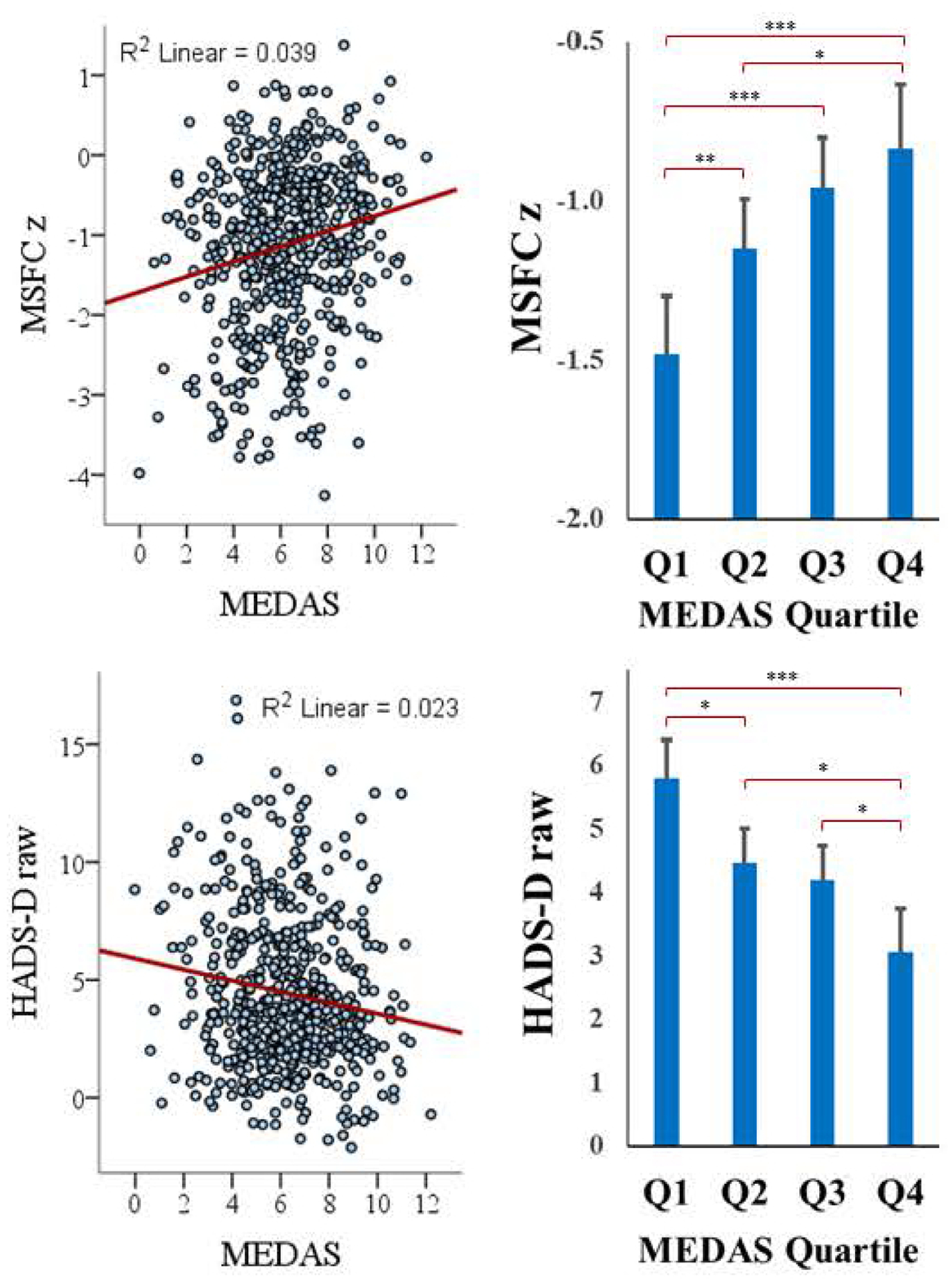
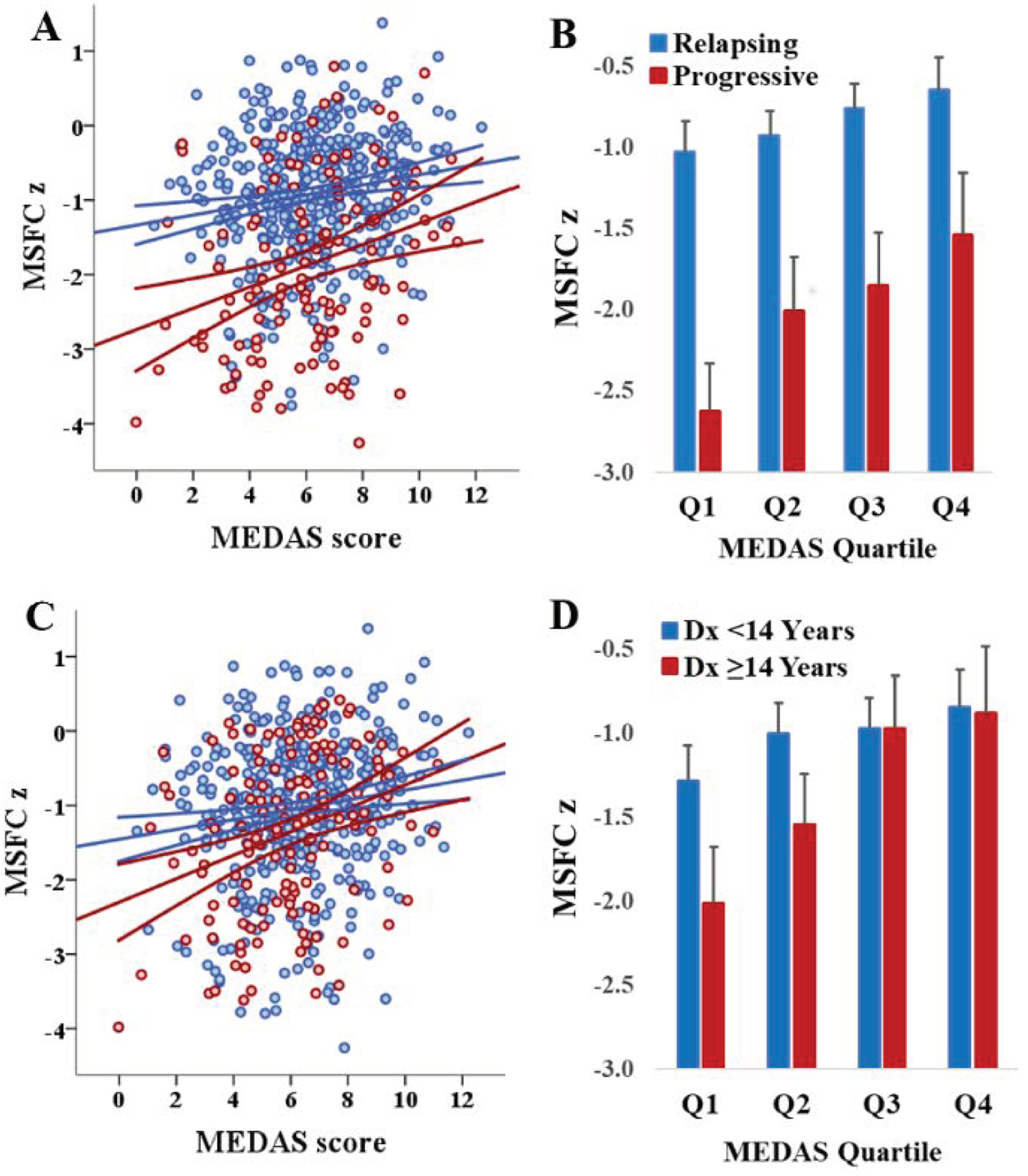
Higher MEDAS independently predicted better outcomes across MSFC (-score, = 0.10 (95% confidence interval (CI): 0.06, 0.13), β = 0.18, < 0.001), MSFC components, and PROs in 563 consecutive patients. Each MEDAS point was associated with 15.0% lower risk for MSFC impairment (⩽ 5th percentile on ⩾ 2 tasks; odds ratio (OR) = 0.850; 95% CI: 0.779, 0.928). Higher MEDAS attenuated effects of progressive disease and longer disease duration on disability.
With robust control for potential confounds, higher Mediterranean diet alignment predicted lower objective and patient-reported disability. Findings lay the necessary groundwork for longitudinal and interventional studies to guide clinical recommendations in MS.
多发性硬化症(MS)患者群体对饮食作为预防残疾的潜在保护因素非常感兴趣,但实证证据仍然有限。
评估真实 MS 队列中患者报告的地中海饮食与客观残疾之间的关联。
分析了年龄在 18-65 岁之间、完成地中海饮食依从性筛查器(MEDAS)、多发性硬化症功能综合评定(MSFC;主要残疾指标)和患者报告结局(PRO;残疾、步态障碍、疲劳、焦虑和抑郁)的 MS 患者的数据。在调整了人口统计学(年龄、性别、种族、民族和社会经济地位)和健康相关因素(体重指数(BMI)、运动、睡眠障碍、高血压、糖尿病、血脂异常和吸烟)后,多元回归预测了 MEDAS 与 MSFC(和 PRO)之间的关系。
在 563 例连续患者中,较高的 MEDAS 独立预测了 MSFC(负评分, = 0.10(95%置信区间(CI):0.06,0.13),β = 0.18, < 0.001)、MSFC 成分和 PRO 更好的结果。每增加一个 MEDAS 点,MSFC 受损的风险就会降低 15.0%(≤第 5 百分位数且至少 2 项任务受损;优势比(OR)= 0.850;95%CI:0.779,0.928)。较高的 MEDAS 减弱了进行性疾病和较长疾病持续时间对残疾的影响。
在对潜在混杂因素进行稳健控制后,较高的地中海饮食一致性预测了较低的客观和患者报告的残疾。这些发现为指导 MS 临床推荐的纵向和干预研究奠定了必要的基础。