Department of Pediatrics, University of California, San Francisco, California, USA.
Department of Pediatrics, Children's Hospital of Philadelphia, Philadelphia, Pennsylvania, USA.
Pediatr Pulmonol. 2023 Feb;58(2):465-474. doi: 10.1002/ppul.26209. Epub 2022 Oct 25.
Newborn screening (NBS) algorithms for cystic fibrosis (CF) vary in the United State of America and include different cystic fibrosis transmembrane conductance regulator (CFTR) variants. CFTR variant distribution varies among racial and ethnic groups.
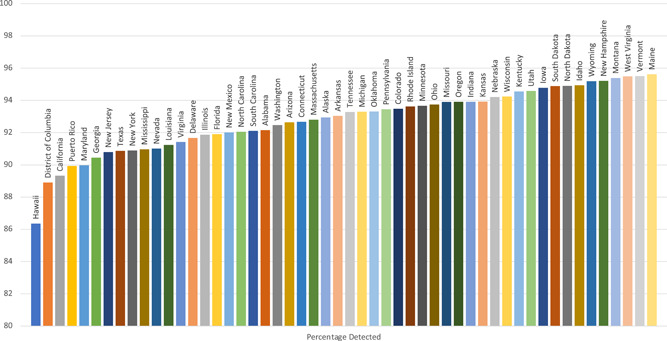
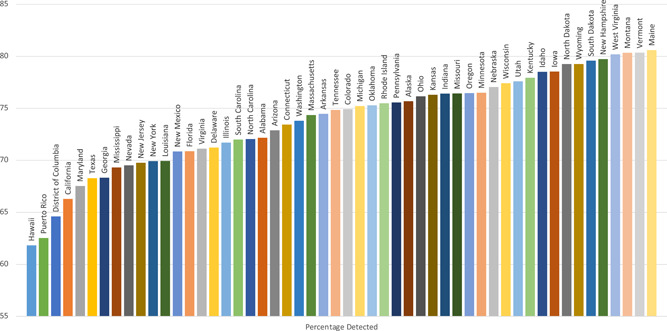
Our objectives were to identify differences in detection rate by race and ethnicity for CFTR variant panels, identify each US state detection rate for CFTR variant panels, and describe the rate of false-negative NBS and delayed diagnoses by race and ethnicity.
This is a cross-sectional analysis of the detection rate of at least 1 CFTR variant for seven panels by race and ethnicity in genotyped people with CF (PwCF) or CFTR-related metabolic syndrome (CRMS)/CFTR-related disorders in CF Foundation Patient Registry (CFFPR) in 2020. We estimated the case detection rate of CFTR variant panels by applying the detection rate to Census data. Using data from CFFPR, we compared the rate of delayed diagnosis or false-negative NBS by race and ethnicity.
For all panels, detection of at least 1 CFTR variant was highest in non-Hispanic White PwCF (87.5%-97.0%), and lowest in Black, Asian, and Hispanic PwCF (41.9%-93.1%). Detection of at least 1 CFTR variant was lowest in Black and Asian people with CRMS/CFTR-related disorders (48.4%-64.8%). States with increased racial and ethnic diversity have lower detection rates for all panels. Overall, 3.8% PwCF had a false-negative NBS and 11.8% had a delayed diagnosis; Black, Hispanic, and mixed-race PwCF were overrepresented.
CFTR variant panels have lower detection rates in minoritized racial and ethnic groups leading to false-negative NBS, delayed diagnosis, and likely health disparities.
美国的新生儿筛查(NBS)算法在囊性纤维化(CF)方面有所不同,包括不同的囊性纤维化跨膜电导调节因子(CFTR)变体。CFTR 变体的分布因种族和民族而异。
我们的目的是确定 CFTR 变体检测面板的种族和民族差异,确定每个美国州 CFTR 变体检测面板的检测率,并描述种族和民族之间假阴性 NBS 和延迟诊断的比率。
这是对 2020 年 CF 基金会患者登记处(CFFPR)中 CF 患者(PwCF)或 CFTR 相关代谢综合征(CRMS)/CFTR 相关疾病中至少有 7 个 CFTR 变体的种族和民族的检测率的横断面分析。我们通过将检测率应用于人口普查数据来估计 CFTR 变体面板的病例检出率。使用 CFFPR 的数据,我们比较了种族和民族之间延迟诊断或假阴性 NBS 的比率。
对于所有面板,非西班牙裔白人 PwCF 的至少 1 种 CFTR 变体检测率最高(87.5%-97.0%),而黑人、亚洲人和西班牙裔 PwCF 的检测率最低(41.9%-93.1%)。黑人、亚洲人和混合种族的 CRMS/CFTR 相关疾病患者的至少 1 种 CFTR 变体的检测率最低(48.4%-64.8%)。种族和民族多样性增加的州,所有面板的检测率都较低。总体而言,3.8%的 PwCF 有假阴性 NBS,11.8%有延迟诊断;黑人、西班牙裔和混血儿 PwCF 占比较高。
CFTR 变体面板在少数族裔中的检测率较低,导致假阴性 NBS、延迟诊断,并可能导致健康差距。