Department of Cardiovascular Medicine, Kyoto University Graduate School of Medicine, Kyoto, Japan.
Clinical Epidemiology, Hyogo College of Medicine, Nishinomiya, Japan.
ESC Heart Fail. 2023 Feb;10(1):353-365. doi: 10.1002/ehf2.14200. Epub 2022 Oct 13.
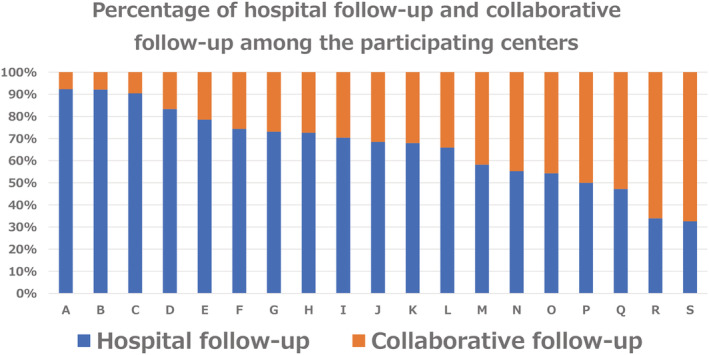
There are no previous studies focusing on collaborative follow-ups between hospitals and clinics for patients discharged after acute heart failure (AHF) in Japan. The purpose of this study was to determine the status of collaboration between hospitals and clinics for patients with AHF in Japan and to compare patient characteristics and clinical outcomes using a large Japanese observational database.
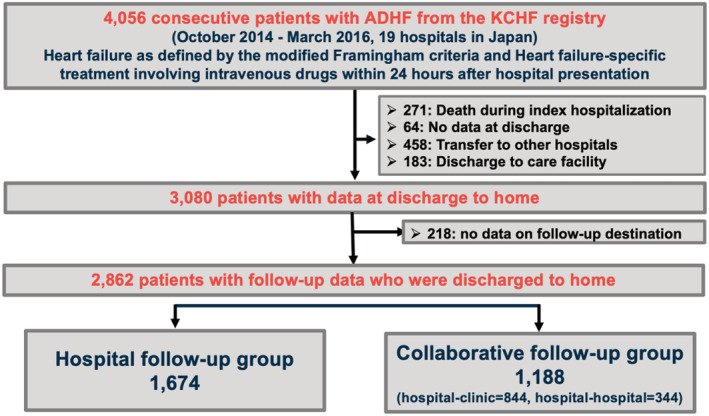
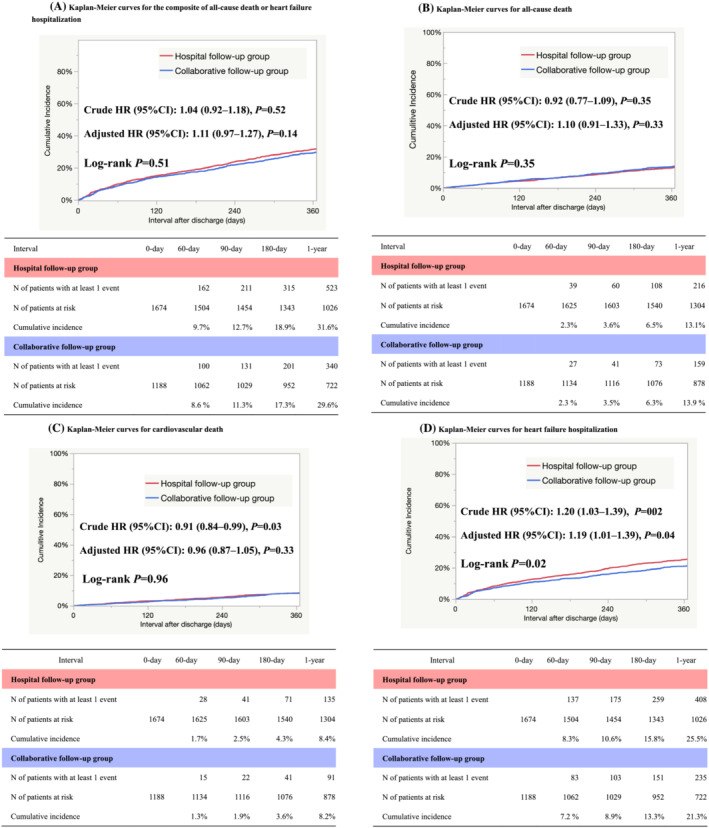
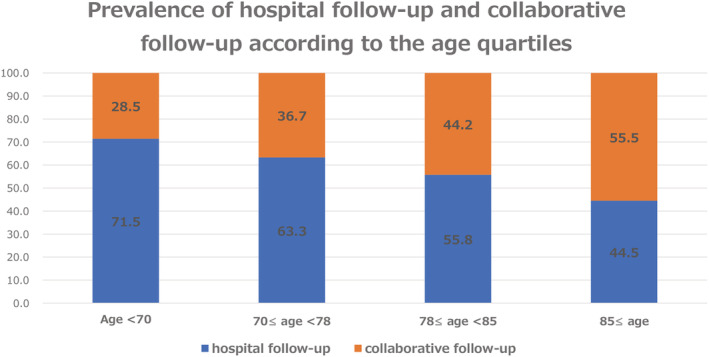
Of 4056 consecutive patients hospitalized for AHF in the Kyoto Congestive Heart Failure registry, we analysed 2862 patients discharged to go home, who were divided into 1674 patients (58.5%) followed up at hospitals with index hospitalization (hospital follow-up group) and 1188 (41.5%) followed up in a collaborative fashion with clinics or other general hospitals (collaborative follow-up group). The primary outcome was a composite of all-cause death or heart failure (HF) hospitalization within 1 year after discharge. Previous hospitalization for HF and length of hospital stay longer than 15 days were associated with hospital follow-up. Conversely, ≥80 years of age, hypertension, and cognitive dysfunction were associated with collaborative follow-up. The cumulative 1-year incidence of the primary outcome, all cause death, and cardiovascular death were similar between the hospital and collaborative follow-up groups (31.6% vs. 29.6%, P = 0.51, 13.1% vs, 13.9%, P = 0.35, 8.4% vs. 8.2%, P = 0.96). Even after adjusting for confounders, the difference in risk for patients in the hospital follow-up group relative to those in the collaborative follow-up group remained insignificant for the primary outcome, all-cause death, and cardiovascular death (HR: 1.11, 95% CI: 0.97-1.27, P = 0.14, HR: 1.10, 95% CI: 0.91-1.33, P = 0.33, HR: 0.96, 95% CI: 0.87-1.05, P = 0.33). The cumulative 1-year incidence of HF hospitalization was higher in the hospital follow-up group than in the collaborative follow-up group (25.5% vs. 21.3%, P = 0.02). The risk of HF hospitalization was higher in the hospital follow-up group than in the collaborative follow-up group (HR: 1.19, 95% CI: 1.01-1.39, P = 0.04).
In patients hospitalized for AHF, 41.5% received collaborative follow-up after discharge. The risk of HF hospitalization was higher in the hospital follow-up group than in the collaborative follow-up, although risk of the primary outcome, all-cause death, and cardiovascular death were similar between groups.
目前尚无研究关注日本急性心力衰竭(AHF)出院后医院与诊所之间的合作随访。本研究旨在确定日本 AHF 患者医院与诊所之间合作的现状,并使用大型日本观察性数据库比较患者特征和临床结局。
在京都充血性心力衰竭登记处连续收治的 4056 例 AHF 住院患者中,我们分析了 2862 例出院回家的患者,将其分为 1674 例(58.5%)在索引住院期间接受医院随访(医院随访组)和 1188 例(41.5%)以协作方式在诊所或其他综合医院接受随访(协作随访组)。主要结局是出院后 1 年内全因死亡或心力衰竭(HF)住院的复合结局。既往 HF 住院和住院时间超过 15 天与医院随访相关。相反,≥80 岁、高血压和认知功能障碍与协作随访相关。医院和协作随访组的 1 年累积主要结局、全因死亡和心血管死亡发生率相似(31.6% vs. 29.6%,P=0.51;13.1% vs. 13.9%,P=0.35;8.4% vs. 8.2%,P=0.96)。即使在校正混杂因素后,与协作随访组相比,医院随访组患者的主要结局、全因死亡和心血管死亡风险仍无显著差异(HR:1.11,95%CI:0.97-1.27,P=0.14;HR:1.10,95%CI:0.91-1.33,P=0.33;HR:0.96,95%CI:0.87-1.05,P=0.33)。医院随访组 1 年累积 HF 住院发生率高于协作随访组(25.5% vs. 21.3%,P=0.02)。与协作随访组相比,医院随访组 HF 住院风险更高(HR:1.19,95%CI:1.01-1.39,P=0.04)。
在因 AHF 住院的患者中,41.5%在出院后接受协作随访。与协作随访组相比,医院随访组 HF 住院风险更高,尽管两组的主要结局、全因死亡和心血管死亡风险相似。