Gastroenterology and Liver Diseases Research Center, Research Institute for Gastroenterology and Liver Diseases, Shahid Beheshti University of Medical Sciences, Tehran, Iran.
Department of Medicine, School of Clinical Sciences, Monash University, 246 Clayton Rd, Clayton, Melbourne, VIC, 3168, Australia.
Eur J Nutr. 2023 Mar;62(2):543-561. doi: 10.1007/s00394-022-03012-9. Epub 2022 Oct 14.
Probiotics or synbiotics consumption have been suggested to reduce the risk of cardiovascular disease (CVD) through a decline in inflammation and oxidative stress, however, the results from studies are conflicting. This study filled this knowledge gap by evaluating randomized controlled trials (RCTs) investigating probiotics or synbiotics intake on adipokines, inflammation, and oxidative stress in patients with prediabetes and type-2 diabetes mellitus (T2DM).
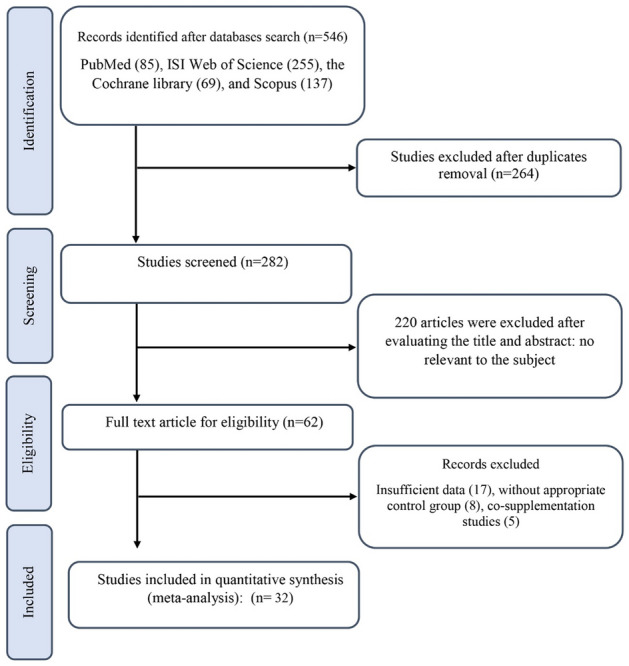
We systematically did search up to March 2022 in PubMed/Medline, Scopus, ISI Web of Science, and Cochrane library. A random-effect model was applied to estimate the weighted mean difference (WMD) and 95% confidence interval (95% CI) for each outcome.
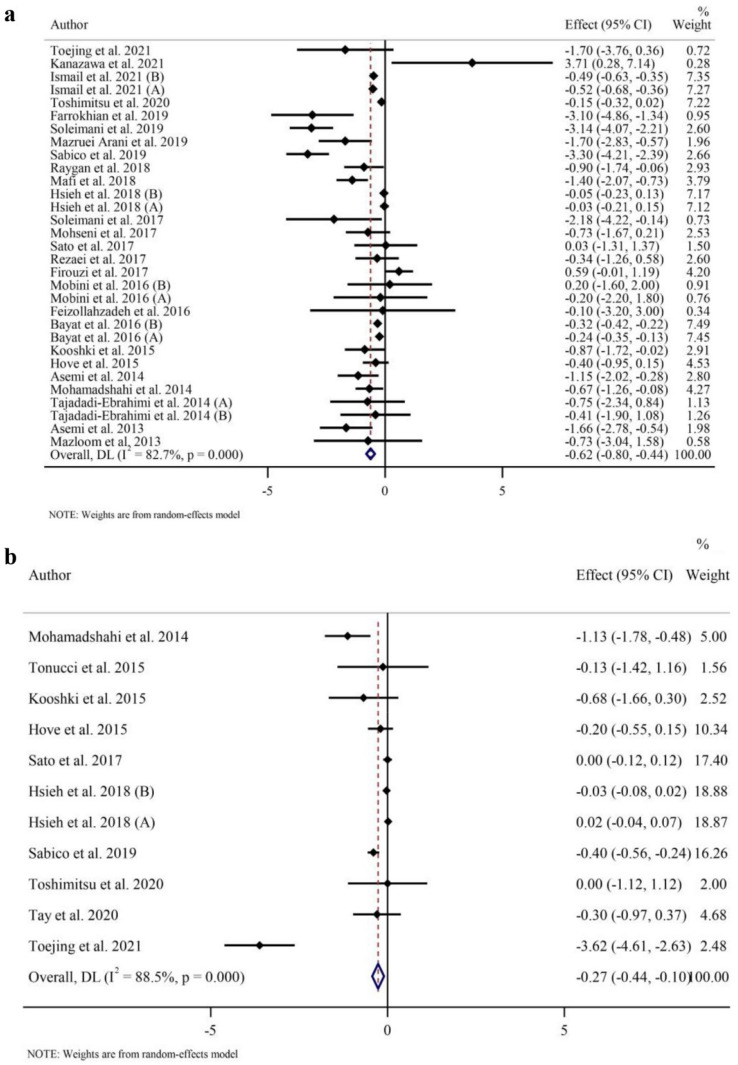
A total of 32 RCTs were included in the meta-analysis. This intervention led to a significant decrease in levels of C-reactive protein (CRP) (WMD - 0.62 mg/l; 95% CI - 0.80, - 0.44; p < 0.001), tumor necrosis factor-α (TNF-α) (WMD - 0.27 pg/ml; 95% CI - 0.44, - 0.10; p = 0.002) and malondialdehyde (MDA) (WMD - 0.51 µmol/l; 95% CI - 0.73, - 0.30; p < 0.001), and also a significant increase in levels of glutathione (GSH) (WMD 69.80 µmol/l; 95% CI 33.65, 105.95; p < 0.001), total antioxidant capacity (TAC) (WMD 73.59 mmol/l; 95% CI 33.24, 113.95; p < 0.001) and nitric oxide (NO) (WMD 7.49 µmol/l; 95% CI 3.12, 11.86; p = 0.001), without significant alterations in interleukin-6 (IL-6) and adipokines levels.
A consumption of probiotics or synbiotics could be a useful intervention to improve cardiometabolic outcomes through a reduced inflammation and oxidative stress in patients with prediabetes and T2DM.
通过降低炎症和氧化应激,益生菌或合生菌的摄入被认为可以降低心血管疾病(CVD)的风险,但研究结果存在冲突。本研究通过评估益生菌或合生菌摄入对糖尿病前期和 2 型糖尿病(T2DM)患者的 adipokines、炎症和氧化应激的随机对照试验(RCT),填补了这一知识空白。
我们系统地在 PubMed/Medline、Scopus、ISI Web of Science 和 Cochrane 图书馆进行了截至 2022 年 3 月的搜索。应用随机效应模型估计每个结局的加权均数差(WMD)和 95%置信区间(95%CI)。
共有 32 项 RCT 纳入荟萃分析。这种干预措施显著降低了 C 反应蛋白(CRP)的水平(WMD -0.62mg/l;95%CI -0.80,-0.44;p<0.001)、肿瘤坏死因子-α(TNF-α)(WMD -0.27pg/ml;95%CI -0.44,-0.10;p=0.002)和丙二醛(MDA)(WMD -0.51μmol/l;95%CI -0.73,-0.30;p<0.001),同时显著增加了谷胱甘肽(GSH)的水平(WMD 69.80μmol/l;95%CI 33.65,105.95;p<0.001)、总抗氧化能力(TAC)(WMD 73.59mmol/l;95%CI 33.24,113.95;p<0.001)和一氧化氮(NO)(WMD 7.49μmol/l;95%CI 3.12,11.86;p=0.001),而白细胞介素-6(IL-6)和 adipokines 水平没有显著变化。
在糖尿病前期和 T2DM 患者中,益生菌或合生菌的摄入可能是一种有用的干预措施,可以通过降低炎症和氧化应激来改善代谢心血管结局。