Core Laboratory, Shanxi Provincial People's Hospital (Fifth Hospital) of Shanxi Medical University, Taiyuan, China.
Institute of Nephrology, Peking University, Beijing, China.
Front Immunol. 2022 Oct 5;13:974648. doi: 10.3389/fimmu.2022.974648. eCollection 2022.
Dysbiosis of the gut microbiota is closely related to chronic systemic inflammation and autoimmunity, playing an essential role in the pathogenesis of primary Sjögren's syndrome (pSS). Abnormalities in the proportions of blood T lymphocyte subtype, that is Th17/Treg, were detected in pSS patients. We aimed to determine the associations between gut microbiota and Th17/Treg in pSS.
98 pSS patients and 105 healthy controls (NC) were enrolled between Dec 1, 2018, and Aug 31, 2019. The baseline information and clinical parameters on pSS patients and healthy controls were collected. 16S rRNA sequencing was performed to characterize the gut microbiome and identify gut microbes that are differentially abundant between patients and healthy controls. Lastly, associations between relative abundances of specific bacterial taxa in the gut and clinical outcome parameters were evaluated.
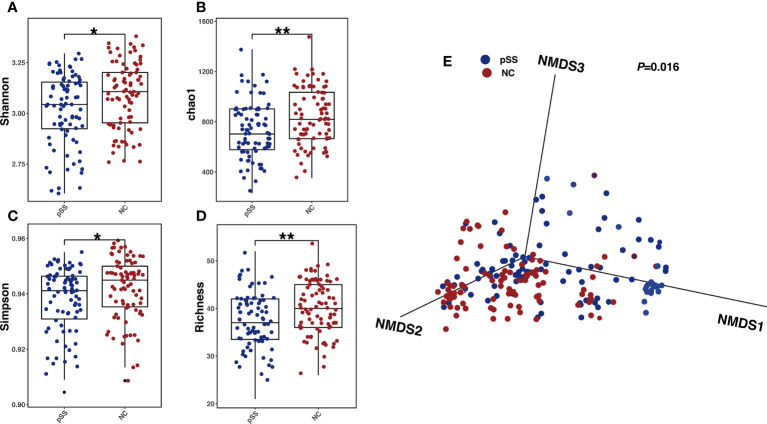
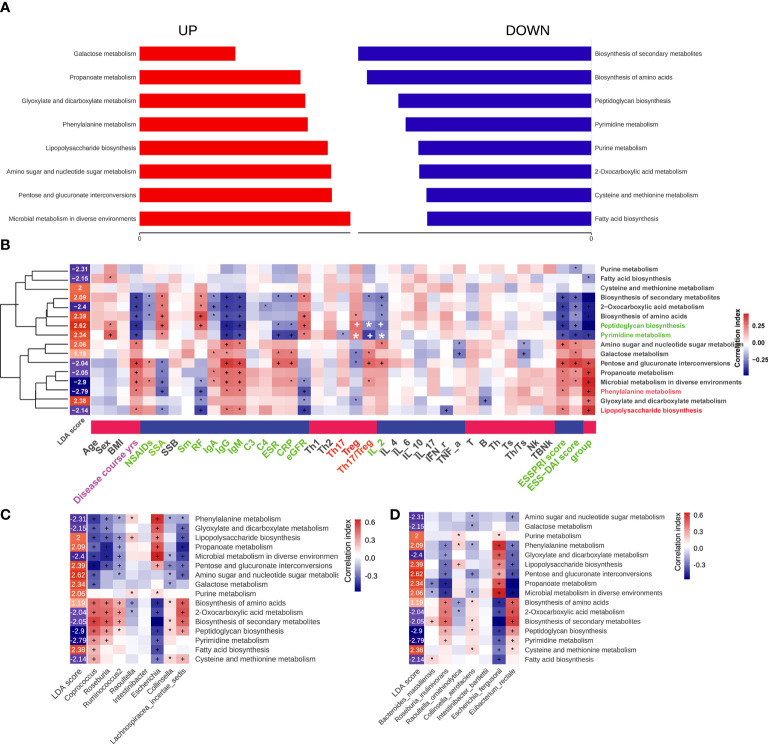
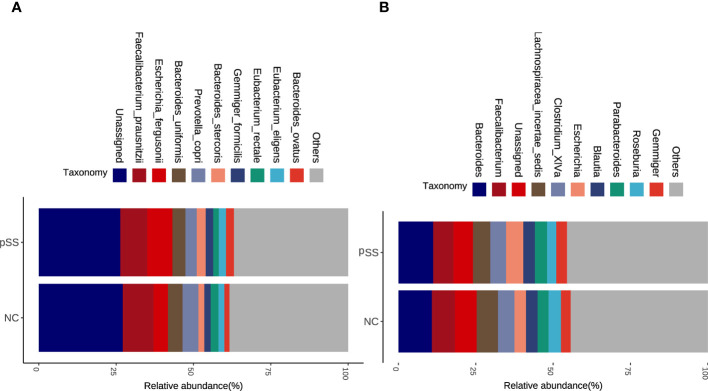
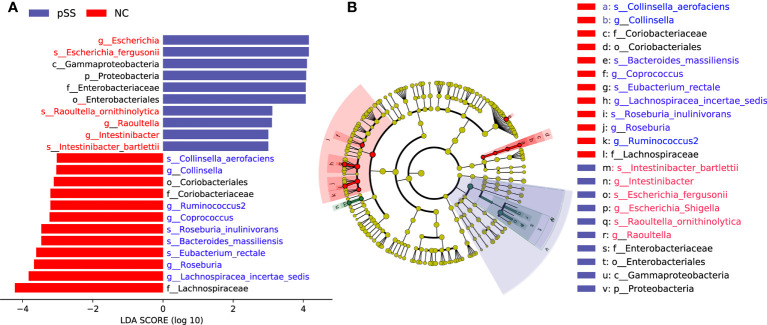
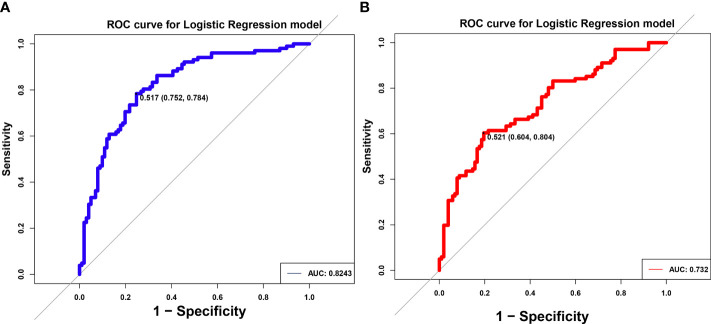
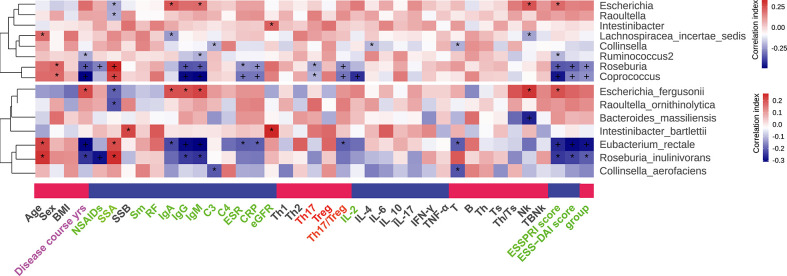
Patients with pSS show decreased gut microbial diversity and richness, decreased abundance of butyrate producing bacteria, such as and , and increased abundance of other taxa, such as and . These bacteria are enriched with functions related to glycolytic and lipogenic, energy, substance, galactose, pentose metabolism pathways and glucuronate interconversions, decreased with functions related to peptidoglycan biosynthesis, pyrimidine metabolism pathways. An integrative analysis identified pSS-related specific bacterial taxa in the gut, for which the abundance of is negatively correlated with Th17/Treg. Furthermore, the pathways of biosynthesis of secondary metabolites, biosynthesis of amino acids, peptidoglycan biosynthesis and pyrimidine, galactose, pentose, microbial metabolism in diverse environments, glyoxylate and dicarboxylate metabolism are associated with Treg or Th17/Treg.
Primary Sjögren's syndrome could lead to decreased gut microbial diversity and richness of intestinal flora in patients. The proportions of Th17 and Treg cells induced by microbiota were predictive pSS manifestations and accounted for the pSS severity.
肠道微生物群的失调与慢性全身炎症和自身免疫密切相关,在原发性干燥综合征(pSS)的发病机制中起着至关重要的作用。pSS 患者存在血 T 淋巴细胞亚群比例异常,即 Th17/Treg。我们旨在确定 pSS 患者肠道微生物群与 Th17/Treg 之间的关系。
2018 年 12 月 1 日至 2019 年 8 月 31 日期间,共纳入 98 例 pSS 患者和 105 例健康对照者(NC)。收集 pSS 患者和健康对照者的基线资料和临床参数。采用 16S rRNA 测序技术对肠道微生物群进行特征分析,并鉴定出患者与健康对照者之间差异丰富的肠道微生物。最后,评估肠道特定细菌分类群的相对丰度与临床结局参数之间的关系。
pSS 患者肠道微生物多样性和丰富度降低,丁酸产生菌如 和 的丰度降低,其他菌如 和 的丰度增加。这些细菌富含与糖酵解和脂类生成、能量、物质、半乳糖、戊糖代谢途径和葡萄糖醛酸互变、肽聚糖生物合成、嘧啶代谢途径相关的功能,减少与与肽聚糖生物合成、嘧啶代谢途径相关的功能。整合分析确定了肠道中与 pSS 相关的特定细菌分类群,其中 的丰度与 Th17/Treg 呈负相关。此外,次生代谢物合成、氨基酸合成、肽聚糖生物合成、嘧啶、半乳糖、戊糖、微生物代谢在不同环境中的途径,乙醛酸和二羧酸代谢与 Treg 或 Th17/Treg 相关。
原发性干燥综合征可导致患者肠道微生物多样性和肠道菌群丰富度降低。微生物诱导的 Th17 和 Treg 细胞比例可预测 pSS 表现,并与 pSS 严重程度相关。