Department of Medicine, Division of Cardiology, Providence VA Medical Center, Providence, RI, United States of America.
Department of Medicine, Division of Cardiology, Warren Alpert Medical School of Brown University, Providence, RI, United States of America.
PLoS One. 2022 Oct 25;17(10):e0276585. doi: 10.1371/journal.pone.0276585. eCollection 2022.
Low heart rate variability (HRV), a measure of autonomic imbalance, is associated with increased risk of coronary heart disease (CHD) and heart failure (HF). However, its relationship with HF subtypes; heart failure with preserved ejection fraction (HFpEF) and heart failure with reduced ejection fraction (HFrEF) has not been studied prior.
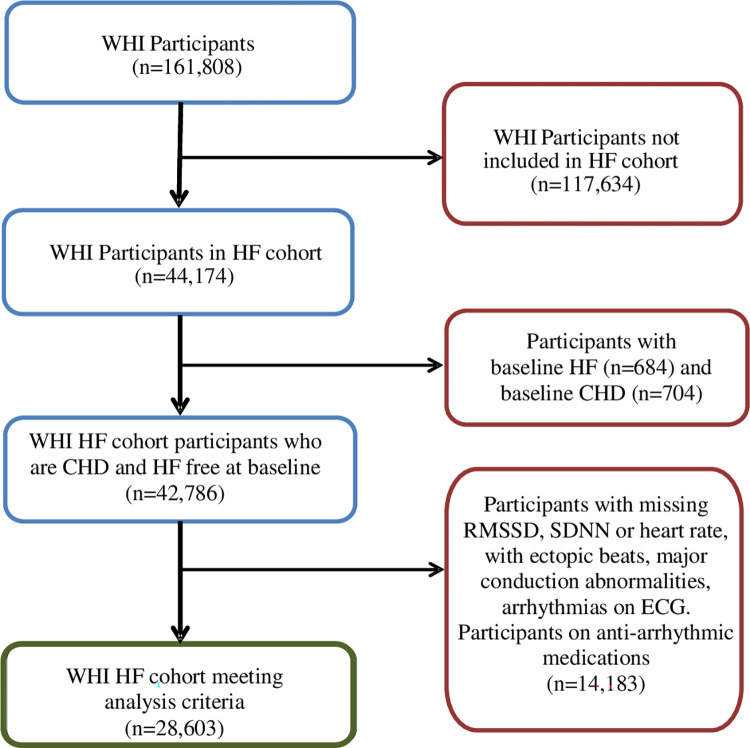
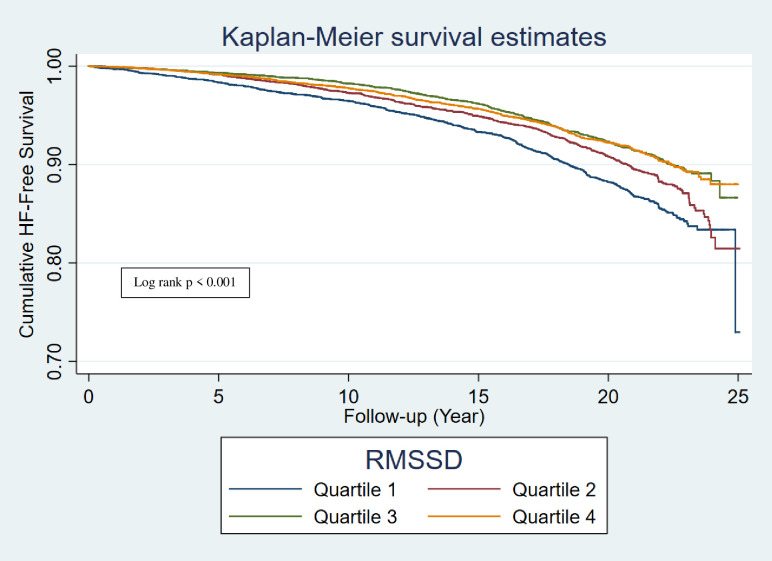
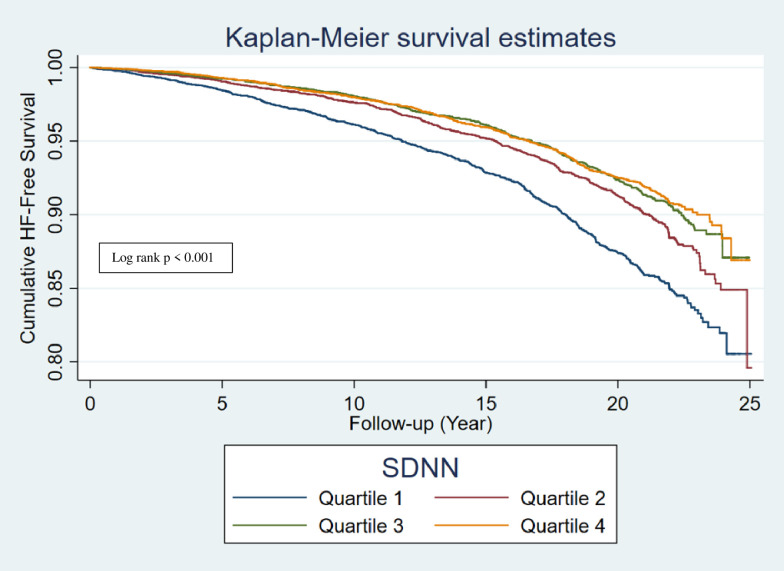
We conducted a longitudinal study in Women's Health Initiative study cohort to investigate the association of baseline quartiles of resting heart rate (rHR) and HRV measures; SDNN (SD of normal-to-normal RR interval) and RMSSD (root mean square of successive difference of RR interval) measured by twelve-lead electrocardiogram (ECG) on enrollment, with the risk of hospitalized HF and its subtypes. Total of 28,603 post-menopausal women, predominantly non-Hispanic whites (69%), with a mean (SD) age of 62.6 (7.1) years, free of baseline CHD and HF were included. In a fully adjusted cox-proportional hazards regression model which adjusted for age, race, BMI, alcohol intake, education, physical activity, hyperlipidemia, hypertension, left ventricular hypertrophy, use of beta-blocker, calcium-channel blocker, hormone therapy, and time-varying incident CHD, the hazard ratios of lowest quartile of HRV (Q1) with HF risk were significant (Q1 SDNN compared to Q4 SDNN: 1.22, 95% CI 1.07, 1.39; Q1 RMSSD compared to Q4 RMSSD: 1.17, 95% CI 1.02, 1.33). On subgroup analysis of HF subtypes, low HRV was associated with elevated HFpEF risk (Q1 vs Q4 SDNN: 1.22, 95% CI 1.02, 1.47) but not with HFrEF (Q1 vs Q4 SDNN: 1.19, 95% CI 0.95, 1.50; Q1 RMSSD: 1.13, 95% CI 0.90, 1.43).
Low HRV is associated with elevated overall hospitalized HF risk and HFpEF risk in post-menopausal women. Whether interventions to increase HRV through healthy lifestyle changes will decrease HF risk warrants further investigation.
心率变异性(HRV)低,即自主神经失衡的一种衡量标准,与冠心病(CHD)和心力衰竭(HF)风险增加相关。然而,它与心力衰竭的亚型;射血分数保留型心力衰竭(HFpEF)和射血分数降低型心力衰竭(HFrEF)之间的关系尚未被研究过。
我们在妇女健康倡议研究队列中进行了一项纵向研究,以调查基线静息心率(rHR)和 HRV 测量的四分位数;通过十二导联心电图(ECG)测量的 SDNN(正常到正常 RR 间期的标准差)和 RMSSD(RR 间期连续差异的均方根)与住院 HF 及其亚型风险的关系。共纳入 28603 名绝经后妇女,主要为非西班牙裔白人(69%),平均(SD)年龄为 62.6(7.1)岁,基线时无 CHD 和 HF。在一个完全调整的 Cox 比例风险回归模型中,该模型调整了年龄、种族、BMI、饮酒量、教育程度、体力活动、血脂异常、高血压、左心室肥厚、β受体阻滞剂、钙通道阻滞剂、激素治疗的使用以及随时间变化的新发 CHD,最低 HRV 四分位数(Q1)的 HF 风险的风险比具有显著意义(Q1 SDNN 与 Q4 SDNN 相比:1.22,95%CI 1.07,1.39;Q1 RMSSD 与 Q4 RMSSD 相比:1.17,95%CI 1.02,1.33)。在心衰亚型的亚组分析中,低 HRV 与 HFpEF 风险升高相关(Q1 与 Q4 SDNN 相比:1.22,95%CI 1.02,1.47),但与 HFrEF 无关(Q1 与 Q4 SDNN 相比:1.19,95%CI 0.95,1.50;Q1 RMSSD 相比:1.13,95%CI 0.90,1.43)。
HRV 降低与绝经后女性总体住院 HF 风险和 HFpEF 风险升高相关。通过健康生活方式改变增加 HRV 是否会降低 HF 风险,还需要进一步研究。