Biozentrum, University of Basel, Basel, Switzerland.
Department of Physics, Philipps-Universität Marburg, Marburg, Germany.
PLoS Biol. 2022 Oct 26;20(10):e3001846. doi: 10.1371/journal.pbio.3001846. eCollection 2022 Oct.
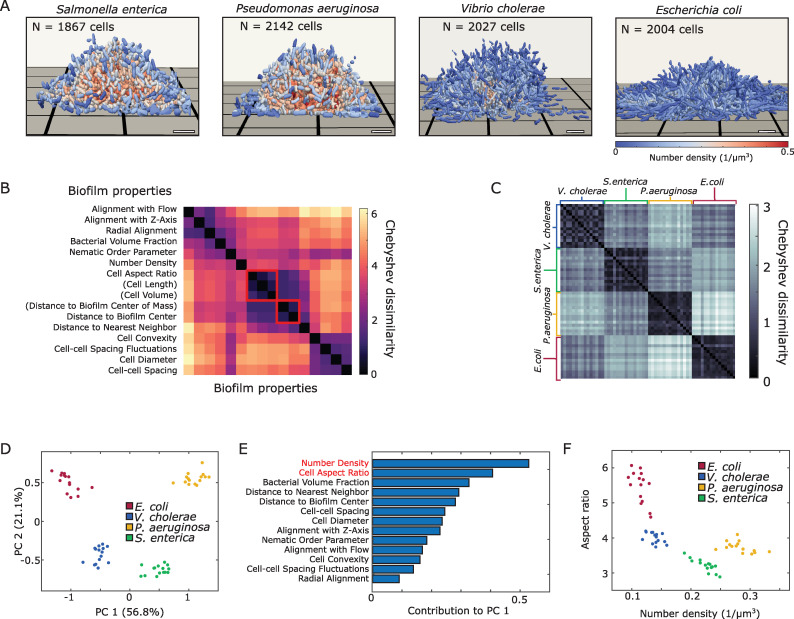
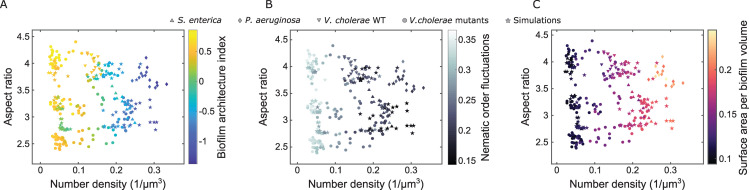
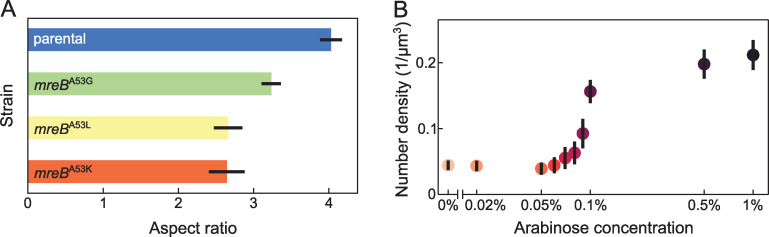
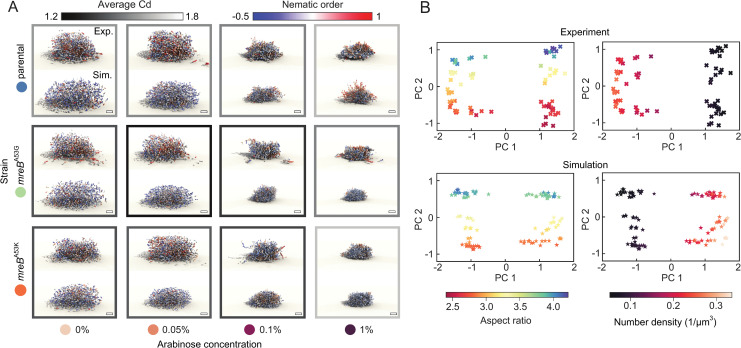
Bacterial biofilms are among the most abundant multicellular structures on Earth and play essential roles in a wide range of ecological, medical, and industrial processes. However, general principles that govern the emergence of biofilm architecture across different species remain unknown. Here, we combine experiments, simulations, and statistical analysis to identify shared biophysical mechanisms that determine early biofilm architecture development at the single-cell level, for the species Vibrio cholerae, Escherichia coli, Salmonella enterica, and Pseudomonas aeruginosa grown as microcolonies in flow chambers. Our data-driven analysis reveals that despite the many molecular differences between these species, the biofilm architecture differences can be described by only 2 control parameters: cellular aspect ratio and cell density. Further experiments using single-species mutants for which the cell aspect ratio and the cell density are systematically varied, and mechanistic simulations show that tuning these 2 control parameters reproduces biofilm architectures of different species. Altogether, our results show that biofilm microcolony architecture is determined by mechanical cell-cell interactions, which are conserved across different species.
细菌生物膜是地球上最丰富的多细胞结构之一,在广泛的生态、医学和工业过程中发挥着重要作用。然而,控制不同物种生物膜结构出现的一般原则仍然未知。在这里,我们结合实验、模拟和统计分析,确定了在流动室中作为微菌落生长的物种霍乱弧菌、大肠杆菌、沙门氏菌和铜绿假单胞菌在单细胞水平上决定早期生物膜结构发育的共享生物物理机制。我们的数据驱动分析表明,尽管这些物种之间存在许多分子差异,但生物膜结构的差异只能用 2 个控制参数来描述:细胞纵横比和细胞密度。进一步使用单细胞突变体进行实验,系统地改变细胞纵横比和细胞密度,以及机械模拟表明,调节这 2 个控制参数可以再现不同物种的生物膜结构。总之,我们的结果表明,生物膜微菌落的结构是由机械细胞-细胞相互作用决定的,这种相互作用在不同物种中是保守的。