Gloag Erin S, Fabbri Stefania, Wozniak Daniel J, Stoodley Paul
Department of Microbial Infection and Immunity, The Ohio State University, Columbus, OH, 43210, USA.
Perfectus Biomed, SciTech Daresbury, Cheshire, WA4 4AB, UK.
Biofilm. 2019 Dec 19;2:100017. doi: 10.1016/j.bioflm.2019.100017. eCollection 2020 Dec.
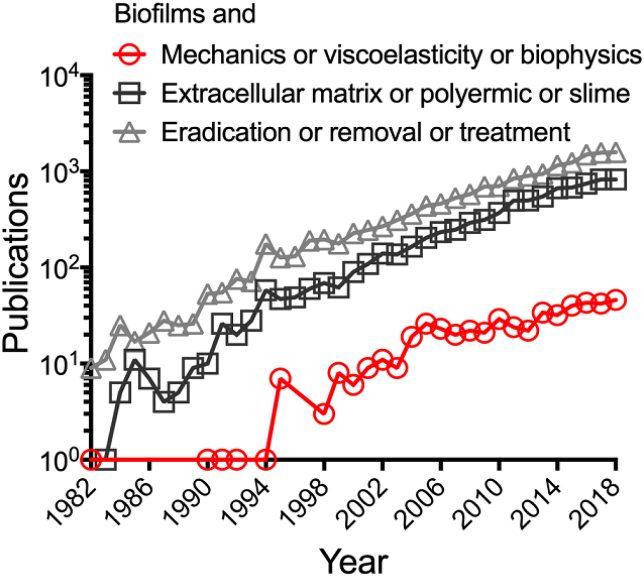
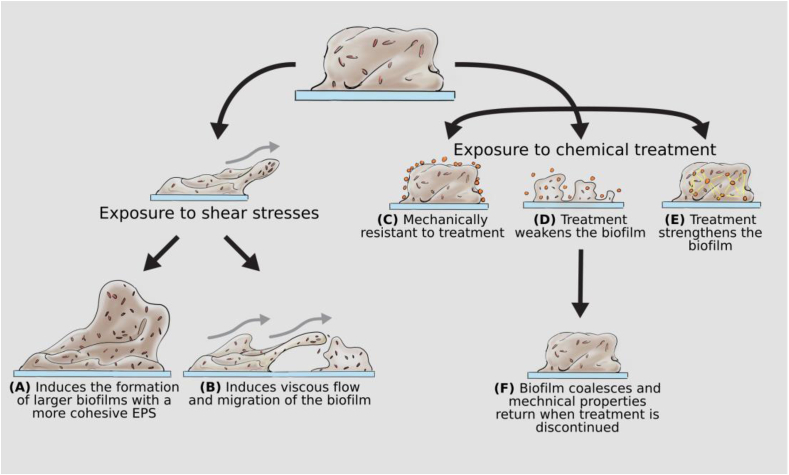
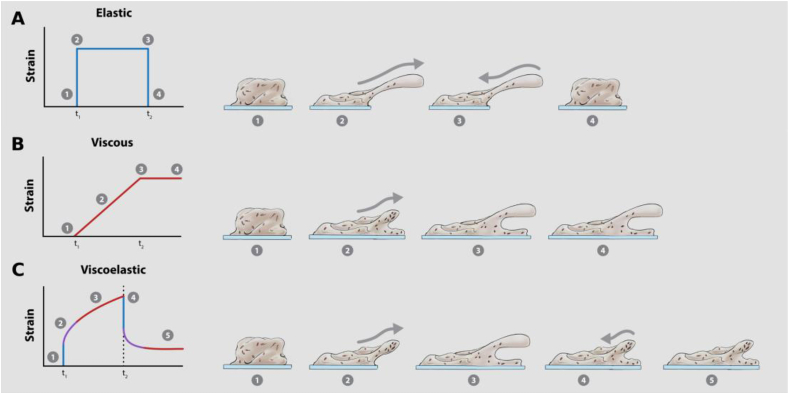
It has long been recognized that biofilms are viscoelastic materials, however the importance of this attribute to the survival and persistence of these microbial communities is yet to be fully realized. Here we review work, which focuses on understanding biofilm mechanics and put this knowledge in the context of biofilm survival, particularly for biofilm-associated infections. We note that biofilm viscoelasticity may be an evolved property of these communities, and that the production of multiple extracellular polymeric slime components may be a way to ensure the development of biofilms with complex viscoelastic properties. We discuss viscoelasticity facilitating biofilm survival in the context of promoting the formation of larger and stronger biofilms when exposed to shear forces, promoting fluid-like behavior of the biofilm and subsequent biofilm expansion by viscous flow, and enabling resistance to both mechanical and chemical methods of clearance. We conclude that biofilm viscoelasticity contributes to the virulence of chronic biofilm infections.
长期以来,人们一直认识到生物膜是粘弹性材料,然而这一特性对这些微生物群落的存活和持续存在的重要性尚未得到充分认识。在此,我们回顾了专注于理解生物膜力学的研究工作,并将这些知识置于生物膜存活的背景下,特别是对于与生物膜相关的感染。我们注意到生物膜的粘弹性可能是这些群落进化而来的特性,并且多种细胞外聚合物黏液成分的产生可能是确保形成具有复杂粘弹性特性的生物膜的一种方式。我们讨论了粘弹性在促进生物膜在受到剪切力时形成更大更强的生物膜、促进生物膜的流体样行为以及随后通过粘性流动实现生物膜扩张、以及使生物膜能够抵抗机械和化学清除方法等方面对生物膜存活的促进作用。我们得出结论,生物膜的粘弹性有助于慢性生物膜感染的致病性。