School of Psychology, University of Ottawa.
Interdisciplinary Centre for Black Health, University of Ottawa.
Perspect Psychol Sci. 2023 May;18(3):675-687. doi: 10.1177/17456916221120428. Epub 2022 Oct 26.
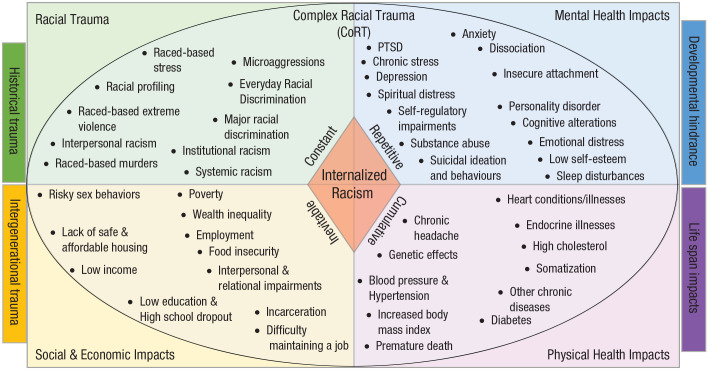
Racial trauma refers to experiences related to threats, prejudices, harm, shame, humiliation, and guilt associated with various types of racial discrimination, either for direct victims or witnesses. In North American, European, and colonial zeitgeist societies, Black, Indigenous, and people of color (BIPOC) experience racial microaggressions and interpersonal, institutional, and systemic racism on a repetitive, constant, inevitable, and cumulative basis. Although complex trauma differs from racial trauma in its origin, the consistency of racist victimization beyond childhood, and the internalized racism associated with it, strong similarities exist. Similar to complex trauma, racial trauma surrounds the victims' life course and engenders consequences on their physical and mental health, behavior, cognition, relationships with others, self-concept, and social and economic life. There is no way to identify racial trauma other than through a life-course approach that captures the complex nature of individual, collective, historical, and intergenerational experiences of racism experienced by BIPOC communities in Western society. This article presents evidence for complex racial trauma (CoRT), a theoretical framework of CoRT, and guidelines for its assessment and treatment. Avenues for future research, intervention, and training are also presented.
种族创伤是指与各种形式的种族歧视相关的威胁、偏见、伤害、羞耻、屈辱和内疚等经历,无论是直接受害者还是目击者都会经历种族创伤。在北美、欧洲和殖民时代的社会中,黑人和其他少数族裔(BIPOC)会不断地、必然地、累积地经历种族微侵犯和人际、制度和系统性种族主义。虽然复杂创伤与种族创伤在起源、童年后持续的种族伤害以及与之相关的内化种族主义方面存在差异,但它们之间存在很强的相似性。与复杂创伤类似,种族创伤围绕着受害者的整个生命历程,并对他们的身心健康、行为、认知、与他人的关系、自我概念以及社会和经济生活产生影响。除了采用生命历程方法来捕捉 BIPOC 群体在西方社会中经历的种族主义的个体、集体、历史和代际经历的复杂性之外,没有其他方法可以识别种族创伤。本文介绍了复杂种族创伤(CoRT)的证据、CoRT 的理论框架以及评估和治疗的指导方针。还提出了未来研究、干预和培训的途径。