Reyna-Villasmil Eduardo, Caponcello Maria Giulia, Maldonado Natalia, Olivares Paula, Caroccia Natascia, Bonazzetti Cecilia, Tazza Beatrice, Carrara Elena, Giannella Maddalena, Tacconelli Evelina, Rodríguez-Baño Jesús, Palacios-Baena Zaira R
Unit of Infectious Diseases and Clinical Microbiology, University Hospital Virgen Macarena, Institute of Biomedicine of Seville (IBIS)/CSIC, 41008 Seville, Spain.
Department of Medical and Surgical Sciences, University of Bologna, 40126 Bologna, Italy.
Biomedicines. 2022 Sep 29;10(10):2437. doi: 10.3390/biomedicines10102437.
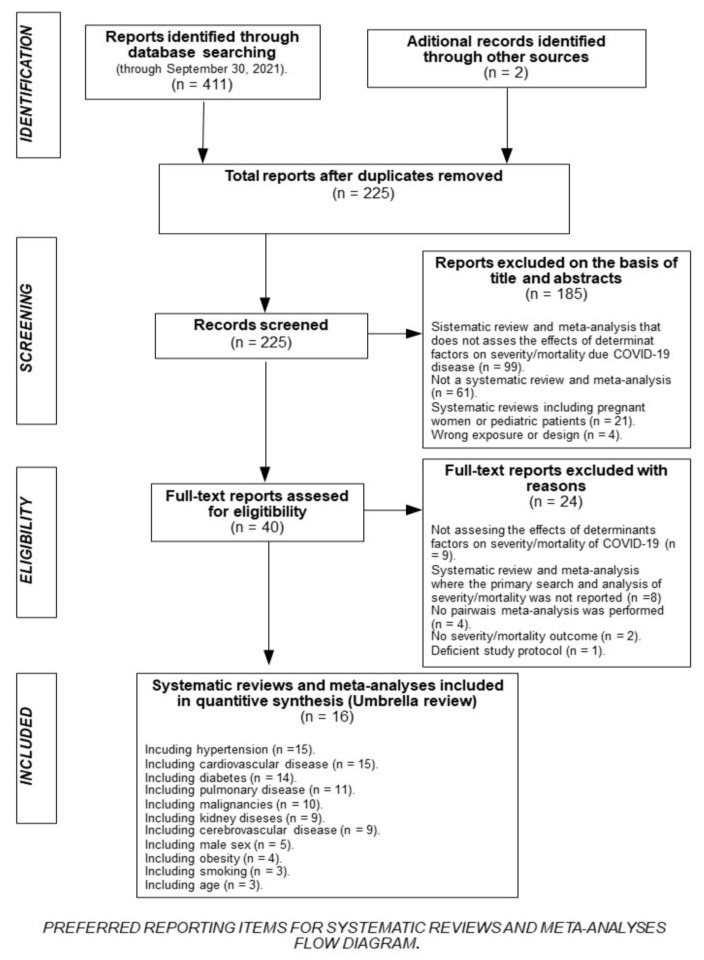
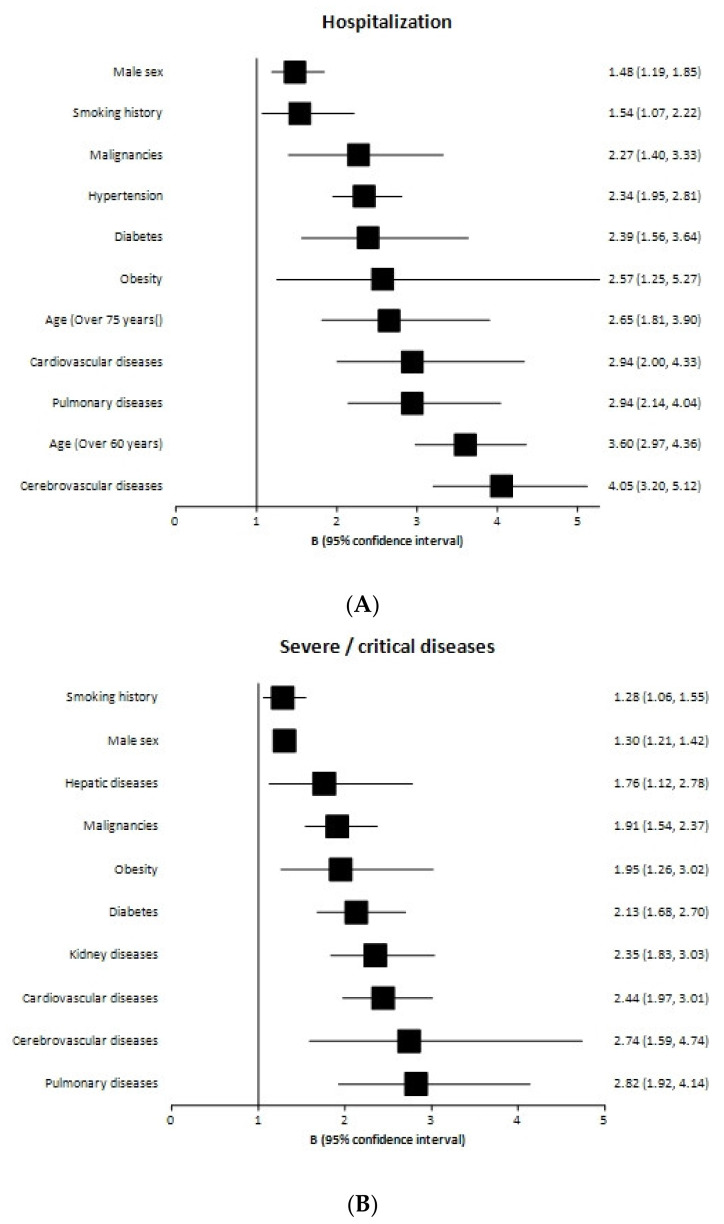
The objective of this study was to assess the association between patients’ epidemiological characteristics and comorbidities with SARS-CoV-2 infection severity and related mortality risk. An umbrella systematic review, including a meta-analysis examining the association between patients’ underlying conditions and severity (defined as need for hospitalization) and mortality of COVID-19, was performed. Studies were included if they reported pooled risk estimates of at least three underlying determinants for hospitalization, critical disease (ICU admission, mechanical ventilation), and hospital mortality in patients diagnosed with SARS-CoV-2 infection. Evidence was summarized as pooled odds ratios (pOR) for disease outcomes with 95% confidence intervals (95% CI). Sixteen systematic reviews investigating the possible associations of comorbidities with severity or death from COVID-19 disease were included. Hospitalization was associated with age > 60 years (pOR 3.50; 95% CI 2.97−4.36), smoking habit (pOR 3.50; 95% CI 2.97−4.36), and chronic pulmonary disease (pOR 2.94; 95% CI 2.14−4.04). Chronic pulmonary disease (pOR 2.82; 95% CI 1.92−4.14), cerebrovascular disease (pOR 2.74; 95% CI 1.59−4.74), and cardiovascular disease (pOR 2.44; 95% CI 1.97−3.01) were likely to be associated with increased risk of critical COVID-19. The highest risk of mortality was associated with cardiovascular disease (pOR 3.59; 95% CI 2.83−4.56), cerebrovascular disease (pOR 3.11; 95% CI 2.35−4.11), and chronic renal disease (pOR 3.02; 95% CI 2.61−3.49). In conclusion, this umbrella systematic review provides a comprehensive summary of meta-analyses examining the impact of patients’ characteristics on COVID-19 outcomes. Elderly patients and those cardiovascular, cerebrovascular, and chronic renal disease should be prioritized for pre-exposure and post-exposure prophylaxis and early treatment.
本研究的目的是评估患者的流行病学特征和合并症与SARS-CoV-2感染严重程度及相关死亡风险之间的关联。我们进行了一项伞形系统评价,其中包括一项荟萃分析,该分析考察了患者的基础疾病与COVID-19严重程度(定义为住院需求)及死亡率之间的关联。如果研究报告了至少三种基础决定因素对确诊感染SARS-CoV-2的患者住院、危重症(入住重症监护病房、机械通气)和医院死亡率的合并风险估计值,则纳入该研究。证据总结为疾病结局的合并比值比(pOR)及95%置信区间(95%CI)。纳入了16项调查合并症与COVID-19疾病严重程度或死亡之间可能关联的系统评价。住院与年龄>60岁(pOR 3.50;95%CI 2.97−4.36)、吸烟习惯(pOR 3.50;95%CI 2.97−4.36)和慢性肺病(pOR 2.94;95%CI 2.14−4.04)相关。慢性肺病(pOR 2.82;95%CI 1.92−4.14)、脑血管疾病(pOR 2.74;95%CI 1.59−4.74)和心血管疾病(pOR 2.44;95%CI 1.97−3.01)可能与COVID-19危重症风险增加相关。最高的死亡风险与心血管疾病(pOR 3.59;95%CI 2.83−4.56)、脑血管疾病(pOR 3.11;95%CI 2.35−4.11)和慢性肾病(pOR 3.02;95%CI 2.61−3.49)相关。总之,这项伞形系统评价全面总结了考察患者特征对COVID-19结局影响的荟萃分析。老年患者以及患有心血管、脑血管和慢性肾病的患者应优先进行暴露前和暴露后预防及早期治疗。