Sahu Ankit Kumar, Mathew Roshan, Aggarwal Praveen, Nayer Jamshed, Bhoi Sanjeev, Satapathy Swayamjeet, Ekka Meera
Department of Emergency Medicine, All India Institute of Medical Sciences, New Delhi, India.
Department of Nuclear Medicine, Post Graduate Institute of Medical Education and Research, Chandigarh, India.
J Glob Infect Dis. 2021 Jan 29;13(1):13-19. doi: 10.4103/jgid.jgid_136_20. eCollection 2021 Jan-Mar.
A systematic review and meta-analysis of available studies was performed to investigate the clinical characteristics that can predict COVID-19 disease severity.
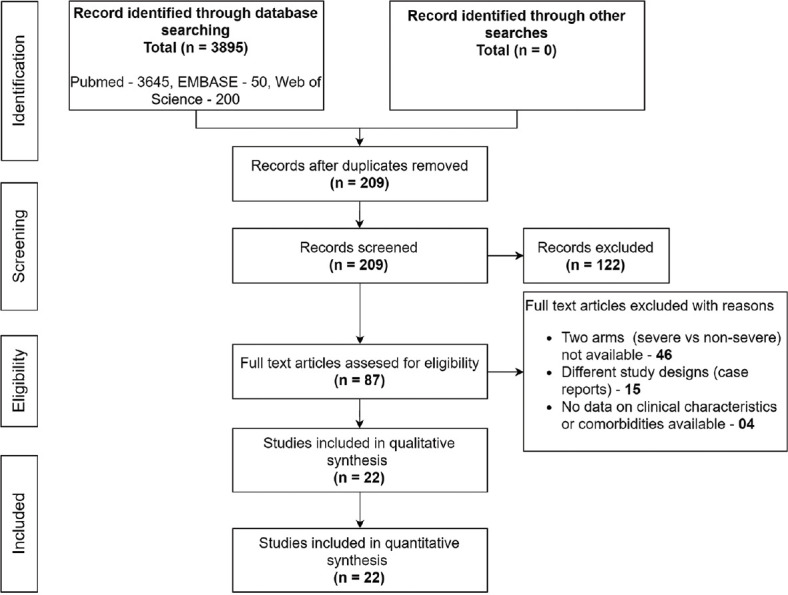
Databases including PubMed, Embase, and Web of Science were searched from December 31, 2019, to May 24, 2020. Random-effects meta-analysis was used for summarizing the Pooled odds ratio (pOR) of individual clinical characteristics to describe their association with severe COVID-19 disease.
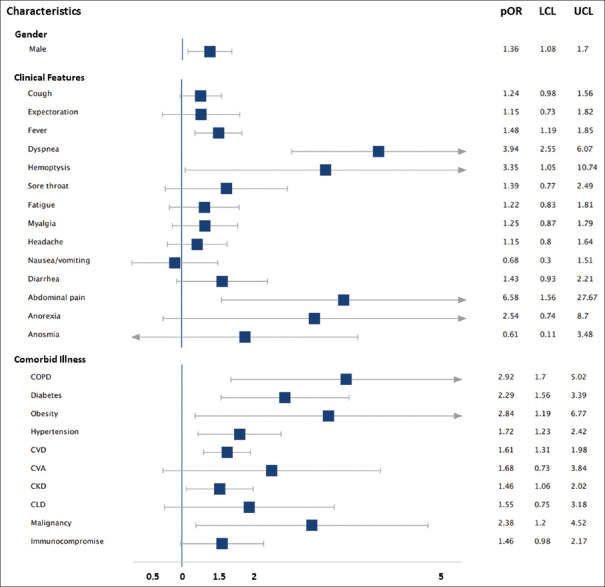
A total of 3895 articles were identified, and finally, 22 studies comprising 4380 patients were included. Severe disease was more common in males than females (pOR: 1.36, 95% confidence interval [CI]: 1.08-1.70). Clinical features that were associated with significantly higher odds of severe disease were abdominal pain (pOR: 6.58, 95% CI: 1.56-27.67), breathlessness (pOR: 3.94, 95% CI: 2.55-6.07), and hemoptysis (pOR: 3.35, 95% CI: 1.05-10.74). pOR was highest for chronic obstructive pulmonary disease (pOR: 2.92, 95% CI: 1.70-5.02), followed by obesity (pOR: 2.84, 95% CI: 1.19-6.77), malignancy (pOR: 2.38, 95% CI: 1.25-4.52), diabetes (pOR: 2.29, 95% CI: 1.56-3.39), hypertension (pOR: 1.72, 95% CI: 1.23-2.42), cardiovascular disease (pOR: 1.61, 95% CI: 1.31-1.98) and chronic kidney disease (pOR: 1.46, 95% CI: 1.06-2.02), for predicting severe COVID-19.
Our analysis describes the association of specific symptoms and comorbidities with severe COVID-19 disease. Knowledge of these clinical determinants will assist the clinicians in the risk-stratification of these patients for better triage and clinical management.
对现有研究进行系统评价和荟萃分析,以调查可预测新冠病毒病严重程度的临床特征。
检索了包括PubMed、Embase和Web of Science在内的数据库,检索时间为2019年12月31日至2020年5月24日。采用随机效应荟萃分析来汇总个体临床特征的合并比值比(pOR),以描述其与重症新冠病毒病的关联。
共识别出3895篇文章,最终纳入了22项研究,共4380例患者。重症疾病在男性中比女性更常见(pOR:1.36,95%置信区间[CI]:1.08 - 1.70)。与重症疾病显著更高比值比相关的临床特征为腹痛(pOR:6.58,95% CI:1.56 - 27.67)、呼吸困难(pOR:3.94,95% CI:2.55 - 6.07)和咯血(pOR:3.35,95% CI:1.05 - 10.74)。慢性阻塞性肺疾病的pOR最高(pOR:2.92,95% CI:1.70 - 5.02),其次是肥胖(pOR:2.84,95% CI:1.19 - 6.77)、恶性肿瘤(pOR:2.38,95% CI:1.25 - 4.52)、糖尿病(pOR:2.29,95% CI:1.56 - 3.39)、高血压(pOR:1.72,95% CI:1.23 - 2.42)、心血管疾病(pOR:1.61,95% CI:1.31 - 1.98)和慢性肾脏病(pOR:1.46,95% CI:1.06 - 2.02),用于预测重症新冠病毒病。
我们的分析描述了特定症状和合并症与重症新冠病毒病的关联。了解这些临床决定因素将有助于临床医生对这些患者进行风险分层,以更好地进行分诊和临床管理。