Centro de Cromatografía y Espectrometría de Masas, CROM-MASS, Universidad Industrial de Santander, Bucaramanga 680002, Santander, Colombia.
Instituto de Investigación Masira, Facultad de Ciencias de la Salud, Universidad de Santander, Bucaramanga 680003, Santander, Colombia.
Molecules. 2022 Oct 12;27(20):6844. doi: 10.3390/molecules27206844.
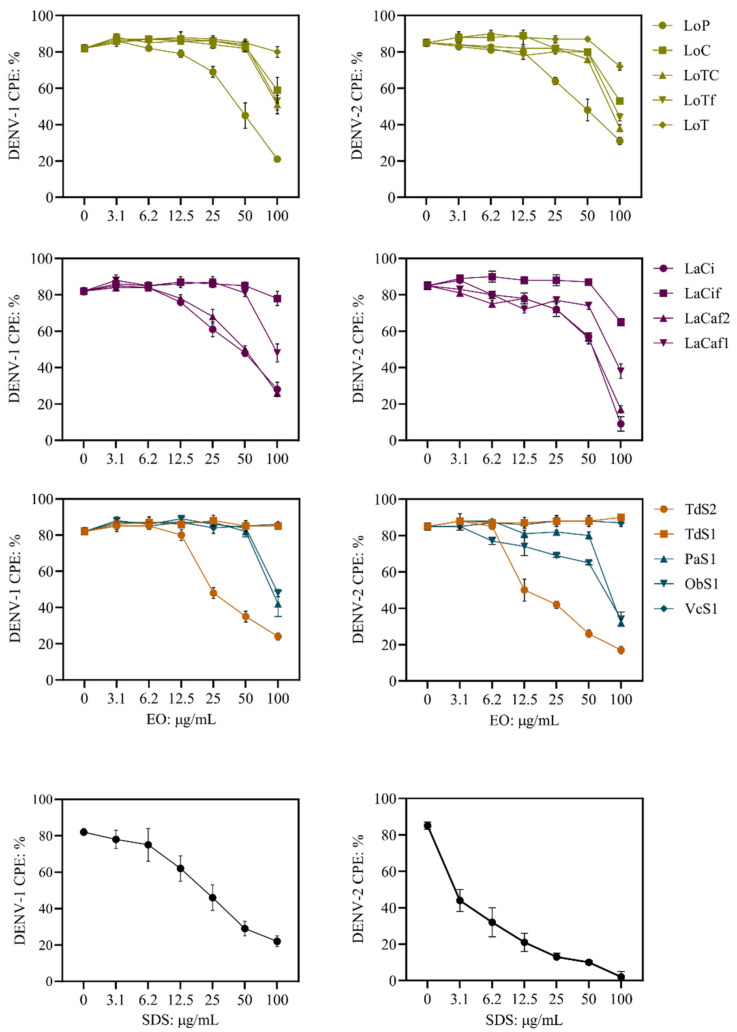
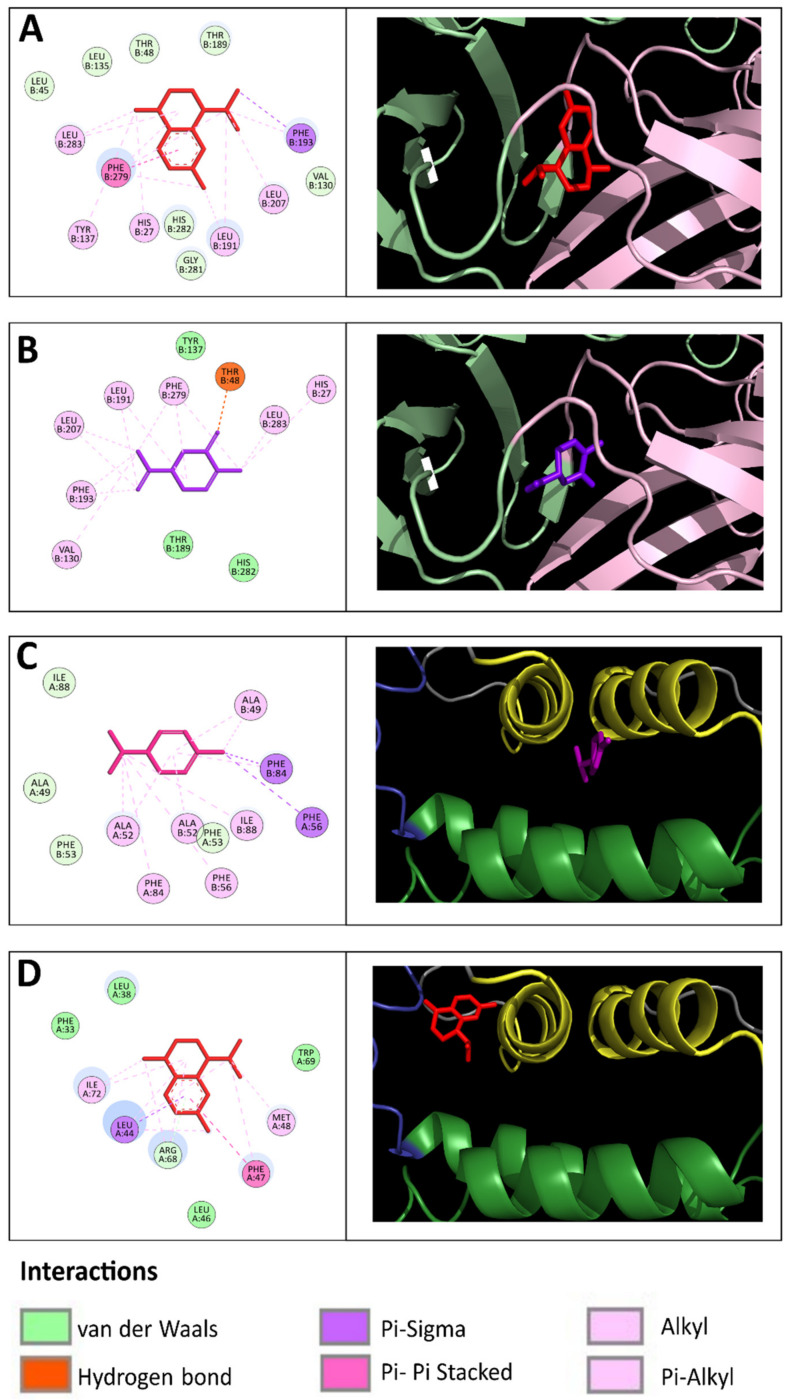
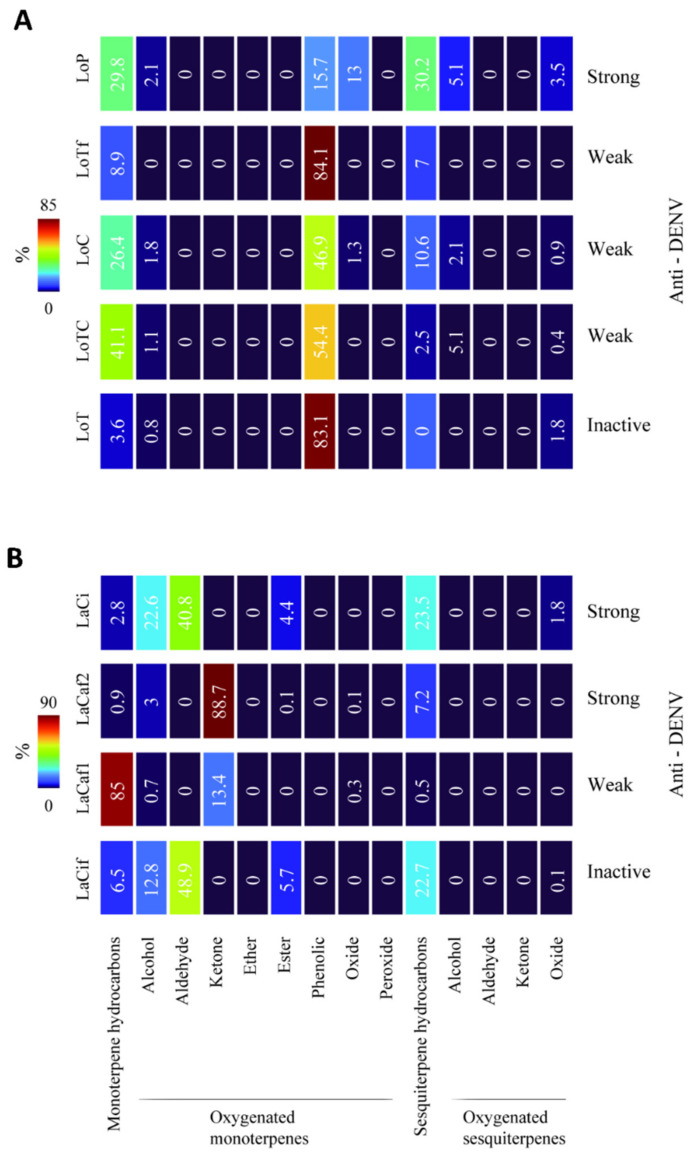
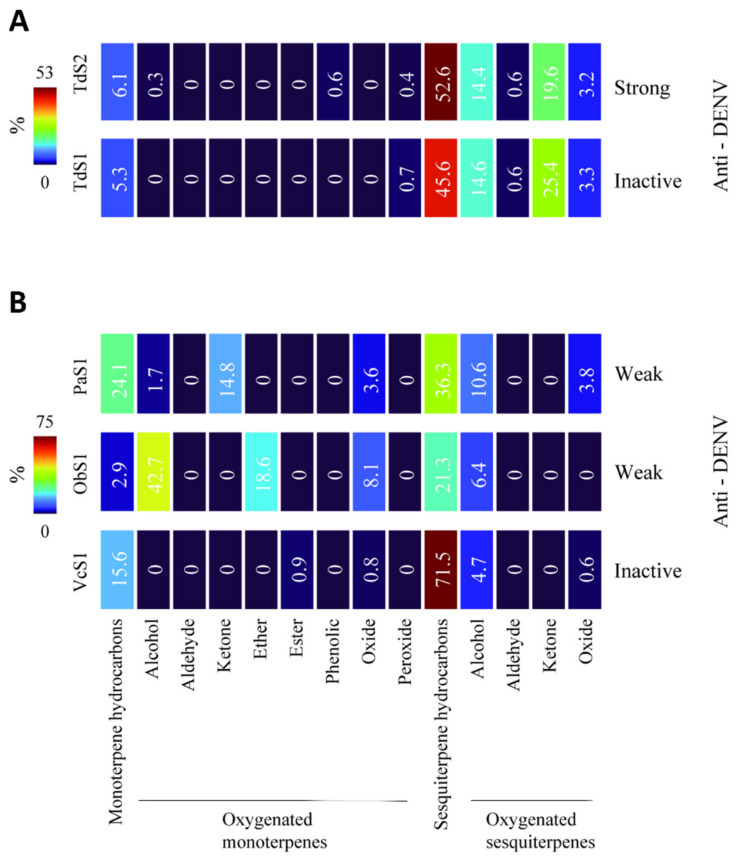
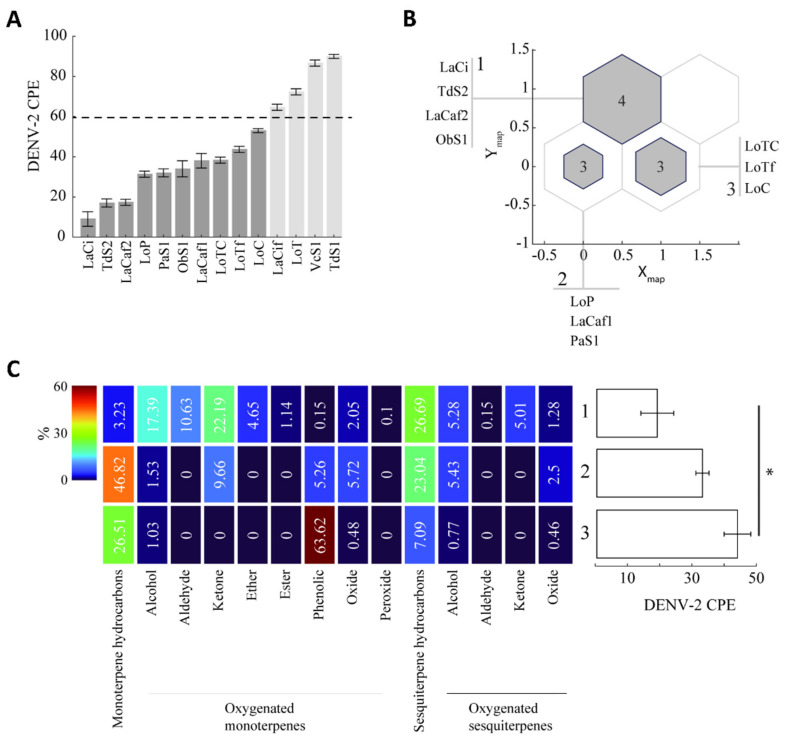
Currently, there are no therapies to prevent severe dengue disease. Essential oils (EOs) can serve as primary sources for research and the discovery of phytomedicines for alternative therapy. Fourteen EOs samples were obtained by distillation from six plants used in Colombian folk medicine. GC/MS analysis identified 125 terpenes. Cytopathic effect (CPE) reduction assays revealed differences in antiviral activity. EOs of Lippia alba, citral chemotype and carvone-rich fraction; Lippia origanoides, phellandrene chemotype; and Turnera diffusa, exhibited strong antiviral activity (IC50: 29 to 82 µg/mL; SI: 5.5 to 14.3). EOs of Piper aduncum, Ocimum basilicum, and L. origanoides, carvacrol, and thymol chemotypes, exhibited weak antiviral activity (32 to 53% DENV-CPE reduction at 100 µg/mL; SI > 5.0). Cluster and one-way ANOVA analyses suggest that the strong antiviral activity of EOs could be attributed to increased amounts of non-phenolic oxygenated monoterpenes and sesquiterpene hydrocarbons. Docking analyses (AutoDock Vina) predicted binding affinity between the DENV-2 E protein and terpenes: twenty sesquiterpene hydrocarbons (−8.73 to −6.91 kcal/mol), eight oxygenated monoterpenes (−7.52 to −6.98 kcal/mol), and seven monoterpene hydrocarbons (−7.60 to −6.99 kcal/mol). This study reports for the first time differences in the antiviral activity of EOs against DENV, corresponding to their composition of monoterpenes and sesquiterpenes.
目前,尚无预防重症登革热的疗法。精油(EOs)可以作为研究的主要来源,并发现替代疗法的植物药。从六种用于哥伦比亚民间医学的植物中通过蒸馏获得了 14 种 EO 样品。GC/MS 分析鉴定了 125 种萜烯。细胞病变效应(CPE)降低测定显示出抗病毒活性的差异。Lippia alba、citral 化学型和富含 carvone 的馏分;Lippia origanoides、phellandrene 化学型;和 Turnera diffusa 的 EOs 表现出强烈的抗病毒活性(IC50:29 至 82 µg/mL;SI:5.5 至 14.3)。Piper aduncum、Ocimum basilicum 和 L. origanoides、carvacrol 和 thymol 化学型的 EOs 表现出弱的抗病毒活性(在 100 µg/mL 时 DENV-CPE 减少 32%至 53%;SI > 5.0)。聚类和单因素方差分析表明,EOs 的强抗病毒活性可能归因于非酚类含氧单萜和倍半萜烃含量的增加。对接分析(AutoDock Vina)预测了 DENV-2 E 蛋白与萜烯之间的结合亲和力:二十种倍半萜烃(-8.73 至-6.91 kcal/mol)、八种含氧单萜(-7.52 至-6.98 kcal/mol)和七种单萜烃(-7.60 至-6.99 kcal/mol)。本研究首次报道了 EOs 对 DENV 的抗病毒活性差异,这与其单萜和倍半萜的组成相对应。