da Silva Alessandra P, Silva Natália de F, Andrade Eloísa Helena A, Gratieri Tais, Setzer William N, Maia José Guilherme S, da Silva Joyce Kelly R
Programa de Pós-Graduação em Biotecnologia, Universidade Federal do Pará, Belém, Pará, Brazil.
Programa de Pós-Graduação em Ciências Farmacêuticas, Universidade Federal do Pará, Belém, Pará, Brazil.
PLoS One. 2017 May 1;12(5):e0175598. doi: 10.1371/journal.pone.0175598. eCollection 2017.
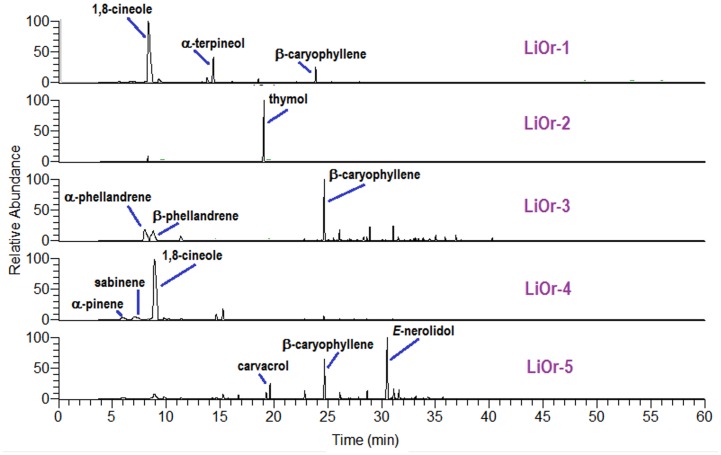
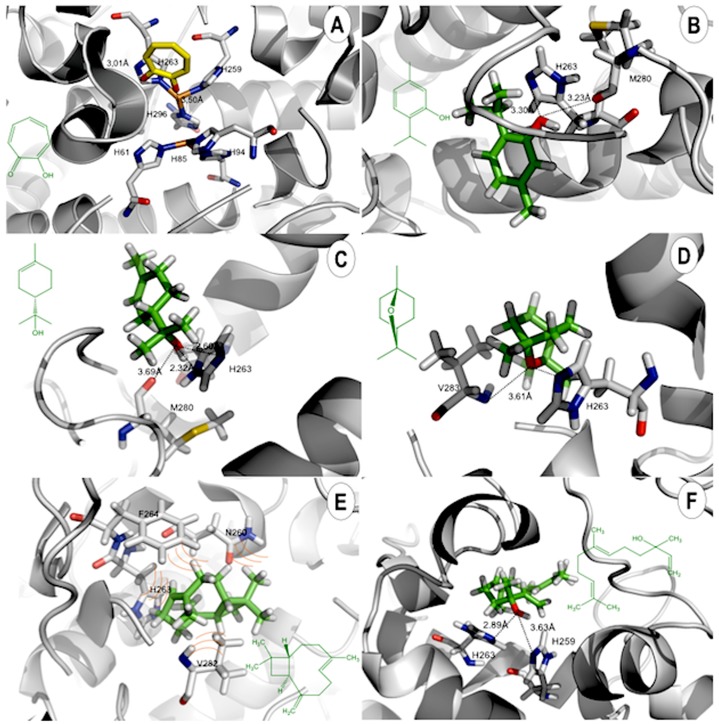
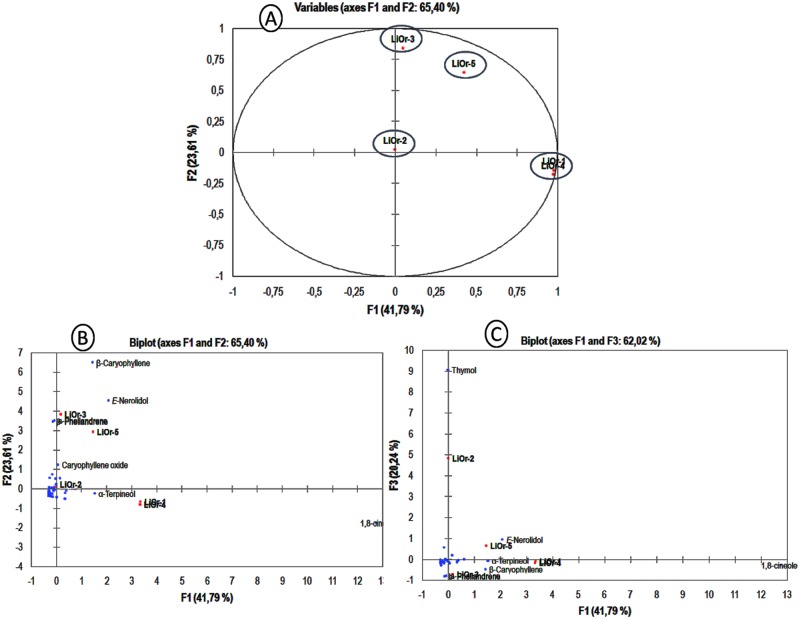
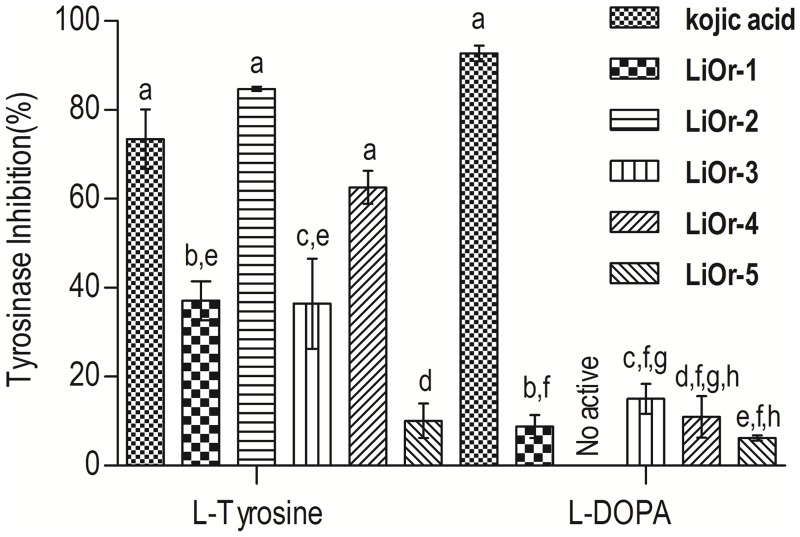
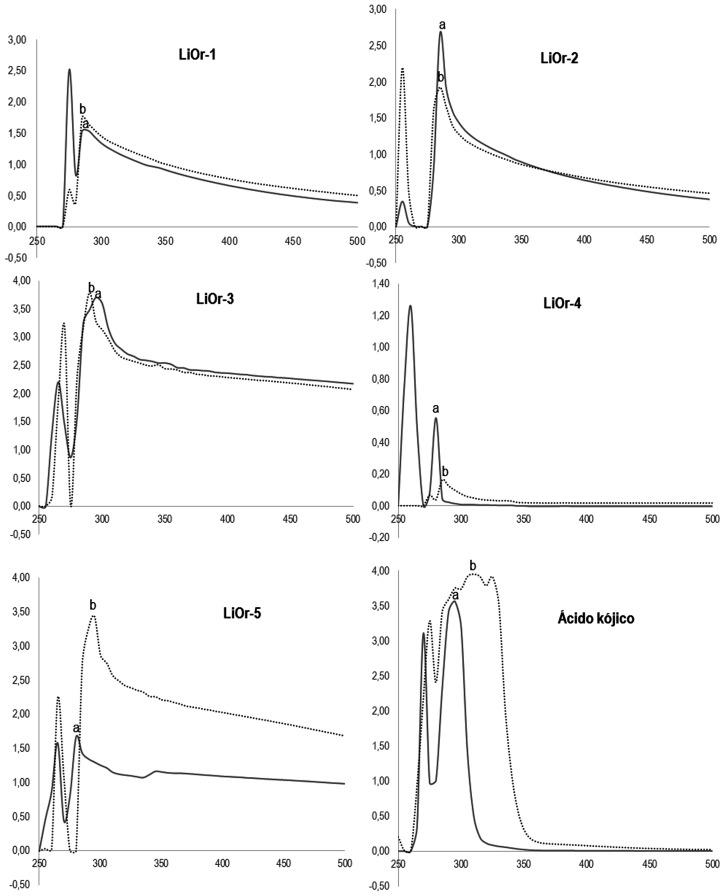
The essential oils (EOs) of the aerial parts of Lippia origanoides (LiOr), collected in different localities of the Amazon region, were obtained by hydrodistillation and analyzed by GC and CG-MS. Principle component analysis (PCA) based on chemical composition grouped the oils in four chemotypes rich in mono- and sesquiterpenoids. Group I was characterized by 1,8-cineole and α-terpineol (LiOr-1 and LiOr-4) and group II by thymol (LiOr-2). The oil LiOr-3 showed β-caryophyllene, α-phellandrene and β-phellandrene as predominant and LiOr-5 was rich in (E)-nerolidol and β-caryophyllene. All samples were evaluated for antioxidant activity and inhibition of tyrosinase in vitro and in silico. The highest antioxidant activity by the DPPH free radical method was observed in LiOr-2 and LiOr-5 oils (132.1 and 82.7 mg TE∙mL-1, respectively). The tyrosinase inhibition potential was performed using L-tyrosine and L-DOPA as substrates and all samples were more effective in the first step of oxidation. The inhibition by samples LiOr-2 and LiOr-4 were 84.7% and 62.6%, respectively. The samples LiOr-1, LiOr-4 and LiOr-5 displayed an interaction with copper (II) ion with bathochromic shift around 15 nm. In order to elucidate the mechanism of inhibition of the main compounds, a molecular docking study was carried out. All compounds displayed an interaction between an oxygen and Cu or histidine residues with distances less than 4 Å. The best docking energies were observed with thymol and (E)-nerolidol (-79.8 kcal.mol-1), which suggested H-bonding interactions with Met281 and His263 (thymol) and His259, His263 ((E)-nerolidol).
采集自亚马逊地区不同地点的牛至叶过江藤地上部分的精油(EOs),通过水蒸馏法获得,并采用气相色谱(GC)和气相色谱 - 质谱联用(CG - MS)进行分析。基于化学成分的主成分分析(PCA)将这些精油分为四种富含单萜和倍半萜的化学型。第一组的特征成分是1,8 - 桉叶素和α - 松油醇(LiOr - 1和LiOr - 4),第二组的特征成分是百里香酚(LiOr - 2)。LiOr - 3精油以β - 石竹烯、α - 水芹烯和β - 水芹烯为主,LiOr - 5富含(E)- 橙花叔醇和β - 石竹烯。对所有样品进行了体外和计算机模拟的抗氧化活性及酪氨酸酶抑制活性评估。采用DPPH自由基法测得LiOr - 2和LiOr - 5精油的抗氧化活性最高(分别为132.1和82.7 mg TE∙mL - 1)。以L - 酪氨酸和L - DOPA为底物检测酪氨酸酶抑制潜力,所有样品在氧化的第一步中更有效。LiOr - 2和LiOr - 4样品的抑制率分别为84.7%和62.6%。LiOr - 1、LiOr - 4和LiOr - 5样品与铜(II)离子发生相互作用,红移约15 nm。为阐明主要化合物的抑制机制,进行了分子对接研究。所有化合物在氧与铜或组氨酸残基之间表现出相互作用,距离小于4 Å。百里香酚和(E)- 橙花叔醇的对接能量最佳(-79.8 kcal.mol - 1),这表明它们与Met281和His263(百里香酚)以及His259、His263((E)- 橙花叔醇)存在氢键相互作用。