Jafarzadeh Abdollah, Gosain Rohit, Mortazavi Seyed Mohammad Javad, Nemati Maryam, Jafarzadeh Sara, Ghaderi Abbas
Department of Immunology, School of Medicine, Kerman University of Medical Sciences, Kerman, Iran.
Immunology of Infectious Diseases Research Center, Research Institute of Basic Medical Sciences, Rafsanjan University of Medical Sciences, Rafsanjan, Iran.
Int J Hematol Oncol Stem Cell Res. 2022 Apr 1;16(2):117-127. doi: 10.18502/ijhoscr.v16i2.9205.
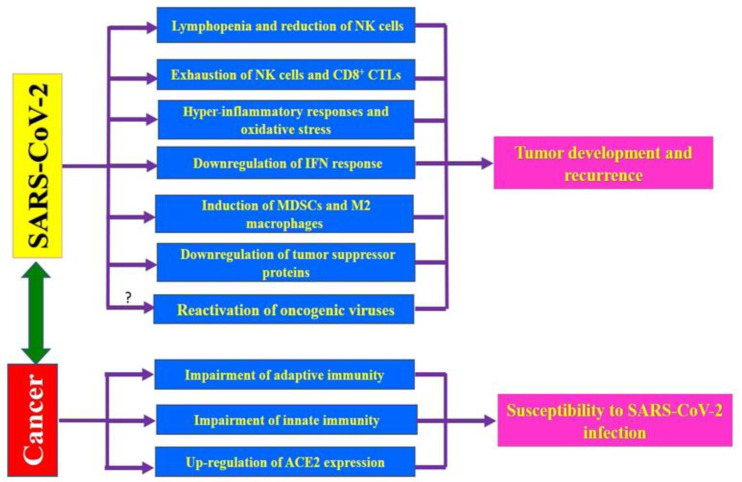
COVID-19 and malignancy can affect the susceptibility of one another. Clinically recovered COVID-19 individuals display immune abnormalities that persist several months after discharge. The lymphopenia-related immunosuppression, functional exhaustion of cytotoxic lymphocytes (such as CD8 cytotoxic T-cells and natural killer cells), hyperinflammatory responses, oxidative stress, downregulation of interferon response, development of the myeloid-derived suppressor cells, downregulation of tumor suppressor proteins and perhaps reactivation of the latent oncogenic viruses may directly and/or indirectly play a role in the cancer development and recurrence in severe COVID-19 patients. SARS-CoV-2-infected malignant patients may be at higher risk of death of their cancer than SARS-CoV-2-uninfected patients with the same cancers. On the other side, the patients with some types of cancers may be more vulnerable to SARS-CoV-2 infection compared with the non-cancerous individuals, due to their immunocompromised state resulted from malignancy, chemotherapy, and other concomitant abnormalities as well as perhaps greater expression of angiotensin-converting enzyme 2. SARS-CoV-2-infected cancerous patients are unable to produce an effective anti-virus immune response and may exhibit more severe forms of COVID-19. This review described the possible impacts of SARS-CoV-2 infection on cancer development and recurrence, and the potential cancer impacts on COVID-19 development, while the possible interventions are highlighted.
新冠病毒(COVID-19)与恶性肿瘤可能会相互影响易感性。临床康复的COVID-19患者表现出免疫异常,这些异常在出院后仍会持续数月。淋巴细胞减少相关的免疫抑制、细胞毒性淋巴细胞(如CD8细胞毒性T细胞和自然杀伤细胞)的功能耗竭、过度炎症反应、氧化应激、干扰素反应下调、髓系来源抑制细胞的产生、肿瘤抑制蛋白下调以及潜在致癌病毒的重新激活可能直接和/或间接在重症COVID-19患者的癌症发生和复发中起作用。感染了严重急性呼吸综合征冠状病毒2(SARS-CoV-2)的恶性肿瘤患者相较于未感染SARS-CoV-2的同类型癌症患者,其癌症导致死亡的风险可能更高。另一方面,某些类型癌症的患者可能比非癌症个体更容易感染SARS-CoV-2,这是由于恶性肿瘤、化疗及其他伴随的异常情况导致其免疫功能受损,以及可能更高水平的血管紧张素转换酶2表达。感染SARS-CoV-2的癌症患者无法产生有效的抗病毒免疫反应,可能会表现出更严重形式的COVID-19。本综述描述了SARS-CoV-2感染对癌症发生和复发的可能影响,以及癌症对COVID-19发展的潜在影响,同时强调了可能的干预措施。